
Announcements
Professorial Inaugural Lecture of Professor Samuel Amos-Abanyie
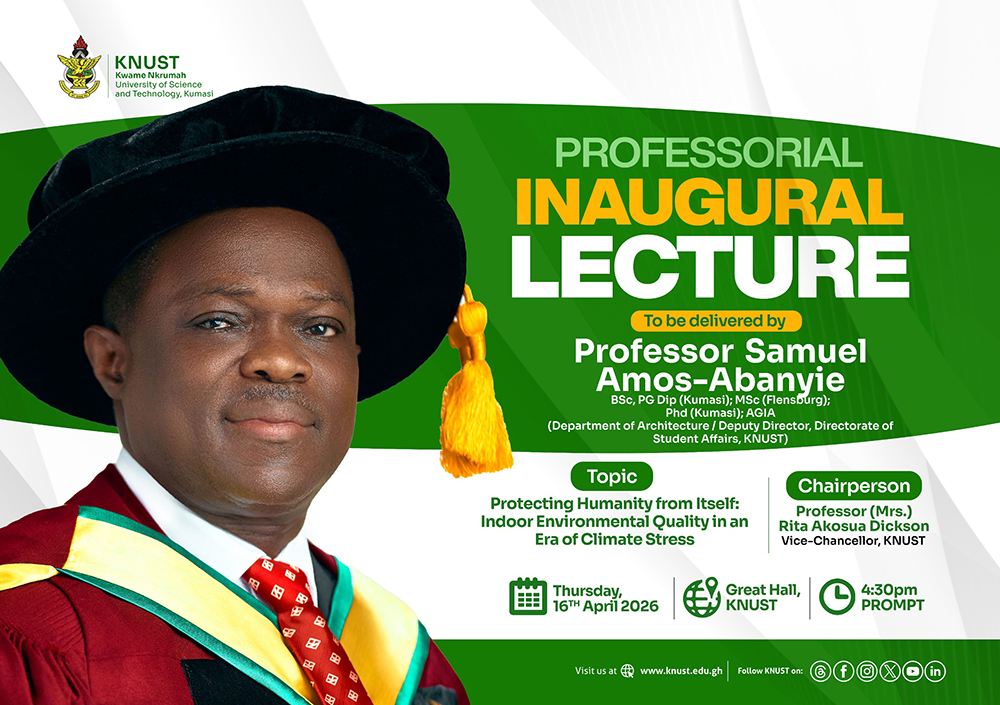
The Vice-Chancellor of the Kwame Nkrumah University of Science and Technology (KNUST), Kumasi, through the Public Lectures Committee invites the academic community and the general public to a Professorial Inaugural Lecture to be delivered by Professor Samuel Amos-Abanyie, a Professor of Architecture at the Department of Architecture, College of Art and Built Environment, KNUST as scheduled below:
Abstract of the Lecture
Protecting Humanity from Itself: Indoor Environmental Quality in an Era of Climate Stress
Besides compliance with building efficiency requirements and increasingly budgetary constraints, the construction industry has to adapt to the unavoidable impacts of climate change in order not to compromise the health, comfort, and productivity of building occupants. From humanity’s earliest shelters to contemporary cities of the Anthropocene, survival has depended on the ability to create indoor environments that offer protection and comfort. Paradoxically, in humanity’s pursuit of progress, modern development has increasingly placed human well-being at risk, particularly within buildings.
Across emerging African cities, sustainability concerns are intensifying within the broader context of socio-environmental conditions associated with rapid urbanisation and climate change. Buildings designed for yesterday’s climate are increasingly misaligned with today’s realities. Moreover, unsustainable building design practices, coupled with the characteristics of the physical environment and activities undertaken within buildings, result in compromised Indoor Environmental Quality. The result is a dangerous feedback loop: rising discomfort drives mechanical dependence, increased energy use accelerates emissions, and the cycle deepens, with consequent threat to the collective survival of humanity.
As occupants’ activities and lifestyles increasingly confine them indoors, the consequences of prolonged exposure to unhealthy indoor conditions become more severe. In this context, safeguarding Indoor Environmental Quality must be understood not merely as a design aspiration, but as a moral imperative in protecting humanity from the unintended consequences of its developmental ambitions.
This lecture will present empirical evidence on changing climate patterns in Ghana and their impact on the indoor environmental quality conditions and energy consumption trends. Occupants’ experience of a space, how hot or cold it feels, how humid or dry, how noisy, how well lit, and how clean the air is, has become a silent determinant of comfort, health, and productivity. The cumulative effect is widespread thermal discomfort, inadequate ventilation and lighting, pervasive noise intrusion, degraded air quality, and associated psychosocial stress.
This lecture also discusses the indoor environmental quality conditions of spaces we inhabit daily: daylighting levels altered by extensions, classrooms shaped by noise, studios fighting against sound, and sealed buildings struggling to breathe. The most unsettling insight from the evidence presented in the lecture is occupants’ adaptation to compromised indoor environmental quality conditions: Occupants accept inadequate daylight as “normal.” Communities internalise chronic noise as “urban life.” Buildings that suffocate, overheat, or contaminate are celebrated as modern.
This lecture further presents evidence on passive cooling strategies, daylight performance, and acoustic retrofitting to sound attenuation in hostile urban contexts, which demonstrate that attaining better indoor environments is achievable.
I strongly submit that a large segment of humanity is living in appalling indoor environmental conditions. Not improving upon what exists implies that the underprivileged groups might have to be exposed to any kind of indoor conditions in buildings. Accepting indoor conditions below the standards will mean turning the clock back on progress and losing faith in human ingenuity. This would violate human progress in other fields to do so. Aligned with the United Nations Sustainable Development Goals, the lecture advances policy, regulatory, and practice-oriented actions aimed at delivering healthier and more productive indoor environments.
Keywords: Indoor Environmental Quality; Climate Change; Passive Cooling Techniques; Thermal Comfort; Visual Comfort; Acoustic Comfort; Urbanisation; Noise Control; Sustainability.
Profile of Professor Samuel Amos-Abanyie
BSc, PG Dip (Kumasi); MSc (Flensburg); PhD (Kumasi); AGIA’
Department of Architecture/Deputy Director (Housing and Welfare), Directorate of Student Affairs, KNUST
Background
Professor Samuel Amos-Abanyie is a Professor of Architecture at the Department of Architecture, Faculty of Built Environment, College of Art and Built Environment, Kwame Nkrumah University of Science and Technology (KNUST), Kumasi, Ghana. Professor Samuel Amos-Abanyie has over two decades of experience in teaching, research, consulting, and mentorship.
Professor Samuel Amos-Abanyie comes from Nyanfeku Ekroful in the Abura-Asebu-Kwamankese District of the Central Region. His parents are Mr. George Amos-Abanyie and Mrs. Francesca Amos-Abanyie, both of blessed memory. He started his kindergarten at St. Joseph’s Catholic School in Saltpond, then transferred to John Mensah Sarbah Experimental Primary School in Cape Coast and finished his secondary education at St. Augustine’s College in Cape Coast, where he earned his “Ordinary” and “Advanced” Level Certificates. After completing his mandatory national service at his alma mater, John Mensah Sarbah Experimental Primary School, he enrolled at Kwame Nkrumah University of Science and Technology to study BSc Architecture. Professor Samuel Amos-Abanyie received his bachelor’s degree and postgraduate diploma in architecture from Kwame Nkrumah University of Science and Technology.
He is a Fellow of Independence Hall at KNUST. Professor Samuel Amos-Abanyie holds certificates in Occupational Health and Safety Management from the Institute of Professional and Executive Development (IPED) in the United Kingdom, as well as in Spoken German. Through the unwavering grace of God and his personal commitment to hard work, Professor Samuel Amos-Abanyie was promoted from Senior Lecturer to Associate Professor, and ultimately to Professor in August 2022.
Early Career Research Experience
Samuel undertook his post-university national service at the Department of Architecture. Following his National Service, he was appointed a Teaching Assistant for two years in the same Department, where he later benefited from a DAAD funding in August 2002 to study at the University of Flensburg in Germany, where he earned his MSc in Sustainable Energy Systems and Management in 2004, and returned to Ghana in March of the same year.
Motivated by Intergovernmental Panel on Climate Change (IPCC), scientific assessments on climate change and the United Nations Environment Programme’s (UNEP) critical role in supporting the Millennium Development Goals (MDGs - 2000–2015), Samuel positioned his MSc research at the intersection of Climate Change and Infrastructure Development by looking at the Impact of Climate Change on Infrastructural Development in the Coastal Belt of Ghana. Samuel's exposure to MSc research informed his PhD research in building performance, and he was successfully awarded a doctoral degree in Building Technology at KNUST in 2012. Samuel’s postgraduate studies in Germany exposed him to advanced methodologies in energy modelling, renewable energy integration, thermal performance analysis, and building simulation techniques. This period marked a transformative stage in his intellectual development, equipping him with tools that would later define his research identity. During Samuel's doctoral research, he engaged extensively in building performance simulation software and laboratory-based evaluation of energy systems.
In June 2006, Samuel was invited to Hong Kong to participate in the 12th Annual Sustainable Development Research Conference, where he submitted a paper titled “Implications of Climate Change on Human Comfort in Buildings.” In June 2007, Samuel was invited to participate in African Architecture Today, an international conference on the study and practice of architecture in Africa at KNUST, where he presented a paper entitled “The Need for a New Framework in the Age of Environmental Consequences.”
In May 2008, Samuel was again invited by the SESAM/ARTES African Alumni to participate in a discussion on “Application of Renewable Energy in Fuelling Sustainable Development in Africa,” organized by the University of Flensburg, Germany, in collaboration with the School of Engineering and Energy Centre, KNUST. He made an impressive contribution to “Applicability of passive and low energy cooling techniques in Ghana”. In June 2008, Samuel represented the Ghana Institute of Architects as a resource person at a seminar on Energy Management Methods in Buildings, organized by the Energy Foundation of Ghana at the Golden Tulip Hotel in Kumasi. This offered an opportunity to share some of the findings and recommendations from my research with top- and middle-level management personnel of selected organizations and institutions in the Ashanti Region of Ghana.
Academic And Administrative Experience
Professor Samuel Amos-Abanyie is currently the Deputy Director in charge of Housing and Welfare of the Directorate of Student Affairs (DoSA), KNUST, a position he has held since November 1, 2024. In August 2017, Professor Samuel Amos-Abanyie assumed the headship of the Department of Architecture, KNUST and as the Dean of the Faculty of Built Environment between August 2019 and October 2021. He was re-elected Dean of the Faculty of Built Environment for another two-year term from November 2021 to October 2023. He was reappointed as Head of the Department of Architecture for a two-year term, but his appointment as Deputy Director of DoSA required him to step aside to allow the two positions to be filled.
Professor Samuel Amos-Abanyie is the current KNUST representative on the Governing Council of the Accra Institute of Technology (AIT). He was the College of Art and Built Environment Representative on the School of Graduate Studies Board from August 2017 to March 2023, and elected to serve as the Professorial Representative, College of Art and Built Environment Board. Beyond leadership, Professor Samuel Amos-Abanyie has held various administrative roles. He served as the Postgraduate Programmes Coordinator of the Department of Architecture between 2018 and 2019, prior to serving as the Undergraduate Programme Coordinator for four (4) years. He also served as the Acting College Examinations Officer in November 2010, when the College Exams Officer was on a Three-Month Fellowship Leave, while he served as the Examinations Officer for the then Faculty of Architecture and Building Technology from Sept. 2009 to 2013.
Professor Samuel Amos-Abanyie has held several roles of Chairmanship and Membership on University, College, Faculty-level boards, Committees, and Sub-Committees within KNUST and beyond. These include, Chairman, College Procurement Committee, College of Architecture and Planning; Member, School of Graduate Studies Board; Member, Committee to Fine-Tune Proposal on Master of Architecture Programme; Chairman, College Environment and Facilities Management Committee, College of Art and Built Environment; Chairman, Sub-Committee of the University Planning and Resource Committee for the review of the MSc Economics Programme; Member, Senior Members Housing Committee; Member, International Programmes Office (IPO) Board, KNUST.
Professor Samuel Amos-Abanyie also served as Member, Organizing Committee, KNUST 4th Annual Summer School; Member, Committee to work on comments of the National Accreditation Board evaluation visit of the IDL Diploma in Architectural Technology programme; Member, College Graduate Committee, College of Art and Built Environment; Resource Person, Orientation Workshop for newly appointed lecturers and research fellows of the Faculty of Built Environment; Member, Examinations Moderation Team, Department of Architecture, KNUST.
Teaching, Thesis Supervision and Examination
For over two decades, Professor Samuel Amos-Abanyie has contributed significantly to architectural education through teaching courses, studio instruction, curriculum innovation, and student supervision. Professor Samuel Amos-Abanyie's teaching portfolio includes various aspects of architectural science courses in Architecture, Building Technology, Civil, and Geological Engineering Departments. Additionally, he has been involved in Architectural Design Studio interactions and in monitoring student progress in building design across various design studio classes. Professor Samuel Amos-Abanyie challenges his students to consider climatic responsiveness, material efficiency, and occupant wellbeing as integral design parameters. Professor Samuel Amos-Abanyie's studio reviews are noted for intellectual severity, methodological clarity, and constructive critique.
At the undergraduate level, Professor Samuel Amos-Abanyie has successfully supervised the completion of over 150 student research projects, and at the postgraduate level, has also successfully supervised more than 100 Master of Architecture thesis. He has a portfolio of 8 successfully supervised PhDs, including 1 Doctor of Philosophy in Building Technology.
Membership of Professional Bodies
Professor Samuel Amos-Abanyie maintains active engagement with professional and scholarly bodies that strengthen the interface between academic research and architectural practice. Professor Samuel Amos-Abanyie is an Associate Member of the Ghana Institute of Architects (GIA), a member in good standing with the Architects Registration Council (ARC) of Ghana. He served as the Treasurer of the Northern Chapter of the Ghana Institute of Architects and, currently, the Chief Electoral Officer and an Examiner for Professional Practice Examination of the Ghana Institute of Architects. Professor Samuel Amos-Abanyie's membership in international academic networks such as the “Society of Building Science Educators (SBSE)” reflects his scholarly orientation toward building performance and environmental design.
Research Outputs and Publications
Professor Samuel Amos-Abanyie's research interests include Building Science and Sustainable Architecture and their interrelationship. He has established a healthy and sustained research interest centred on Climate Change, thermal comfort, Environmental Sustainability, climate-responsive design, building envelope performance, and energy efficiency in buildings.
Professor Samuel Amos-Abanyie's research is grounded in empirical field measurements, simulation modelling, occupant comfort analysis, and energy performance evaluation. Professor Samuel Amos-Abanyie has to his credit over sixty (60) single and co-authored publications, including papers in peer-reviewed Journals, Books, conference proceedings, and Consultancy Reports. Professor Samuel Amos-Abanyie has presented his research at more than 20 conferences and workshops worldwide.
Professor Samuel Amos-Abanyie has successfully placed his research at the service of society. His research output has also informed policy discussions on sustainable housing, low-energy building design, and climate adaptation strategies. Combining scientific measurement with architectural design principles, Professor Samuel Amos-Abanyie bridges the gap between technical analysis and creative practice.
In addition to his examining responsibilities, Professor Amos-Abanyie serves as a reviewer for several scholarly journals, including Journal of Building Performance, Journal of Engineering, Design and Technology, Engineering, Construction and Architectural Management, Journal of Building Materials and Structures, Journal of Science and Technology, International Journal of Scientific & Technology Research, and International Journal of Construction Management.
Grants, Collaborations, Awards, and Consultancies
Professor Samuel Amos-Abanyie has collaborated on numerous research projects and programs, including securing funding support for Industry-Research collaboration between KNUST and GHACEM - the GHACEM Mobile Cement Academy Project, an initiative aimed at enhancing professional knowledge transfer within Ghana’s construction industry. This project underscores his ability to translate academic expertise into industry-relevant training and outreach, Climate and Resource Protection and Sustainable Development Project in Ghana, Tec Energy Centre/College of Engineering in collaboration with North Rhine Westphalia/GIZ, Proposal for re-development of the Akosombo township into a modern green, smart and sustainable city, Design, Construction and Completion of Solar Collector Demonstration Stand for the Energy Centre, CoE – KNUST, Conceptualization and Organization of the First Afro-Mobitecture Awards and Exhibition at KNUST, Collaboration with Sector Ministries and Allied Industry for Faculty of Architecture and Building Technology.
Samuel is a proud recipient of the German Academic Exchange Service - DAAD Fellowship Award to undertake the MSc Programme at the University of Flensburg, Germany. In addition to these, Professor Samuel Amos-Abanyie has received several travel grants to participate in international conferences, workshops, and training programs in countries across Africa, Asia, Europe, and North and South America. Professor Samuel Amos-Abanyie has worked on several projects and has considerable industry experience in consultancy services, project planning, and contract administration.
Mentorship
Mentorship is a defining feature of Professor Samuel Amos-Abanyie’s academic legacy. Beyond formal supervision, Professor Samuel Amos-Abanyie has invested time and intellectual energy in nurturing young academics, research assistants, teaching assistants, and emerging professionals.
Professor Samuel Amos-Abanyie has and continues to provide structured guidance in research design, publication strategies, and academic career planning. Professor Samuel Amos-Abanyie's mentorship approach combines high expectations with supportive engagement, encouraging mentees to pursue excellence while maintaining ethical standards.
Many of Professor Samuel Amos-Abanyie's mentees now hold academic positions at universities, professional roles at architectural firms, and consulting roles at consultancy organisations. Professor Samuel Amos-Abanyie's influence extends across generations of architects trained under his supervision. Professor Samuel Amos-Abanyie views mentorship not merely as academic oversight but as holistic professional development, emphasising integrity, discipline, collaboration, and continuous learning.
Community Service, Engagement, and Outreach
Professor Samuel Amos-Abanyie’s commitment to outreach extends beyond the University, and he actively participates in community education and professional outreach to promote sustainable building practices.
His research findings often inform professional practice and capacity-building efforts within Ghana’s built environment sector. Integrating academic knowledge with community needs. Through public engagements, workshops, seminars, and industry engagements, Professor Samuel Amos-Abanyie advocates for climate-responsive architecture design, housing quality, and energy-efficient construction methods.
Professor Samuel Amos-Abanyie has served as a member of the Consultative Meetings to Coordinate and discuss, among others, St. Augustine's College 83rd Anniversary Project, Cape Coast; Member, National Construction Fair Organizing Committee; Member, Education Committee of the Architect’s Registration Council of Ghana; Member, Rattray Park Kumasi City Management Board; Resource Person, Development of BSc Green/Sustainable Architecture programme for the University of Energy and Natural Resources (UENR); Resource Person, Ghana Academy of Arts and Sciences Schools (Senior High Schools) Outreach Programme - Science, Technology and Innovation (STI) Career Workshops, Accra, Ghana, Speaker, International Students Workshop organized by the CLEAN-AFRICA in collaboration with KNUST and FRAUAS in Accra – Ghana, with the Theme: Parliament Without Barriers, Speaker & Facilitator, Sustainable Development Goals (SDG) Winter School 2018 Workshop organized by CLEAN-AFRICA at Stuggart with the theme: innovation’s through BRAINGAIN: the SGDs and the next generation.
He has served as an External Assessor for the Promotion of Academic Staff for the Tamale Technical University, Tamale; Research Grade Promotion from Research Scientist to Senior Research Scientist. Council for Scientific and Industrial Research (CSIR). External Examiner, BSc. Interior Design programme in the School of Architecture and Design, Central University, Accra.
Family
Professor Samuel Amos-Abanyie is married to Dr. (Mrs.) Esi Botsewa Amos-Abanyie, a hospitality expert and Managing Director of Silver Lobster Food Service. Their union is blessed with three (3) sons: Dr. (Med.) Papa Amos-Abanyie; Joojo Amos-Abanyie; and Yookow Amos-Abanyie. Outside his professional commitments, he enjoys listening to music and taking fitness walk. He is a Catholic and worships at the Our Lady of the Holy Rosary Catholic Chaplaincy on the KNUST campus.