
Announcements
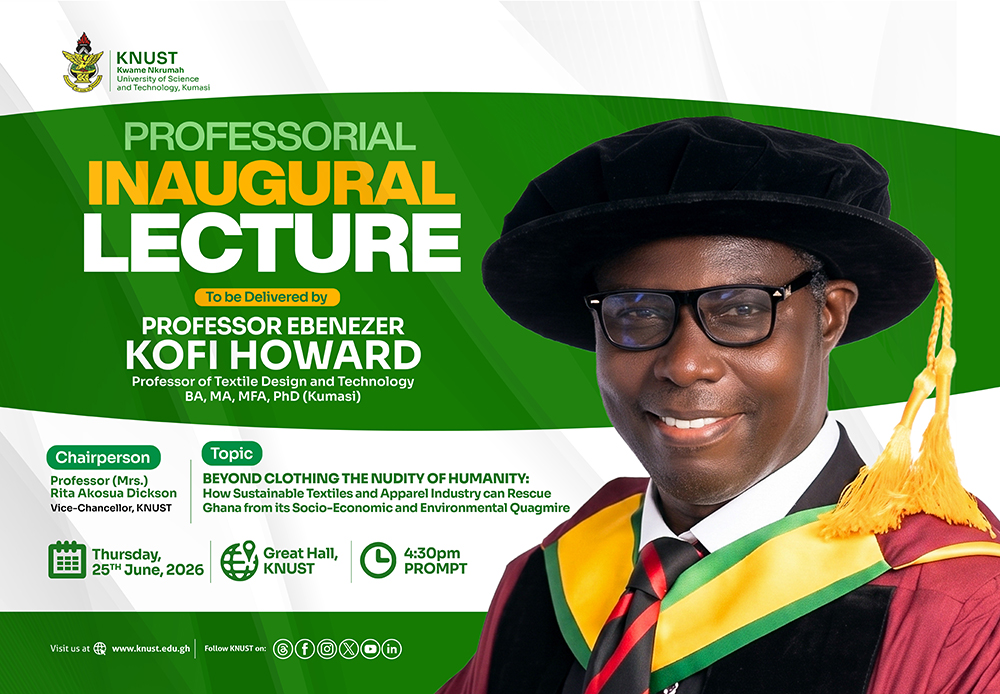
Professorial Inaugural Lecture of Professor Ebenezer Kofi Howard
The Vice-Chancellor of the Kwame Nkrumah University of Science and Technology (KNUST), Kumasi, through the Public Lectures Committee, invites the academic community and the general public to a Professorial Inaugural Lecture. The lecture will be delivered by Professor Ebenezer Kofi Howard, a Professor of Textile Design and Technology in the Department of Industrial Art, College of Art and Built Environment, KNUST. Find details of the lecture below:
Abstract of the Lecture
Topic: Beyond Clothing the Nudity of Humanity: How Sustainable Textiles and Apparel Industry Can Rescue Ghana from Its Socio-Economic and Environmental Quagmire
Ghana, one of the West African countries known for its vibrant textile industry, is gradually joining the league of other nations in the sub-region with a collapsed Textile and Apparel (T&A) manufacturing sub-sector. The industry, which was once the leader in Ghana’s industrial sector, serving as an engine of economic growth and providing employment at all skill levels, has undergone a considerable decline over the years due to internal and external bottlenecks.
Empirical evidence revealed that the sector’s decline is attributed not only to obsolete technology and high production costs but mainly to policy lapses that led to the proliferation of cheap textiles and second-hand clothing. These factors practically rendered Ghana’s domestic textiles and apparel products uncompetitive, crippling local operations, and forcing the closure of most firms. This has resulted in a surging unemployment index and a deepening economic crisis. Unfortunately, due to the limited supply of textile raw materials from domestic textile firms, Ghana’s emerging apparel industry has depended heavily on imported fabrics to sustain its growth, thereby relinquishing more than 70% of T&A value chain operations and economic and employment benefits to offshore counterparts.
The contending issues and the rippling effects of the dwindling state and lack of development of the T&A sector include:
- High unemployment rate in the subsector as a result of a massive redundancy rate, leaving thousands of textiles and fashion graduates churned out by the country’s academic institutions jobless, affecting livelihoods and the country’s economy.
- Acculturation of Western dress norms, where Ghanaian dress culture has been compromised by the adoption of Western fashion ideologies, negating Ghanaian cultural values, promoting imported textiles, and killing domestic textile firms.
- The canker of second-hand clothing and textiles, fuelled by high imports of used clothing and textiles, is crippling the growth of the T&A industry with its socio-economic, health, and environmental nightmares.
Sadly, 95% of Ghanaians rely on second-hand clothes, including handkerchiefs, underwear, pants, bedsheets, towels, and socks, among others, for their clothing needs, highlighting the massive impact of the global second-hand trade on local T&A manufacturing. This dependency presents not only environmental and public health concerns but also constitutes a massive economic leak and social fracture.
Paradoxically, the country’s economy is becoming a “Marketing Economy,” where everyone is buying and selling, but with limited productivity. This certainly does not provide a good scenario for a developing country like Ghana that is pushing the agenda of job creation and economic empowerment. Such an agenda arguably thrives on a sustainable “Production Economy” that sustains and empowers nations to become giant economies, enabling them to be independent and self-reliant. The questions we should be asking ourselves are: “Are we truly independent? How do we justify our independence and self-reliance philosophy?” There is no argument that “Ghana is sitting on gold and begging for straw”.
It is in this respect that African revolutionary leaders, notably Dr. Kwame Nkrumah, Thomas Sankara, and Nelson Mandela, advocated economic self-sufficiency, anti-imperialism, and Pan-Africanism. They warned against dependence on foreign aid, imports, and neocolonial exploitation, arguing that countries unable to produce their own necessities would be forced into debt traps, resource extraction deals and labour exportation. This is in tandem with the Dependency Theory by German-American economist and sociologist, Andre Gunder Frank, who describes how peripheral nations become trapped in cycles of dependency, exporting raw materials and labour while importing finished goods. Evidently, Ghana’s current experiences and those of many African nations reflect the prophetic warnings foretold by these great minds. It is not out of place to establish that “a nation that does not produce to cater for the needs of its people and depends on imports will eventually sell its people in exchange for goods and services to survive”.
Aligned with Ghana’s commitment to contributing its quota to achieve the Sustainable Development Goals (SDGs) by 2030, coupled with my passionate desire to find a lasting solution to the ostensibly insurmountable “wicked problems” of the T&A industry, I seek, through this lecture, to adopt a Socratic approach in tackling Ghana’s socio-economic and environmental crisis. I will argue for the desirability, feasibility, and viability of ways the T&A Industry can drive sustainable growth, create jobs, and uplift communities, drawing on lessons from over two decades of empirical research and global economic benchmarks.
The lecture will elucidate practical strategies for revitalising a thriving and vibrant T&A industry, positioning it as a plausible catalyst and the surest way to save Ghana from its socio-economic and environmental quagmire. I will briefly share my academic and professional journey towards the topic, contextualize the rationale and paradigm of the lecture; discuss the significance of the textiles and apparel industry with empirical evidence; establish the state of the industry; government’s safeguarding policies to sustain the industry; major challenges leading to the decline of the industry; contending issues; and key lessons from selected benchmarked countries that have capitalised on T&A as an engine for employment and economic growth. Consequently, I will propose pragmatic interventions grounded in the Triple Bottom Line (TBL) model to promote sustainable growth in the industry, with key policy recommendations and future research directions.
Keywords: Textiles and Apparel Industry, Clothing, Nudity, Humanity, Sustainability, Circular Economy, Self-reliance, Fast Fashion, Second-hand Clothing, Marketing Economy, Production Economy, Quagmire.
Profile of Professor Ebenezer Kofi Howard
Professor of Textile Design and Technology
(Vice-Dean, Faculty of Art, KNUST; Vice-President, ITFP, Ghana)
BA, MA, MFA, PhD (Kumasi)
Background
Professor Ebenezer Kofi Howard is an astute academic and professional in the field of Textile Design and Technology in the Department of Industrial Art (DIA) at the College of Art and Built Environment (CABE) at Kwame Nkrumah University of Science and Technology (KNUST). He holds a PhD in Art Education, with a research focus on textiles. Notably, he is the first and youngest academic to attain full professorial rank in Textile Design and Technology in Ghana. With over 24 years of consistent experience in university teaching, research, and institutional management and administration, he has made significant contributions to his field.
Professor Kofi Howard was born on Friday, August 26, 1975, in Cape Coast, Central Region of Ghana to Mr Joshua Billy Howard, a building contractor, and Madam Esther Andoh, a trader, both of blessed memory. He spent most of his early years in Abura, a suburb of Cape Coast. His father was a native of Ekumfi Otuam, while his mother hailed from Nyame Bekyere, also in the Central Region. He completed his basic education at Abura St. Lawrence Catholic Basic School in Cape Coast. In 1991, Kofi was admitted to Mfantsipim School, where he studied Visual Art and graduated in 1994. He began his tertiary education at Fosu College of Education in 1996. However, he discontinued in 1997 after gaining admission to the University of Science and Technology (UST), where he pursued a Bachelor of Arts in Art with a focus on Textiles, and graduated in 2001. This choice represented a departure from his father’s wish for him to become an Architect to support the family’s building construction business.
Upon completion, he undertook his national service at KNUST in the Department of Industrial Art (Textiles Section). He approached this role with passion and commitment, which ultimately led to his appointment as a Senior Technician in 2002. He steadily rose through the ranks, becoming a Principal Technician in 2008. Motivated by the desire to become a lecturer, he pursued further studies on a part-time basis, obtaining two master’s degrees: a Master of Arts in Art Education in 2005 and a Master of Fine Art in Textile Design in 2008. He later completed a Doctor of Philosophy in Art Education and completed in 2014. Additionally, he has taken certificate courses to enhance his skills in digital applications and methodologies for professional development, including a certificate in Online Design, Teaching and Learning from the Amsterdam University of Applied Sciences Digital Society School.
As a distinguished professor, researcher and consultant, he is deeply passionate about finding a lasting solution to Ghana’s declining textile industry and developing practical strategies to establish a vibrant and sustainable fashion industry in Ghana. To achieve this, his research has concentrated on several key areas: sustainable practices in textile and apparel production; technology adoption and innovation; design thinking; textiles and apparel waste management; eco-friendly design principles; the circular economy; ethical fashion; trade regimes, policies and emerging trends. Additionally, he focuses on curriculum design and review within the global and domestic textile and apparel sectors.
Early Career Research Experience
Professor Howard’s early career research focused on studio-based investigations of Textile Art and Installations, utilising both locally available conventional and non-conventional textile materials and African prints. To highlight the symbolism of Ghanaian art, his undergraduate research involved translating Akan proverbs into symbols for textile designs. He began his art studio research practice during his time as a teaching assistant and technician at the University. This practice focused on textile art installations and printed textile designs to push the boundaries of design as a tool for social intervention. He explored theme-based artistic expressions, addressing societal issues using conventional and non-conventional textile materials. This artistic trajectory was projected in his MA and MFA theoretical and studio research projects.
The MA in Art Education involved studio research that explored innovative textile art murals, including composite textile techniques and materials, while the MFA in Textile Design research included experiments with mixed media and textile art techniques. These artistic exploratory research works resulted in several publications in local and international art and design journals, both refereed and peer-reviewed. Motivated by a desire to address challenges facing the textile industry, Professor Howard’s PhD research focused on revitalising the Ghanaian textile sector. The exploration of sustainability aimed to expand the boundaries of design thinking and innovation in the textile and apparel industry.
Academic and Administrative Experience
Professor Kofi Howard began his career at KNUST in 2002 as a Senior Technician in 2002 after his National Service. He was later promoted to Principal Technician in 2008. Driven by a desire to teach, he became a Lecturer in the Department of Industrial Art at KNUST in 2009, which marked the start of his academic career. Through hard work and dedication to community engagement, quality teaching, and research, he advanced to the ranks of Senior Lecturer, Associate Professor, and finally Professor in 2014, 2019, and 2022, respectively.
Currently, Professor Kofi Howard serves as the Vice-Dean of the Faculty of Art and is the immediate past Head of the Department of Industrial Art at KNUST. He has held the roles of Vice-Dean and Head of Department multiple times and has also served as the Sectional Head and Postgraduate Coordinator for his Department on several occasions.
Since his appointment as a lecturer at the University, Professor Kofi Howard has actively contributed to the Institution in various roles on both statutory and ad hoc committees. He currently serves as the Chair of several committees, including the CABE Excellence Awards Committee, the Practical Training and Internship Committee, and the Faculty of Art Curriculum Review and Development Committee.
Additionally, he is the Chief Examiner for the Faculty of Educational Studies and a member of the College Appointment and Promotions Committee (CAPC), CABE, KNUST. Professor Howard has held the chairmanship of various boards and committees, including the Department of Industrial Art Board, the Faculty of Art Board, and the PhD/MPhil Viva Committee.
He has also been involved in committees assessing teaching for the promotion of senior members, as well as in the Department of Industrial Art Accreditation/Curriculum Review Committee and the Department of Industrial Art Production Unit Committee. Furthermore, he has served as the CABE Non-Professorial Representative on the Academic Board and has been a member of various committees, including the Academic Board Residence Committee, the KNUST Promotion Criteria Review Committee, the Procurement Committee, and the Junior Members Disciplinary Committee.
Professor Howard has also been involved in the Faculty of Art Board, KNUST Sport Union Board, the Programmes Review Committee of Affiliate Universities, and the KNUST Central Review Committee for Programmes Accreditation. His involvement extends towards committees focused on developing standardised templates for programme accreditation, reviewing the certificate programme in Digital Fabrication of Jewellery for Kumasi Hive, and working with the Technology Consultancy Service (TCC) Tech-Park Ad-hoc Committee.
Additionally, he has contributed to the development of guidelines and templates for tracer studies and the Curriculum Development and Local Accreditation Committee. Professor Howard has also been part of the CABE Logo Design Committee, the Industry and Professional Relations (IPR) Team, and the committee drafting the Memorandum of Understanding between KNUST and the School of Design, Reutlingen University in Germany.
He has also helped organise the Industrial Art Exhibition Committee and has served as a cognate member of the College of Humanities and Social Sciences (CoHSS) Board. Beyond these roles, he has also acted as a resource person for the QAPO Training Workshop on Accreditation Processes and Procedures for Deans and Heads of Department, served as a patron for the Textiles Students’ Association, and worked as an ICT Coordinator for the Department of Industrial Art, among other responsibilities.
Kofi Howard has played a significant role at both national and international levels as an external examiner and moderator for key institutions, including the Ghana Tertiary Education Commission (GTEC) and the Commission for Technical and Vocational Training (CTVET). His work focuses on programme and institutional accreditation and the moderation of examination questions throughout the country. He has chaired several GTEC panels that concentrate on textiles, fashion programmes and institutional accreditation. Additionally, Kofi has served as a facilitator and consultant for various organisations and institutions of higher learning on textiles and fashion-related issues, both nationally and internationally. He has also been a resource person and speaker at numerous conferences and workshops worldwide.
His contributions as an external examiner continue to impact the field.
Teaching, Thesis Supervision and Examination
As a distinguished professor and mentor, Kofi Howard has taught numerous courses and supervised several undergraduate and postgraduate theses, projects and research both within and outside the University. Before his appointment as a lecturer, he taught on a part-time basis at Kumasi Technical University and Radford University College. Kofi has played a vital role in the design, development and review of demand-driven academic programmes and accreditation processes at all levels of the university. His focus on quality assurance has ensured effective content delivery across these programmes. With his expertise in curriculum design and review, combined with his pragmatic leadership skills, he successfully led the Department of Industrial Art at KNUST in the development, accreditation and implementation of nine (9) postgraduate programmes, including three (3) PhD, three (3) MPhil and three (3) MFA.
Additionally, he oversaw the introduction of five (5) undergraduate programmes, resulting in a total of fourteen (14) accredited programmes that are in high demand. This expansion has significantly enhanced the academic activity and increased enrolment, making the Department the top choice for prospective students in textiles and fashion in Africa. Kofi also led the Faculty of Art in creating 22 short courses designed to provide practical training for practising artists and designers. He has successfully supervised twenty (20) PhD candidates and over thirty (30) MPhil and MFA candidates, many of whom are actively contributing to industry and academia both within Ghana and internationally. Currently, he is supervising fifteen (15) PhD candidates and eighteen (18) MPhil candidates either as a principal or co-supervisor. Moreover, he has supervised more than two hundred (200) BSc. and BA. candidates, assisting many in securing scholarships for further studies in the USA, China, the UK, Hong Kong, Canada, and beyond.
Kofi Howard has made significant contributions to textile and fashion education in Ghana and beyond. He has served in various roles such as external examiner, assessor, moderator and chief examiner, for public, private and technical universities, as well as important government institutions including the Ghana Tertiary Education Commission (GTEC), the Commission for Technical and Vocational Education and Training (CTVET), the Ministry of Trade, Agribusiness and Industry (MOTAI), and the Ministry of Tourism, Culture and Creative Arts (MoTCCA). Additionally, Kofi worked as an external examiner and moderator for five public universities: the University of Ghana (UG), the University of Education, Winneba (UEW), the University for Development Studies (UDS), the University of Cape Coast (UCC), and the University of Skills Training and Entrepreneurial Development (USTED). He has also contributed to ten technical universities in Ghana, including Cape Coast Technical University (CCTU), Kumasi Technical University (KsTU), Koforidua Technical University (KTU), Takoradi Technical University (TTU), Tamale Technical University (TaTU), Dr Hilla Liman Technical University (DHLTU), Bolgatanga Technical University (BTU), Sunyani Technical University (STU), Ho Technical University (HTU), and Accra Technical University (ATU).
He has worked remotely with several foreign institutions as an external examiner for PhD and MPhil theses assessment. Additionally, he has served as a coordinator and resource person for various institutional collaborations, partnerships, exchanges, conferences, exhibitions, workshops, and seminars. Notable contributions include the University of Florida (UF) Centre for African Studies in the USA, the School of Design at Reutlingen University in Germany, Cape Peninsula University of Technology (CPUT) in South Africa, the Akademie Mode & Design (AMD) in Germany and the University for the Creative Arts (UCA) in the UK.
Membership of Professional Bodies
Professor Kofi Howard currently serves as the National Vice-President and a Board Member of the Institute of Textiles and Fashion Professionals-Ghana (ITFP-G), a position he has held since the Institute’s establishment in 2011. Additionally, he is an Executive Board Member of the West African Fashion Council-Ghana (WAFC-G) and a Member of the Design Institute of Ghana.
Awards
Since his appointment as lecturer in the Department of Industrial Art at KNUST in 2009, Professor Kofi Howard has contributed significantly to effective teaching and research, equipping students with the knowledge and skills required for professional practice. In recognition of his outstanding scholarship and performance, he received multiple honours at the 2019 College of Art and Built Environment (CABE) Staff Excellence Awards, including: Overall Best Senior Member (Teaching Category, 1st Runner-Up) at the College level; Best Senior Member (Research and Publication) and Best Senior Member (Teaching) in the Faculty of Art (FoA).
Research Outputs and Publications
As an academic, staying abreast of current developments in teaching and research is essential to maintaining professional relevance. Professor Howard has made significant contributions to his field of study. He has published extensively in reputable and highly indexed journals, with his work appearing in publications from leading academic publishers such as Emerald, Elsevier, Taylor and Francis, Routledge, ScienceDirect, the Directory of African Journals (DOAJ), and African Journals Online (AJOL). He is credited with over 150 scholarly and professional outputs, including peer-reviewed journal articles, edited volumes, book chapters, conference proceedings, curated exhibitions, and technical consultancy. His publications have attracted a significant number of citations on Google Scholar and Scopus. Additionally, he has participated in and presented research papers on textiles, fashion and art education at local and international conferences, workshops, and seminars, adding his voice and expertise to academic discourse and staying well-informed about current and emerging trends and debates in the global textiles and apparel sector.
He has served as a keynote speaker, session chairman, moderator, and peer reviewer at various international and local conferences. Currently, he holds multiple editorial positions, including Associate Editor for Fashion and Textiles Review (FTR) and Editorial Board Member for the Journal of Sustainable Fashion Business, which is published by the Institute of Textiles and Fashion Professionals-Ghana (ITFP-GH). Additionally, he serves as a peer reviewer for the Journal of Science and Technology (JUST) at KNUST, the Ghana Journal of Science, Technology and Development (GJSTD) at the University for Development Studies (UDS), and the Journal of Textile Science and Technology (JTST) in the USA.
He has also served as an editor, reviewer, and moderator at various conferences, including the International Conference on Applied Sciences and Technology (ICAST) in 2025; the 2025 E-Learning Conference at KNUST; the International Conference on Social Science, Arts, Business and Education (ICSSABE), 2022, in Frankfurt, Germany; the 2017 NAK-KIDeC Conference on Sustainable Development Goals in Africa: The Role of Indigenous Design Concepts in Ghana; the 6th International Conference on Infrastructure Development in Africa (ICIDA) in 2017, focusing on Building Resilience through African Urban Culture and Infrastructure Development at KNUST; the 2025 Design Ghana Conference on Designing in Afrika: Bridging Cultures, Inspiring Innovations and the 2025 International Textiles Machinery Exhibition (ITMA-Asia), Singapore, among others.
Grants, Collaborations and Consultancies
Professor Kofi Howard has collaborated with both local and international partners to secure numerous research grants and projects focused on textiles and apparel development. To mobilise funding for academic and industry initiatives, he has partnered with experts from relevant departments and research centres within and outside the university to develop competitive grant proposals to undertake key textile and apparel projects. These collaborative efforts have resulted in multiple grant awards and the successful management and delivery of impactful research projects. A key highlight of his work is his role as Team Lead and Textiles Expert for the Kente Value Chain Project, which was procured through Quality and Cost-Based Selection. This project provided consultancy services to Ghana’s Ministry of Trade, Agribusiness and Industry (MOTAI) as part of the Rural Enterprise Project (REP). The project was funded by the German Development Cooperation under the German Agency for International Cooperation (GIZ) in partnership with Samira Empowerment & Humanitarian Projects (SEHP), with the Technology Consultancy Centre (TCC) in KNUST serving as the implementing consultant (2019-2020). He also served as Team Lead and Textiles Expert for the Feasibility Study of the Fashion Industry in Ghana, in line with the objectives of the Network for Enterprise Development Learning through Sewing (NEEDLES) for Girls (N4G) Initiative. The project was funded by the GIZ and SEHP in 2018, with Top Technocrats (GH) Limited (TTL) as the implementing consultant.
Professor Kofi Howard has taken the lead in efforts to secure funding to establish a state-of-the-art Jewellery Centre at KNUST, making it one of the first of its kind in the sub-region. As such, a special mention goes to Mr. Etornam Cyril Adala, the Coordinator of the Centre for his significant contributions, and the members of the Metals Product Design Section for their roles in making the initiative a reality. In addition, Professor Howard has been a team member for the mobilisation and donation of books to the Prempeh II Library at KNUST, an effort funded by Prof. El-Anatsui in 2020. He also served as the team lead for the fundraising and procurement of equipment to establish the Textiles Laboratory in the Department of Industrial Art. This project was a collaboration between the Wuxi Institute of Technology in China and KNUST Textiles alumni in China and Hong Kong spanning from 2022 to 2025. Significant contributions to this initiative were made by Dr. Benjamin Tawiah, Dr. Bismark Sarkodie and Dr. Christopher Narh.
Kofi Howard also played a crucial role in the collaboration between KNUST and Shue Shimmers to develop a curriculum for professional gemstone training, which was funded by the Ghana Skills Development Fund (GSDF) in 2023. He also served as team lead for the design and development of a Competency-Based Training (CBT) curriculum for the Textile Materials and Production Technology programme (Project Code: PLANET-1), funded by the Government of Ghana for CTVET, with Elgen as the implementing consultant, in 2021-2022. Following this, he led the second phase of this CBT curriculum development for the Textile Materials and Technology programme, funded by the World Bank for CTVET, again with Elgen as the implementing consultant, in 2023-2024.
As a textile design consultant, Prof Howard has made significant contributions to his community and beyond by providing expert design and consultancy services to meet the textile and apparel needs of various institutions, including academic, royal, corporate and civil institutions. His portfolio features commemorative cloth designs for milestone celebrations. Notable commissions in his work feature: the 75th and 70th Anniversaries Cloths for KNUST; the 70th Anniversary Cloth for the KNUST Faculty of Agriculture; 50th Anniversary Cloths for the KNUST School of Medical Sciences, University Hall and Africa Hall; the 75th Anniversary Cloth for Sekondi College; and the 20th Anniversary Cloth for Agona Senior High School. Additionally, he designed the official cloth commemorating the 25th Anniversary of the enstoolment of His Royal Majesty Otumfuo Osei Tutu II, themed “25 Years of Global and Local Impact.” He has designed commemorative cloths for AMEND Ghana, the Faculty of Art, KNUST, and Boamposem Secondary School, among others.
Mentorship
Professor Howard has shown a strong commitment to mentoring newly appointed and young academics at KNUST and other universities in Ghana. He has played a significant role in helping them effectively fulfil their core responsibilities in teaching, research, and community service. In the Department of Industrial Art, he has served as a mentor to several faculty members, many of whom have advanced to become professors. Additionally, He has guided some faculty members in obtaining their terminal degrees. Kofi is well respected as the “Chief Whip” for the Promotion of Senior Members (Academic) in the Faculty of Art, where he has supported many faculty members in achieving promotions to various academic ranks. His mentorship extends beyond KNUST, reaching academic staff at sister institutions as well. Some of his mentees have been accepted into prestigious MFA, MPhil, PhD, and Postdoctoral Fellowship programmes in the US, UK, China, and Hong Kong, leading to further studies and lectureship appointments.
Community Service, Engagement and Outreach
Professor Howard has made significant contributions to community impact engagements and outreach programmes in the textiles and fashion sector, both in Ghana and internationally. His dedication to sustainable development within the textile and apparel sector has improved lives in local communities. He was crucial in establishing the Kente Heritage Museum at Bonwire under the auspices of the Ministry of Tourism, Culture and Creative Arts (MoTCCA). As part of the Technology Consultancy Centre’s (TCC) team, he contributed to the Kente Value Chain Project, which focused on promoting sustainable development and innovation in Kente-weaving communities in the Ashanti Region. Additionally, Professor Kofi Howard participated in a feasibility study of the fashion industry across various regions in Ghana, including Northern, Ashanti, Greater Accra, and Western Regions. This initiative aimed to provide employable sewing skills to young underprivileged girls, including head potters and school dropouts. His extensive community engagement efforts have included field research, advocacy, and outreach programmes with smock weavers in towns like Tamale, Bolgatanga, Daboya, and Yendi in the Northern Region of Ghana, as well as kente weavers in Agbozume and Agotime-Kpetoe in the Volta Region of Ghana.
Family and Religious Life
Professor Kofi Howard is married to Lady Rev. (Mrs.) Sylvia Dede Howard, an early childhood educationist and headmistress of Bill Howard Educational Complex in Edwinase-Kuntanase, Kumasi. They are blessed with three lovely children: Joshua Billy Howard, Eunice Peace Ewurama Howard and Jeremiah Joejo Nhyiraba Howard. Professor Howard is a devoted, Christ-centred Christian. He was born into the Calvary Methodist Church in Abura, Cape Coast in the Central Region. During his youth, he joined the Liberation Family Church, Assemblies of God International in Pedu, Cape Coast, and has been a member of the Presbyterian Church of Ghana, Christ Congregation at KNUST, since 2000, where he serves as the praise and worship leader. He is also the founder and leader of Jesus Encounter Ministries (JEM), a non-denominational outreach ministry focused on village evangelism. Kofi has played a significant role in preaching at local churches and supporting church planting efforts in villages across Ghana for various Bible-believing congregations.