
Announcements
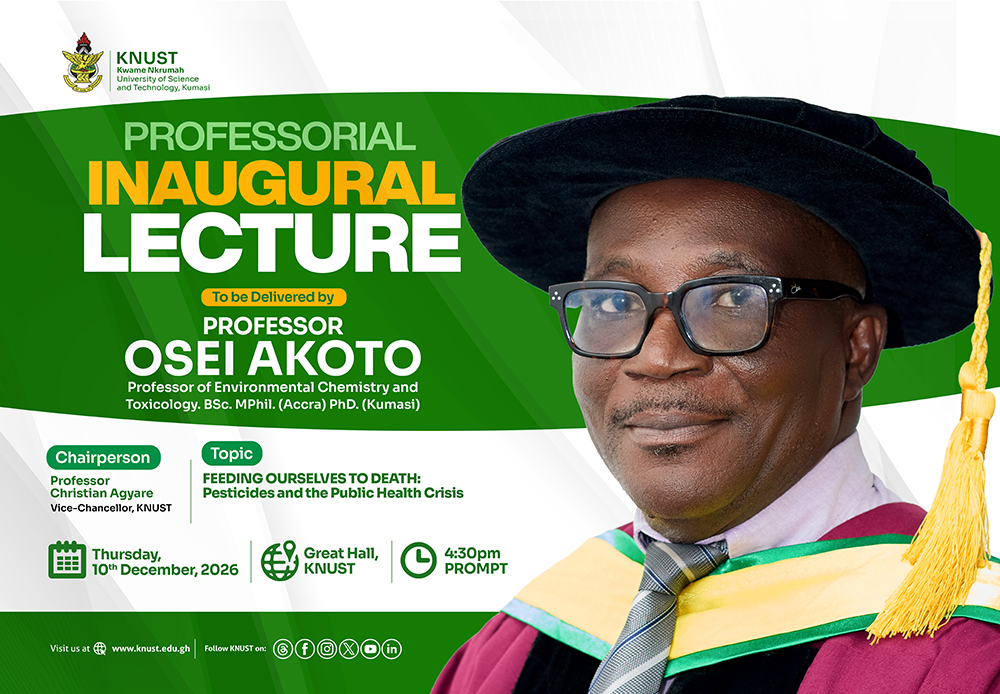
Professorial Inaugural Lecture by Professor Osei Akoto
The Vice-Chancellor of the Kwame Nkrumah University of Science and Technology (KNUST), Kumasi, through the Public Lectures Committee, invites the academic community and the general public to a Professorial Inaugural Lecture. The lecture will be delivered by Professor Osei Akoto, a Professor of Environmental Chemistry and Toxicology in the Department of Chemistry, College of Science, KNUST. Find details of the lecture below:
Abstract of the Lecture
Title: Feeding Ourselves to Death: Pesticides and the Public Health Crisis
This inaugural lecture, titled “Feeding Ourselves to Death: Pesticides and the Public Health Crisis,” presents a reflective and research-driven exploration of the complex relationship between agriculture, pesticide use, environmental sustainability, and human health in Ghana. Drawing from personal experiences growing up in a farming community, the lecture traces the author’s academic journey and enduring commitment to environmental chemistry and toxicology, shaped by early exposure to the unregulated use of pesticides and its hidden consequences.
The lecture examines the historical evolution of pesticide use in Ghana, from traditional plant-based methods to the widespread adoption of synthetic chemicals, particularly organochlorine and organophosphate pesticides. While these chemicals have contributed significantly to agricultural productivity and public health interventions, their persistence in the environment and potential for bioaccumulation raise critical concerns. Empirical evidence from multiple studies conducted by the author reveals the presence of pesticide residues in water bodies, staple foods, vegetables, and even in human biological samples, indicating widespread and continuous exposure.
Findings highlight both acute and chronic health risks associated with pesticide exposure, including neurological, reproductive, and carcinogenic effects. Case studies of pesticide poisoning in Ghana further underscore the real-life consequences of improper handling, weak regulatory enforcement, and limited public awareness. Importantly, the lecture emphasises the cumulative and synergistic risks posed by multiple pesticide residues consumed through everyday diets, a dimension often overlooked in regulatory frameworks.
Despite these challenges, the lecture offers a message of cautious optimism by demonstrating that exposure risks can be mitigated through improved agricultural practices, adherence to safety protocols such as pre-harvest intervals, and effective household-level interventions. It calls for a holistic and interdisciplinary approach that integrates science, policy, education, and community engagement.
Ultimately, the lecture frames pesticide use not only as a scientific issue but also as a moral and public health imperative. It advocates a transition toward safer and more sustainable food systems, emphasising that food security must not come at the expense of human health. The work serves as both a scholarly contribution and a call to action to ensure that efforts to feed populations do not inadvertently compromise their well-being.
Keywords: Pesticide Residues, Food Security, Public Health, Environmental Sustainability
Profile of Professor Osei Akoto
Professor of Environmental Chemistry and Toxicology
BSc MPhil (UG Accra) PhD (KNUST Kumasi)
Background
Professor Osei Akoto is a distinguished Professor of Environmental Chemistry and Toxicology in the Department of Chemistry, Faculty of Physical and Computational Sciences, College of Science at Kwame Nkrumah University of Science and Technology (KNUST), Kumasi, Ghana. With over two decades of experience, he has made significant contributions to teaching, research, community service and mentorship of students.
He hails from Kwahu Pepease in the Kwahu East District of Ghana’s Eastern Region and was born to the late Mr. Kwadwo Atakorah Akoto and Madam Agnes Meriku. He began his early education at Kwahu Pepease L/A Primary School and continued to St. Augustine’s College in Cape Coast, where he obtained both his Ordinary and Advanced Level Certificates.
Following his mandatory national service at the National Service Secretariat, he proceeded to the University of Ghana, Legon, where he pursued a Bachelor of Science degree in Chemistry with Zoology.
Following his university education, he undertook his national service at Achimota School, where he taught Core Science and Chemistry. This early teaching experience not only strengthened his passion for education but also laid a solid foundation for his future academic career.
Driven by a deep interest in advancing his knowledge, he returned to the University of Ghana, Legon, to pursue postgraduate studies in Chemistry. During this period, his growing interest in environmental health and sustainability began to take clearer shape, ultimately influencing the direction of his academic and research career. This passion and dedication are reflected in his steady and well-earned progression through the academic ranks, rising from Lecturer to Associate Professor and ultimately attaining the rank of Professor in August 2020, an achievement that underscores his sustained commitment to excellence in teaching, research, and academic service.
Early Career Development
In the early stages of his professional journey, a defining opportunity emerged that would shape both direction and purpose. Driven by a deep and abiding passion for environmental protection and public health, Professor Osei Akoto took up an appointment as a Programme Officer at the Environmental Protection Agency (EPA) of Ghana (now Authority). In that role, he encountered firsthand the realities of environmental regulation and management, experiences that not only broadened his perspective but also anchored his lifelong commitment to environmental chemistry and toxicology.
It was upon this solid foundation that he transitioned into academia, joining the Department of Chemistry at the Kwame Nkrumah University of Science and Technology (KNUST) in June 2005 as a Lecturer. This moment marked the beginning of a journey defined by dedication to teaching, research, and service.
His quest for knowledge and impact soon extended beyond national borders. In June 2009, he was invited to Dar es Salaam, Tanzania, to participate in an inception workshop under the Rotterdam Convention Pesticide Programme. This important gathering, focused on the implementation of international frameworks for pesticide management, further deepened his engagement with global efforts to safeguard human health and the environment.
As his career evolved, so too did his involvement in collaborative research of international significance. In 2012, he became part of a landmark partnership between KNUST and Hokkaido University in Japan, under the auspices of the Japan Society for the Promotion of Science. The project, which examined environmental pollution in Ghana and its effects on humans and animals, stands as a testament to the power of cross-continental scientific collaboration in addressing shared challenges.
This spirit of collaboration has continued in his work on emerging environmental concerns, including ongoing research into the impact of perfluoroalkyl and polyfluoroalkyl substances (PFAS) on air, water, and soil systems in Ghana, in partnership with the University of Pittsburgh. Such work reflects not only scientific curiosity, but a deep commitment to confronting the complex environmental issues of our time.
Beyond the laboratory and classroom, Professor Akoto has also contributed significantly to the scientific community through leadership and service. In September 2013, he served as Chairman of the Organizing Committee and Conference Coordinator for the 5th International Toxicology Symposium in Africa, hosted here in Kumasi. This landmark event brought together scholars from across the continent and beyond, fostering dialogue on pressing issues in toxicology and environmental health.
In recognition of his growing stature in the field, he was, in August 2016, invited to serve as a Sectional Chair at the 8th International Toxicology Symposium in Africa, held in Cairo, Egypt, an honour that speaks to his influence and respect within the global scientific community.
Academic and Administrative Experiences
Professor Osei Akoto’s academic and administrative experience reflects a distinguished record of leadership, service, and commitment to institutional development within KNUST and beyond.
At the departmental level, Professor Akoto currently serves as Head of the Department of Chemistry, a position he has held since November 2024. This appointment marks a return to a role in which he previously demonstrated strong leadership, having first served as Head of Department from August 2016 for two academic years. In these roles, he has provided strategic direction, strengthened teaching and research activities, and fostered an environment conducive to academic excellence and innovation.
His administrative experience extends significantly into faculty and college leadership. He served as Vice Dean of the Faculty of Physical and Computational Sciences (FPCS) from 1st August 2019 to 30th July 2020, where he supported the coordination of academic programmes and policy implementation. Building on this experience, he was elected Dean of the Faculty, serving two successful terms from August 2020 to October 2024. As Dean, he provided visionary leadership, oversaw academic planning, enhanced interdisciplinary collaboration, and contributed to the overall growth and reputation of the faculty.
Professor Akoto has also made notable contributions to pre-tertiary and tertiary education quality assurance. He served as an examiner for the West African Examinations Council from 2007 to 2017, playing a key role in maintaining academic standards across the region. Additionally, he has contributed to national higher education quality assurance as a member of academic audit teams for the Ghana Tertiary Education Commission.
Within the university system, Professor Akoto has actively participated in governance through membership and chairmanship of numerous boards and committees. His service includes Chairman of the FPCS Management Board, Member of the School of Graduate Studies Board, Member of the College of Science Management Board, and Member of the College of Science Appointments and Promotions Committee. He has also served as the College of Science Representative on the College of Engineering Appointments and Promotions Committee. Through these roles, he has contributed to policy formulation, staff development, and institutional governance.
Beyond KNUST, Professor Akoto’s expertise has been widely recognized at both national and international levels. He has served as an External Examiner for PhD theses in universities within and outside Ghana, and as an External Assessor for the promotion of academic and research staff in various institutions. He has also contributed to academic quality assurance through the vetting of examination questions of some tertiary institutions including the University of Cape Coast.
In addition to his academic engagements, Professor Akoto has provided technical and policy support in national development initiatives. He has served as a resource person in reviewing Ghana’s draft National Implementation Plan under the Stockholm Convention on Persistent Organic Pollutants, contributing his expertise in environmental chemistry and toxicology. Furthermore, he has participated in local governance as a member of a District Statutory Planning Committee, supporting planning and development efforts at the district level.
Teaching, Thesis Supervision and Examination
Professor Osei Akoto’s contributions to teaching, research, and innovation over more than two decades reflect a sustained commitment to advancing chemical education, generating impactful knowledge, and translating research into practical solutions for society.
In the area of teaching, Professor Akoto has distinguished himself as an engaging and forward-thinking educator. He delivers multidisciplinary courses that explore the fundamental principles of chemistry while emphasizing their relevance to everyday life, public health, environmental sustainability, and global development. His teaching philosophy is anchored in the conviction that chemistry is not merely an abstract science but a powerful tool for societal transformation. Through his courses, he seeks to enhance students’ scientific literacy, ethical awareness, and critical thinking skills by encouraging them to interrogate how chemical knowledge can be applied to address real-world challenges. This approach has not only enriched the learning experience but has also inspired many students to pursue careers and research in environmentally relevant fields.
Professor Akoto’s research is firmly situated at the interface between humans and their environment, with a strong focus on environmental chemistry and toxicology. His work investigates the occurrence, distribution, and fate of environmental pollutants, including pesticides, polycyclic aromatic hydrocarbons (PAHs), and heavy metals in various environmental matrices. He has also explored pathways of human exposure to these contaminants, assessing associated health risks and broader ecological implications. In addition, his research extends to food safety, where he examines chemical contaminants in food systems and their potential impact on public health. Collectively, his work contributes to a deeper understanding of environmental pollution and provides evidence to inform policy, regulation, and risk mitigation strategies.
Beyond teaching and research, Professor Akoto has demonstrated a commendable capacity for innovation. Notably, he has contributed to the development and quality evaluation of an oleoresinous wood varnish produced from resin synthesized using tannin extracted from the stem bark of the Khaya senegalensis. This work exemplifies the application of indigenous natural resources in developing sustainable and environmentally friendly products, aligning with global efforts to promote green chemistry and local innovation.
A significant aspect of Professor Akoto’s academic legacy lies in his dedication to research supervision and mentorship. He has successfully supervised the completion of over 200 undergraduate research projects, thereby nurturing foundational research skills among students. At the postgraduate level, he has guided more than 55 MSc and MPhil theses to completion, in addition to supervising 11 PhD candidates. Through this extensive supervision portfolio, he has played a pivotal role in developing the next generation of scientists, many of whom are contributing to academia, industry, and public service.
Research Experience, Output and Publications
Professor Osei Akoto’s research output and publications represent a substantial and influential contribution to the field of environmental chemistry and toxicology. His scholarly work has significantly advanced the fundamental understanding of the fate, behaviour, and interactions of environmental pollutants within human and ecological systems. His research has shed light on how contaminants move through environmental compartments, how humans are exposed to them, and the risks they pose to biota and ecosystem health.
Beyond generating new knowledge, Professor Akoto’s research has played an important translational role. His findings have enriched teaching by bringing current, real-world scientific challenges into the classroom, thereby strengthening the link between research and pedagogy. At the same time, his work has informed public institutions and policymakers, contributing to evidence-based decision-making aimed at safeguarding public health, protecting the environment, and supporting sustainable economic development.
In terms of scholarly productivity, Professor Akoto has co-authored over 150 publications, including articles in peer-reviewed journals, conference proceedings, and consultancy reports. This extensive body of work reflects both depth and consistency in research engagement, as well as a strong culture of collaboration within the scientific community. His publications span a wide range of topics within environmental science, reinforcing his reputation as a leading voice in the study of environmental contaminants and their impacts.
Complementing his publication record is his active participation in the dissemination of knowledge through academic and professional platforms. He has presented his research at more than 50 conferences and workshops, both locally and internationally. These engagements have not only provided avenues for sharing his findings but have also facilitated scholarly exchange, fostered collaborations, and enhanced the global visibility of his work.
In addition to his research and publication achievements, Professor Akoto has contributed significantly to the academic community through scholarly peer review. He has served as a reviewer for several reputable international and local journals, including Chemosphere, Science of the Total Environment, International Journal of Environmental Science & Technology, Environmental Monitoring and Assessment, Lakes and Reservoirs: Research and Management, Journal of Science and Technology, Journal of Ghana Science Association, and Human and Ecological Risk Assessment: An International Journal. Through this role, he has supported the maintenance of high academic standards and contributed to the advancement of quality scientific publishing.
Grants, Collaboration and Consultancy
A significant feature of Professor Osei Akoto’s academic career has been his commitment to collaborative research, international partnerships and capacity building. He has participated in several externally funded research projects addressing environmental pollution, chemical exposure and associated human health risks.
He has served as a Collaborative Scientist on three major international research projects. The first, undertaken with the University of Pittsburgh, USA, and KNUST (2023–2028), investigates the environmental and health implications of per- and polyfluoroalkyl substances (PFAS) in Ghana, with initial funding of US$60,000. The second, a KNUST–Hokkaido University collaboration funded by Japan’s MEXT (2020–2025), examined occupational exposure to neonicotinoids in Ghana’s cocoa-growing areas, with funding of US$200,000. Earlier, he participated in the Japan Society for the Promotion of Science (JSPS) Asian–Africa Science Platform project, “Environmental Pollution in Ghana and Elucidation of Their Effects on Human Beings and Animals” (2012–2018), valued at US$250,000. This project investigated heavy metal pollution in mining communities and supported the training of two PhD and three MPhil students at Hokkaido University, Japan.
Beyond research grants, Professor Akoto has secured sponsorship opportunities that promoted international exposure and professional development. Between 2012 and 2019, Japanese Government support facilitated the participation of two senior colleagues and two graduate students in international toxicology conferences. He also received Africa/ANCAP sponsorship to attend the 4th SETAC Africa Meeting in Kampala, Uganda, in November 2009, and a travel grant to participate in an inception workshop under the Rotterdam Convention Pesticide Programme in Dar es Salaam, Tanzania.
These grants, collaborations and sponsorships reflect his commitment to advancing environmental science, strengthening international research partnerships, developing institutional capacity and creating opportunities for the next generation of scientists.
Mentorship
At the heart of Professor Osei Akoto’s academic philosophy lies a deep commitment to mentorship, an enduring dedication to guiding students not only toward academic success, but also toward personal growth and professional fulfilment.
In his role as a mentor, he provides thoughtful guidance to students in navigating their academic journeys, assisting them with course selection and long-term academic planning. He works closely with them to set clear and realistic goals, while continuously monitoring their progress to ensure that they remain on a path of excellence.
Recognizing that success in academia requires more than intellectual ability alone, he equips students with practical strategies in time management, effective study habits, and examination preparation. Through regular engagement, he carefully tracks their academic performance, identifying areas of concern early and offering the necessary support to address them.
Beyond the classroom, Professor Akoto actively connects students to essential institutional resources, including counselling services, career guidance, and financial support systems, ensuring that they are holistically supported throughout their university experience. He also encourages participation in academic workshops and seminars, fostering intellectual curiosity and continuous learning.
Central to his mentorship approach is the cultivation of a relationship built on trust, respect, and genuine care. He creates a safe and supportive environment where students feel valued and heard, while upholding the highest standards of confidentiality and always acting in their best interest.
Through this unwavering commitment, his mentorship has not only shaped academic outcomes but has also nurtured confident, capable, and responsible individuals prepared to contribute meaningfully to society.
Membership of Professional Bodies
An important aspect of his professional journey has been his engagement with scholarly and scientific communities through active membership in professional associations. He has always believed that belonging to such bodies is not merely a matter of affiliation, but a commitment to shared learning, collaboration, and the advancement of knowledge.
Since 2006, Professor Osei Akoto has been a member of the Ghana Science Association (GSA), an organisation that continues to play a vital role in promoting scientific development and discourse within the country. His involvement in this association has provided a valuable platform for engaging with colleagues across disciplines and contributing to national conversations on science and development.
Professor Akoto has also maintained a long-standing relationship with the Ghana Chemical Society, having first joined in 1995 and remaining an active member to date. This enduring affiliation reflects his continued commitment to the discipline of chemistry and to the professional community that supports its growth and relevance.
In addition, Professor Osei Akoto has served as a member of SETAC–Africa from 2008 to 2014, a professional body dedicated to the study of environmental toxicology and chemistry. His engagement with SETAC–Africa allowed him to interact with researchers and practitioners working at the forefront of environmental science across the continent, further strengthening his interest and contributions in this field.
These affiliations, over the years, have enriched his academic journey, broadened his perspectives, and reinforced his commitment to contributing to both national and international scientific communities.
Family
Professor Osei Akoto is married to Dr (Mrs) Esther Gyedu- Akoto and they are blessed with two children, Dr (Pharm) Akosua Tema Akoto and Kwadwo Gyedu Akoto.