
Announcements
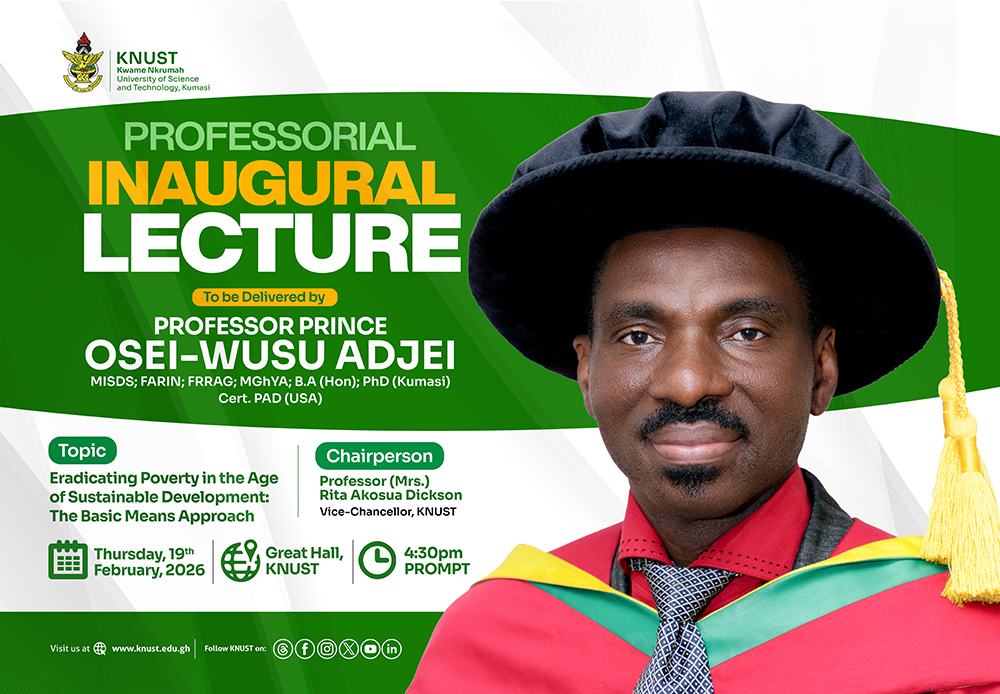
Professorial Inaugural Lecture of Professor Prince Osei-Wusu Adjei
The Vice-Chancellor of the Kwame Nkrumah University of Science and Technology (KNUST), Kumasi, through the Public Lectures Committee invites the academic community and the general public to a Professorial Inaugural Lecture to be delivered by Professor Prince Osei-Wusu Adjei, a Professor of Human and Development Geography as scheduled below:
Abstract
Topic: Eradicating Poverty in the Age of Sustainable Development: The Basic Means Approach
Poverty has become a global scourge and a social canker. Like a disease with multidimensional symptoms, poverty and its manifold manifestations remain major developmental challenge not just for Ghana or Africa, but the world as a whole. Since the inception of the 21st Century for example, poverty eradication has remained on top of global development agenda emerging as the number one Millennium and Sustainable Development Goals (M/SDGs). Consequently, governments and non-governmental organizations, scholars and development practitioners remain in search for sustainable solutions to its multiple dimensions and debilitating impacts towards addressing spatial, gender and income inequalities and creating a just world with equal opportunity for all. Over the last two decades, poverty issues have occupied central position in global development literature attracting research and policy attention on where we are globally in our eradication efforts, with ongoing discourse on what works for improving the quality of life of masses of the global and regional population disadvantaged in terms of wealth, health, gender, location, ethnicity and education due to poverty. These developments underpin the policy and research interest surrounding the discourse on poverty, its manifestations and eradication strategies within global development literature.
In this lecture, Professor Prince Adjei will dwell on evidence from almost two decades of policy relevant research experience to address associations between poverty, health, gender and rurality at the intersection of the millennium and sustainable development goals. More specifically, the lecture will provide answers to central questions focusing on why poverty remains on top of global development agenda; why policy interventions often make minimal impact; and how such interventions should be modelled to optimize impact in this poly-crises age. First, the lecture shall address the nexus of poverty and health by unravelling major health outcomes of poverty with emphasis on social conduits through which poverty breeds poor health. Second, the gendered perspectives of poverty in the context of Social Darwinian Theory shall be examined in this lecture to address the nexus of gender and poverty which lies at the core of the SDGs. In this segment, major determinants underpinning feminization of poverty and livelihood vulnerabilities with experiences from both national and local scales shall be unravelled using evidence from spatio-temporal research outputs. The lecture shall also draw from research-based knowledge outputs to explain how transformative politico-economic participation of women at the local scale in an equal opportunity for all society could engender effective relative and absolute poverty reduction and promote appropriate health-seeking behaviour towards sustainable societal development. Third, the lecture will highlight poverty as the single most important push factor behind mass rural-urban migration with concomitant depopulation and de-agraianization of the rural milieu linked to projected food security threads in Africa, thereby, calling for transformation of evidence to action through inclusive rural development policy interventions. This call to action is emphasized in the lecture as indispensable considering that, our world stands at a crossroad where things are likely to fall apart if strategic measures for rural and urban poverty eradication through sustainable action planning continue to be relegated to the background whilst policy interventions remain ‘business as usual’. Drawing experiences from poverty reduction and social policy interventions monitoring and evaluation research outputs, this lecture shall outline reasons behind the failure and limited impacts of poverty reduction interventions implemented in Ghana. To halt and begin to reverse this trend particularly in rural and urban Ghana, the Basic Means Approach (BMA) shall be presented and recommended in this lecture as an effective framework, alternative to cash hand-out interventions, for optimizing and sustaining poverty reduction across scale in this age of sustainable development and beyond.
Keywords: Poverty, Health Nexus, Gender, Rurality, Gender Equality, Social Determinants of Health; Poverty Eradication, Basic Means Approach; Sustainable Livelihood Framework, Rural Transformation, Sustainable Development.
Profile of Professor Prince Osei-Wusu Adjei
MISDS; FARIN; FRRAG; MGhYA; B.A (Hon); PhD (Kumasi) Cert. PAD (USA)
Professor Osei-Wusu Adjei is a Professor of Human and Development Geography
(President, Ghana Geographers’ Association (GGA)-Ashanti Region, and Immediate Past Head, Department of Geography and Rural Development, KNUST)
Background
Professor Prince Osei-Wusu Adjei is an esteemed academic and Professional in the field of Development Studies, Human and Medical Geography with expertise in Decentralization, Local Governance, Livelihood Sustainability, Gender and Social Policy Appraisal. He currently serves as Professor at the Department of Geography and Rural Development, Faculty of Social Sciences, College of Humanities and Social Sciences at the Kwame Nkrumah University of Science and Technology (KNUST) where he has worked for almost two decades with wealth of experience in teaching, research, community service, mentorship and consultancy. He holds the honour of being the first postgraduate student to graduate from the Department where he now works, and notably, the youngest to rise through the ranks to attain full Professorship in the Department.
Professor Prince Adjei hails from Amoaful in the Bekwai Municipality of the Ashanti Region. Born at Suame in Kumasi to Mr. Alex Osei Adjei and Madam Grace Afia Pinamang (both of blessed memory), Professor Prince Adjei spent most of his formative years at Kwadaso in Kumasi where he had his basic education. He started his basic education at Ohwimase Municipal Authority Primary School at Kwadaso, where he also completed his Junior Secondary Education. Growing up in a compound house at Kwadaso, Prince had to combine his basic education with vending to support his mother’s commitment to his basic education. After successfully completing his Junior Secondary School (JSS), and passing the Basic Education Certificate Examination (BECE) with distinction, Prince gained admission to Prempeh College in Kumasi to read General Science. But upon realizing his lack of interest in Chemistry after almost two years, he changed his programme to pursue General Arts with Geography, Economics and History as his electives for less than two years of his Senior Secondary Schooling which he completed in 1994. Whilst waiting for admission to the University, Prince enrolled for a post-secondary teacher training education at the Kibi Presbyterian Teacher Training College (KITCO) in 1996. However, in 1998, he successfully sat for the University Entrance Examinations and gained admission to read Bachelor of Arts (Hon.) Social Sciences (Geography and History option). He therefore truncated his post-secondary teacher training education at KITCO to accept admission into KNUST. Whilst at KNUST for his undergraduate studies, Prince was a member of the then Paulistic School of Thought, a study group of history students on campus who were known for their interest in historical facts, academic prowess and commitment to achieving academic excellence against all odds. Prince successfully completed his programme and graduated with Second Class Honours (Upper Division) in June 2002 at the then Department of General and African Studies. He then worked as a Teaching Assistant after his first degree at the History Section of the then Department of General and African Studies, KNUST for his National and Voluntary Service from 2002 to 2004 under the mentorship and supervision of the late Dr. Ahiable Addo and Dr. Welhemina Josline Donkoh (both of blessed memory).
Early Career Research Experience
Following his national and voluntary service with the History Section of the then General and African Studies, KNUST, Prince was admitted amongst the first cohort of postgraduate students in the Department of Geography and Rural Development established in 2004 to pursue an MPhil/PhD programme in Geography and Rural Development under the KNUST Vice-Chancellors’ Staff Development Initiative. After successfully completing all taught courses at the Master’s level in the Department, he was recommended by his supervisory committee led by Professor Dr. Dr. Daniel Buor to have his programme converted to a PhD by research in Geography and Rural Development under the KNUST Staff Development Initiative. Motivated by World Health Organization’s (WHO’s) end of 20th Century Report on Global Poverty and Health nexus (1999) and the millennium declaration which introduced the MDGs at the UN Millennium Summit in September, 2000, Prince positioned his PhD research at the intersection of social and health sciences by looking at the impact of poverty on the health of rural communities in Ghana. He successfully completed his PhD thesis in February, 2008 and graduated in June, 2009 as the first postgraduate student to graduate from the Department of Geography and Rural Development.
In July, 2009, Prince was invited to Aleppo, Arab Republic of Syria to participate in the 5th International Conference on ‘Children and Youth in the Middle East and North African (MENA) Cities’ organized by the World Bank, The Syrian Trust, UNICEF-Syria, Aleppo City Council and the Arab Urban Development Institute, where he received his first International Excellence Award as one of the most outstanding paper contributors amongst the Researchers and Main Presenters’ Category with his paper on ‘Employments and Employability for Poverty Reduction through Youth Policy Interventions’. In November, 2009, Prince was again invited to the United Kingdom to be part of a discourse on Poverty and Social Vulnerability impacts of the 2008/2009 global food, fuel and financial crisis organized by UNICEF and the Overseas Development Institute (ODI) in which he made impressive contribution. In December, 2009, Prince was appointed to join the Department of Geography and Rural Development at KNUST.
Between 2010 and 2012, Prince was invited to India, Malaysia, Nigeria, Uganda and the United Kingdom by International Organizations including Development Studies Association (DSA), UK, Lartin American Council of Social Sciences (CLACSO), Comparative Research Programme on Poverty (CROP), to be part of international research community engagements on eradication of poverty. In 2012, Prince was selected amongst three researchers from Ghana to join the African-wide Responsive Forest Governance Initiative (RFGI) by the Council for the Development of Social Sciences in Africa (CODESRIA), University of Illinois, USA, and the International Union for the Conservation of Nature (IUCN). At their Golden Jubilee International Conference in May 2012, Prince was amongst the few researchers invited by the Ghana Institute of Management and Public Administration (GIMPA) to present his work on the basic means approach (BMA) for poverty reduction in Ghana. In 2013, he was admitted to the Brown International Advanced Research Institute (BIARI) at Brown University, Rhode Island Province, USA, for a postdoctoral fellowship in Population and Development. In 2014, he was appointed by the Regional Institute for Population Studies (RIPS), University of Ghana to join and lead the economic work package of the four-year Deltas Vulnerability and Climate Change Migration and Adaptation (DECCMA) research project implemented in Ghana, India and Bangladesh and coordinated by the University of Southampton, United Kingdom. These local and international exposures and engagements within the first four years following the award of his PhD at KNUST, provided a solid foundation for his teaching and research career progression at KNUST.
Academic and Administrative Experience
Prince was appointed a lecturer in December, 2009 in the Department of Geography and Rural Development, KNUST. He was promoted to Senior Lecturer in August, 2014, to Associate Professor in August, 2019 and Professor in August, 2022.
Professor Adjei is the immediate past Head of the Department of Geography and Rural Development serving from January, 2022 to October, 2025, a position he also held from August, 2015 to July, 2017. His contribution to the growth and development of the Department cannot be overemphasized. During his headship between 2015 and 2017, his Department was ranked the second-best Department at KNUST and number one in the College of Humanities and Social Sciences in the University’s 2015/2016 Departmental Ranking. This was possible through his students and staff development initiatives including the introduction of the Departmental Journal, Departmental Strategic Plan, the Community Lab Project (CLaP), and the Staff Mentorship initiative which was later adapted by the University Management for all newly appointed academic senior members.
Over the years, he has served on several statutory and ad-hoc committees at the University, National and International levels. At the University level, Professor Prince Adjei currently serves as an Associate Editor of the Journal of Science and Technology (JUST), an Editor-in-Chief of the Journal of Social Sciences and Policy (JoSSP), and for several years served as a member of the College of Humanities and Social Sciences (CoHSS) and Faculty of Social Sciences Boards. He has also served as Chairman of the University’s Tender Committee, Chairman of the CoHSS International Sustainability Conference Steering Committee, Chairman of the Faculty of Social Sciences Admissions as well as Research and Publications Committee, Chairman of the Departmental Board for Geography and Rural Development Department for several years, and a Board member of the University’s International Programmes Office (IPO).
At the national level, Professor Prince Adjei has served as an external examiner for the University of Education, Winneba (UEW), University of Cape Coast (UCC), Presbyterian University College (PUC), University for Development Studies (UDS), and the SD Dombo University for Business and Integrated Development Studies (SDD-UBIDS). Professor Adjei has also served as the General Secretary of the Ghana Geographers’ Association (GGA) from 2011-2015, Chairman of the School Board for the Presbyterian Church of Ghana, Christ Congregation, Anwomaso; Chairman of the Centre for Rural Research and Poverty Reduction (CRRPR) management board and coordinator for the Rural Research and Advocacy Group (RRAG). He is currently the President of the Ghana Geographers’ Association (GGA)-Ashanti Region, Chairman of the Ideal Voice Theological Seminary (IVTS), Anwomaso, Chairman of the 40th Anniversary Planning Committee for the Presbyterian Church of Ghana, Christ Congregation, Anwomaso-Kumasi; and the President of the Ohwimase M/A Junior Secondary School 1991 Alumni Association.
At the international level, Professor Prince Adjei has worked as a Research Associate for the Council for the Development of Social Science Research in Africa (CODESRIA) for three years; as Senior Researcher for the Nordic Africa Institute (NAI), Uppsala-Sweden for one year; as Senior Fellow for the Merian Institute for Advanced Studies in Africa (MIASA) for five months; as Resource Person for the Violence Early Warning Systems (ViEWS) Project by the University of Uppsala Sweden for two years; as Work Package Lead for the Ghana team on the DECCMA Project led by the University of Southampton, UK for four years; as Resource Person for the Social Policy Programme by the University of Bolivia for two months; as National Consultant for the Centre for Evaluation, Saarland University, Germany for two months and as an external assessor for the University of Witwatersrand, South Africa. Professor Adjei continues to serve as reviewer for several high-ranking international journals including Poverty and Public Policy; Development in Practice; Land Use Policy; GeoJournal; SN Social Sciences; African Geographical Review; Environment, Development and Sustainability; Health Sociology Review; Journal of Housing and Built Environment; and Journal of Rural Studies. Prince has presented papers at over thirty (30) international conferences in over 16 countries across Asia, Europe, North and South America and Africa as a distinguished academic and professional.
Teaching, Theses Supervision and Mentorship
Professor Adjei has taught several courses at the undergraduate and graduate levels at the University. Before joining KNUST as a lecturer, he had worked as a Teaching Assistant and a Demonstrator at KNUST. He also worked briefly as a tutor at the Ghana National Academy in Kumasi. Regarding teaching at the University, his areas of specialization in Development Studies and Human Geography include Decentralization and Development, Gender and Development, General Issues in Development, Techniques of Geographic Research and Communication, Poverty and Rural Development, Rural Development Theories, Policies and Experiences and Human Geography.
Pertaining to dissertation and theses supervision, Professor Prince Adjei has supervised and facilitated the graduation of eleven (11) PhD candidates, over 40 MPhil and MSc. Students and over 200 undergraduate research students. In the records of the Department of Geography and Rural Development, Professor Adjei is also credited to have facilitated the completion and graduation of the highest number of graduate students from the Department during his period of headship.
Professor Prince Adjei has approached mentoring of staff and students with strong passion throughout his academic and professional career. He is the first known Head of Department to have initiated a structured mentorship programme for his Department in 2015 which was later adapted by other Departments and the University management for all newly appointed academic senior members. Prior to this, in 2010, Prince introduced and coordinated the Rural Research and Advocacy Group (RRAG) to mentor and build the capacity of over 250 undergraduate and graduate student-researchers with passion for rural development over a period of five years in collaboration World Vision Ghana and selected MMDAs. In the Department of Geography and Rural Development, Prince has worked as a mentor for four newly appointed academic senior members and continues to mentor many postgraduate and undergraduate students and alumni. He has also worked as a mentor for some early career African Scholars through the mentorship programme by the African Academy of Science.
Membership of Professional Bodies
Professor Adjei is an executive member of the Ghana Geographers’ Association (GGA). He served as the National General Secretary of GGA from 2011 to 2015 and is currently the President of GGA-Ashanti Region. Prince is also a fellow of the African Research and Impact Network (ARIN), a member of the International Sustainable Development Society (ISDS), an Alumni Senior Fellow of the Merian Institute for Advanced Studies in Africa (MIASA), University of Ghana and a fellow of the Rural Research and Advocacy Group (RRAG). Professor Prince Adjei has also been a member of the Ghana Young Academy (GhYA), An Executive Member of the Development Studies Association (African Chapter), and President of the Consortium for Sustainable Local Governance and Development (ConSLoGaD). Professor Adjei also remains a proud member of the University Teachers’ Association of Ghana (UTAG).
Research Outputs and Publications
The Professor’s major contributions to knowledge fall within the research fields of Development, Human and Medical Geography. His research interests and expertise cut across poverty and livelihood studies, decentralization and local governance, gender equity and social inclusion, rural transformation, development policies and practices, migration, climate change and social determinants of health. Through his research, Professor Osei-Wusu Adjei has emerged as an esteemed Development Geographer, Decentralization, Local Governance and Social Policy Expert. His contribution to these fields has provided richer insights into the outcomes of man-environment interactions, spatial changes, areal differentiation, regional and rural dynamics in Ghana. Within the last two decades, Prince has been involved in several individual and collaborative research initiatives with partners across Ghana, Africa and the Global Development Research Community leading to an overwhelming number of impactful publications and knowledge outputs.
He played lead role in major research projects including the Livelihood Empowerment against Poverty and Environmental Change Outcomes in Displaced Delta Communities of Ghana (LEAPECODD-Ghana) project with support from USAID through Innovations for Poverty Action (IPA); Gender Equality Transitions in Africa (GET-Africa) project with support from the Nordic Africa Institute (NAI), Uppsala-Sweden; Water, Energy and Food Systems (WEFS) Outcomes of Large-Scale Land Investment project under the Sustainable Rural Transformation Interdisciplinary Fellows Group (IFG), Merian Institute for Advanced Studies in Africa (MIASA), University of Ghana; Deltas Vulnerability and Climate Change Migration and Adaptation (DECCMA) project with support from IDRC, DFID and CRDI through the University of Southampton, UK, and the Regional Institute for Population Studies (RIPS), University of Ghana; Responsive Forest Governance Initiative with support from the Swedish International Development Agency (SIDA) through CODESRIA; Fairtrade Impact Study on Poverty through Rural Development project with support from the Centre for Evaluation, Saarland University, Germany; and the Impact of Poverty on the Health of Ghana’s Rural Population project with support from KNUST Staff Development Support Grant.
Professor Prince Adjei has to his credit over one hundred and forty (140) single and co-authored publications including papers in peer reviewed journals, book chapters, books, edited collection, conference proceedings, policy briefs, working papers, consultancy reports and research summaries. He has participated and presented his knowledge outputs at over thirty (30) conferences in over sixteen (16) countries globally including India, Malaysia, Bangladesh, Syria, Ireland, Switzerland, Spain, Sweden, England, Italy, Belgium, Bolivia, USA, Uganda, South Africa, Senegal, Nigeria and Ghana. His recently published edited collection on Democratic Decentralization, Local Governance and Sustainable Development: Ghana’s Experiences for Policy and Practices in Developing Countries published by Springer Nature Switzerland and Listed on Amazon, has become one of the most cited reference books for Decentralization and Local Governance studies and practice in Africa.
As an Associate Editor for the Journal of Science and Technology (JUST) and Editor-in-Chief for the Journal of Social Sciences and Policy (JoSSP), Professor Adjei has contributed significantly to knowledge translation and science communication in Ghana, Africa and beyond. He is ranked amongst the top Geography scholars in Ghana whose research impact globally remains highly visible in high-ranking Journals in his field including GeoJournal, African Geographical Review, Land Use Policy, Poverty and Public Policy, SN Social Sciences, Environment, Development and Sustainability and Ghana Journal of Geography. The scientific and policy relevance of his research outputs and publications cannot be overemphasized.
As a Social Scientist, and Development, Human and Medical Geographer with expertise in social determinants of health, health sector governance and social policy, Professor Prince Adjei plans to champion an agenda for Collaborative Research into Social Science, Medicine and Preventive Healthcare (CRiSSMAPH) in the coming years. This he deems necessary considering the rising impact of social and behavioural factors on increasing cases of morbidity and mortality in Ghana in particular and Africa in general.
Collaborations, Grants and Awards
In the last three years, the Professor has been the main architect behind the institutional partnership and collaboration between the Department of Geography and Rural Development, KNUST and the Department of Geography at the Mary Immaculate College, Ireland which has produced staff and doctoral students exchange, mobility and joint research between the two Departments with support from Erasmus+ Exchange and Mobility Grant Award. He also initiated collaborations with Professors from the University of British Columbia (UBC), Canada, Sam Houston State University, USA, and the Technical University of Berlin, Germany which attracted awards of Carnegie Diasporan Fellowship Grants and Erasmus+ Mobility Grants to support Visiting Professors for capacity building and collaboration at the Department of Geography and Rural Development, KNUST.
The Professor’s publications and research outputs have thrived on collaborations within Ghana and across the global research community. These collaborations have been possible through major grant awards including the SIDA grant for the RFGI research project, the DFID and IDRC grant for the DECCMA project, the Displaced Livelihood Initiative (DLI) grant for the LEAPECODD Ghana project and the KNUST Staff Development Support grant for his doctoral research project. Professor Prince Adjei was also the proud recipient of the 2018 African Scholar Award from the Nordic Africa Institute, Uppsala Sweden with his Gender Equality Transition in Africa (GET-Africa) research project that also provided support for convening an international conference on Democratic Decentralization, Local Governance and Sustainable Development in April, 2019 at KNUST. As Head of Department, he also received the Second-Best Department Recognition Award in 2016 from the University Management on behalf of the staff and students of the Department of Geography and Rural Development. In addition to these, Professor Prince Adjei has received over twenty (20) travel grant awards to participate in international conferences, workshops and training programs in more than sixteen (16) different countries across Africa, Asia, Europe, North and South America.
Community Service, Engagements and Outreach
Community engagement, field visits and outreach programs championed by Professor Prince Osei-Wusu Adjei throughout his academic and professional career prove that he is not an armchair geographer. Beyond his board and lecture rooms, The Professor has almost always ensured that his research outputs and experiences translate into actual community impact through stakeholder engagements, community sensitization and advocacy. He co-founded the Rural Research and Advocacy Group (RRAG) in 2010, and the Forests and Farmlands Restoration Mission, Ghana (FFaRM Ghana) in 2025, to promote community-led environmental protection and local development through stakeholder engagement, sensitization and capacity building. He has also engaged and worked with selected MMDAs and NGOs including Bekwai, Mampong, Nkoranza North Municipal Assemblies, Sekyere South and Asante Akyem North District Assemblies, and World Vision Ghana to address practical decentralization and local governance issues and has often provided field exposure to his students through community visits and field school. Through his support services and initiatives including the Community Lab Project (CLaP), Ashanti Geographers’ Mission (AGM) and the WaSH for Health Promotion Exercise undertaken in consultation and collaboration with the Community Water and Sanitation Agency (CWSA) in Ashanti Region, it is obvious that local communities in Ghana have benefited tremendously from the knowledge, research and expertise of Professor Prince Osei-Wusu Adjei.
Family
Professor Prince Osei-Wusu Adjei is married to Dr. (Mrs.) Joyce Osei Adjei (a Research Associate of the Rural Research and Advocacy Group). They are blessed with three children - Maurice, Vanessa and Prince Osei Adjei Junior. The Professor is a Christian and currently worships with the Presbyterian Church of Ghana, Christ Congregation, Anwomaso, where he serves as an usher.