
Researchers at the Kwame Nkrumah University of Science and Technology, Kumasi (KNUST), are developing an air pollution exposure intelligence platform intended to support the United Nations’ Quality of Life Initiative by helping West African cities use environmental data to inform planning and policy decisions.
The team says the application, which is still being improved, is designed to make information on potential population exposure to air pollution more accessible to policymakers, environmental agencies, researchers and the public.
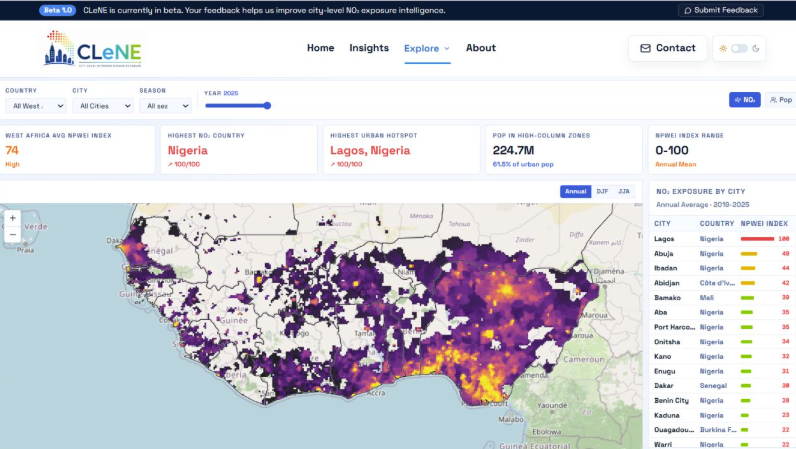
Known as the City-Level Nitrogen Dioxide Exposure platform, or CLeNE, the application combines satellite observations of nitrogen dioxide with population data and city boundaries to identify areas where elevated pollution overlaps with populated communities.
Its interactive dashboard allows users to explore exposure maps, examine seasonal patterns and compare information across locations and years. The aim is to turn complex satellite data into information that can help authorities identify areas requiring attention and guide further monitoring.
The researchers’ stated ambition to support the Quality of Life Initiative centres on the role of environmental information in improving urban living conditions. Implemented by UN-Habitat, the initiative helps local authorities use data and residents’ experiences to assess well-being and guide investment and policy priorities.
CLeNE addresses a challenge across West Africa, where ground-based air-quality monitoring is limited and unevenly distributed. Its current focus is nitrogen dioxide, a pollutant associated with vehicle exhaust, industrial activity, power generation and the burning of fuels and vegetation.
The published development work used satellite observations from 2019 to 2024 to demonstrate the platform’s approach. Further improvements will incorporate higher-resolution observations, surface nitrogen dioxide data and more detailed information on emissions.
The researchers emphasised that the platform provides comparative estimates of exposure to support environmental assessment and decision-making. Its indicators do not directly measure individual health risks or establish whether air-quality standards have been breached.
The team led by Dr. Prince Junior Asilevi, comprises Alex Kwao Ablerdu and Prof. Emmanuel Quansah of KNUST’s Department of Meteorology and Climate Science, and Stephen Amankwah of the Ghana Meteorological Agency.
The study documenting the platform’s development was published in Discover Environment on October 10, 2026.
Readers can explore CLeNE at https://no2exposure.netlify.app/. The research team is continuing to refine the platform and expand its capabilities.


