
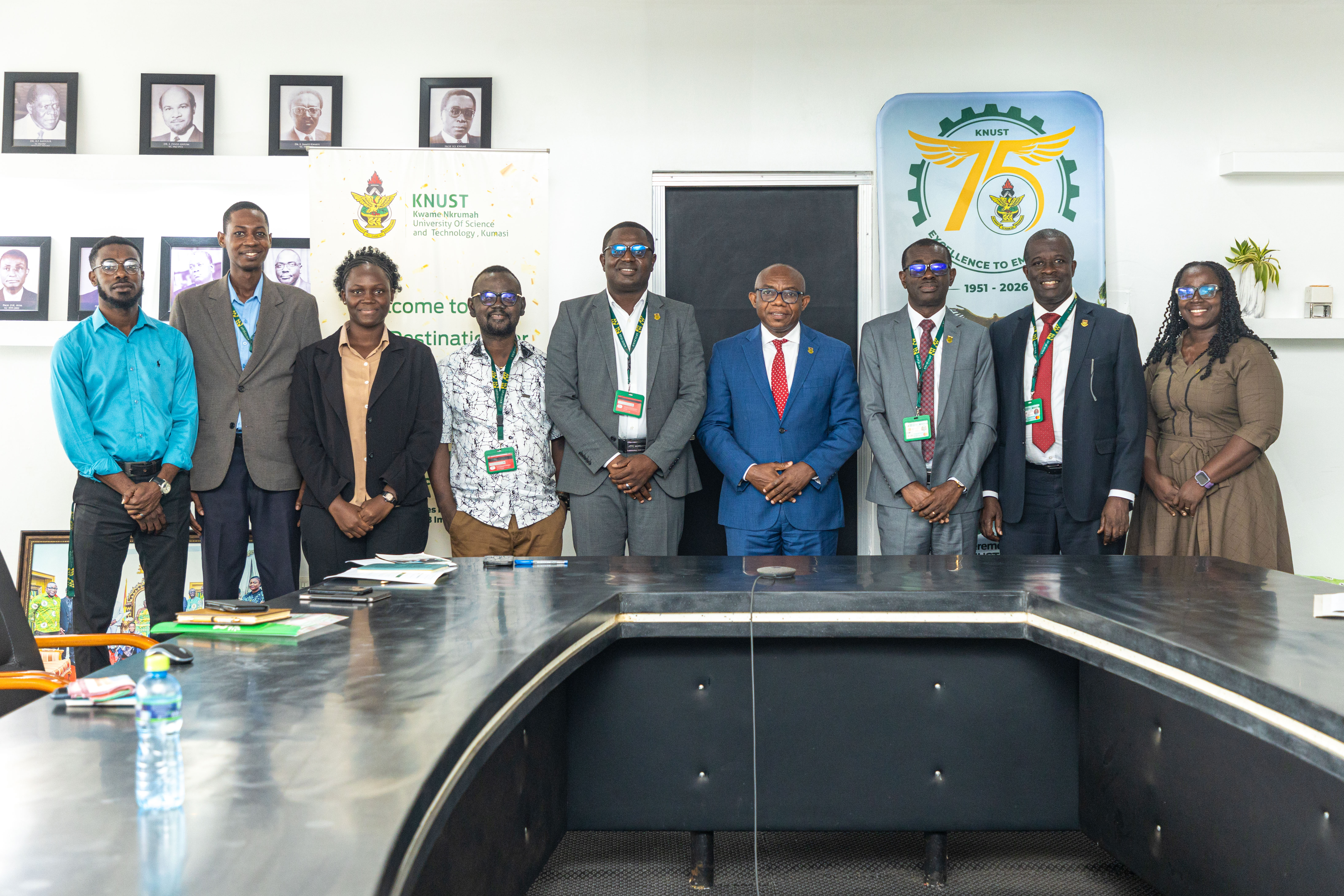
The Kwame Nkrumah University of Science and Technology, Kumasi (KNUST) has approved the expansion of its Net-Zero Emissions Project across the University, paving the way for its first comprehensive system to measure, monitor and manage greenhouse gas emissions.
Phase II of the KNUST Net-Zero Emissions Project (KNEP), expected to commence in September 2026, will cover all six Colleges as well as relevant administrative, residential and operational units. The project is expected to produce KNUST’s first University-wide carbon emissions dashboard in 2027.
Led by the College of Engineering through the Net-Zero Carbon Emissions Laboratory (NCEL), the project will establish a verified baseline of emissions from University operations and develop a costed roadmap to guide KNUST towards its long-term net-zero ambitions.
The expansion follows the completion of Phase I at the College of Engineering, where researchers developed a greenhouse gas inventory covering Scope 1, Scope 2 and Scope 3 emissions in accordance with the internationally recognised Greenhouse Gas Protocol.
The assessment covered electricity and fuel consumption, refrigerants, transportation, commuting, procurement and waste, and resulted in the development of a digital emissions dashboard for monitoring and decision-making.
Phase II will apply the approach across KNUST, covering facilities, energy use, transportation, employee and student commuting, procurement, residential halls, waste management and other institutional activities. Carbon sinks and relevant environmental assets will also be mapped where appropriate.

Dr. Yen Adams Sokama-Neuyam, Principal Investigator of KNEP and Scientific Director of NCEL, said the project was intended to move the University beyond sustainability commitments towards measurable action.
“The most important outcome of KNEP is not simply knowing KNUST’s carbon footprint. It is establishing a credible institutional system that allows the University to measure progress, identify priority interventions, monitor its performance over time, and make sustainability decisions based on evidence,” he said.
Under Phase II, Carbon Focal Persons will be appointed across Colleges, Directorates, Halls of Residence and relevant administrative units to support the collection and verification of data for annual greenhouse gas reporting.
NCEL will provide technical leadership in carbon accounting, greenhouse gas measurement, reporting and verification, emissions monitoring and management of the University's carbon dashboard. Sustainability reporting and international ranking functions will be coordinated through the University's institutional planning structures.
By the end of the project, KNUST expects to have an independently verified University-wide Scope 1–3 greenhouse gas inventory, a publicly accessible emissions dashboard, a costed net-zero roadmap and a system for routine emissions monitoring and reporting.
Dr. Sokama-Neuyam said the University-wide exercise would also generate research data that could help develop approaches to institutional carbon accounting suited to Ghana and other environments where emissions data are limited.
The project supports KNUST's PLAN 2K35, particularly its focus on data-driven governance, measurable sustainability performance and the development of a smart and green campus.
The resulting data and reporting framework are also expected to strengthen the University's submissions to international sustainability assessment platforms, including the Times Higher Education Impact Rankings and UI GreenMetric, from 2028.
KNEP Phase II is expected to run through 2027.


