
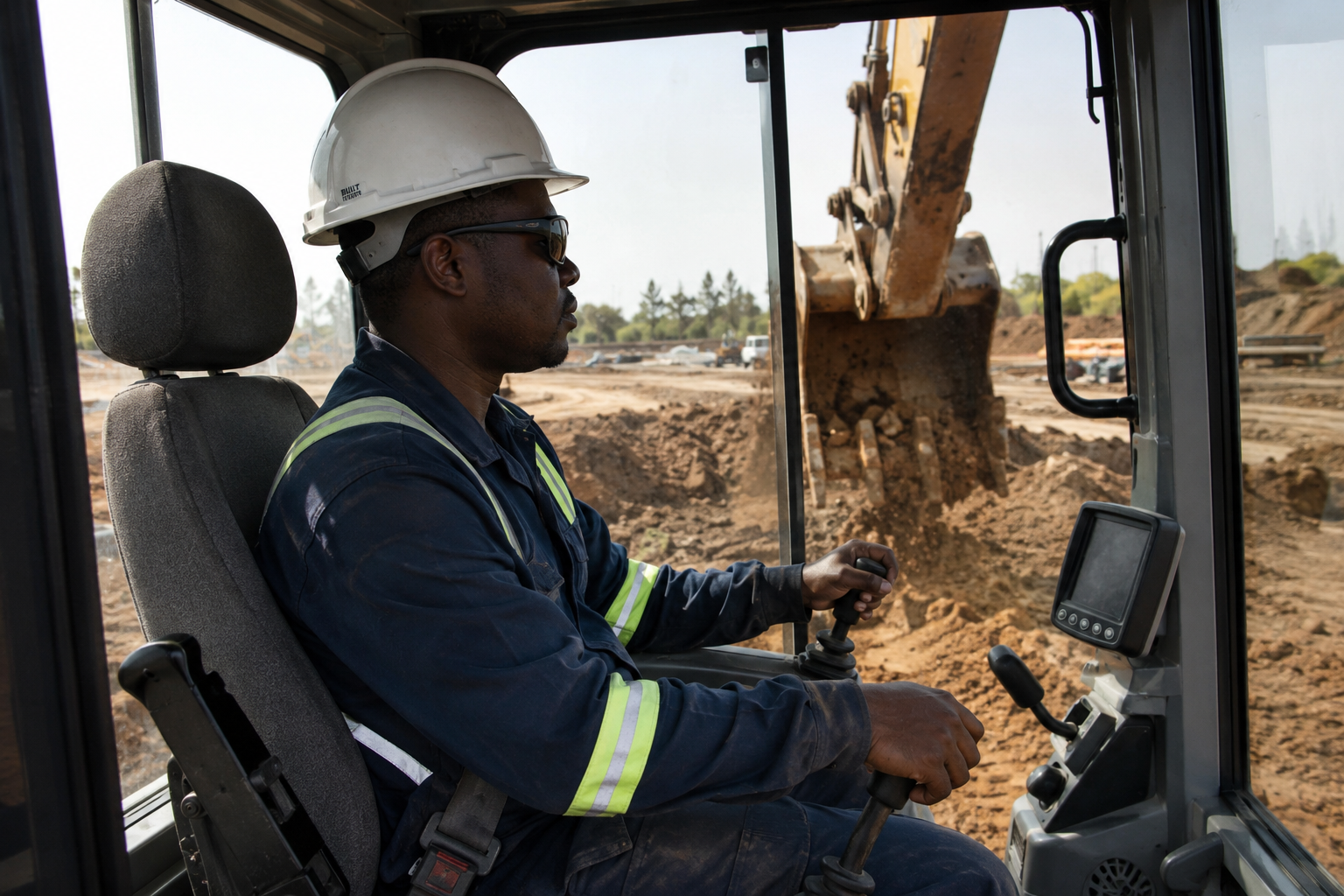
As Ghana accelerates infrastructure development, we must pay greater attention to the safety and condition of the heavy machines and the people operating them.
Every day, across Ghana, massive machines move the earth that becomes our roads, drains, bridges, schools, hospitals, housing projects, and other infrastructure.
The excavators digging trenches. The bulldozers clearing land. The graders shaping our roads. The trucks moving mountains of material. The rollers compacting the ground.
We see these machines everywhere, particularly as construction activity expands across the country.
But behind every machine is a human being.
And that raises a question we need to ask more seriously:
Are we doing enough to protect the people sitting inside these machines?
Ghana's construction industry is one of the country's high-risk working environments, and heavy equipment is an important part of that risk. Operators and other workers can be struck by moving machinery, trapped between equipment and fixed objects, crushed by overturned machines or exposed to hazards associated with excavation and earthworks.
But there is another danger that receives far less attention. Sometimes, the danger is inside the machine itself.
The cabin matters
Imagine spending eight or more hours in a machine cabin with a damaged or uncomfortable seat, excessive heat, constant vibration and noise, poor ventilation and limited visibility.
Imagine operating a several-tonne excavator while struggling to see clearly around the machine because mirrors, windows or cameras are inadequate.
Imagine working in a cabin where an alarm does not function properly or where a seatbelt is damaged.
These may sound like minor inconveniences. They are not.
Operating earthmoving equipment requires constant concentration, good judgement and awareness of what is happening around the machine. Poor cabin conditions can contribute to fatigue, discomfort and reduced attention. Excessive heat, noise and vibration, poor air quality and inadequate ventilation can further affect concentration and situational awareness.
And when concentration and judgement are compromised, the consequences can be serious.
A machine operator does not get the luxury of saying, “I can't concentrate today; I'll continue tomorrow.” The machine is already moving. Workers may be walking nearby. Materials are being lifted, excavated or transported. The margin for error is small.
There is no doubt that the quality and availability of plant and machinery in Ghana's construction sector have improved over the years. Newer and more modern equipment is increasingly being used on construction projects.
The growth of equipment from non-OECD countries, including China, India and the Gulf States, has contributed to this development, with China playing a particularly significant role in supplying new plant and machinery.
Government programmes have also created significant demand for construction equipment.
A good example is the District Road Improvement Programme (DRIP), under which the Government of Ghana acquired 2,240 units of road equipment including motor graders, backhoes, rollers, wheel loaders, bulldozers, water tankers, concrete mixers, tipper trucks, low beds and other machinery for distribution to Metropolitan, Municipal and District Assemblies (MMDAs).
This is a positive development. But alongside the new equipment, anecdotal evidence suggests a large number of second-hand, and sometimes third-hand, machines continue to operate on construction sites across the country.
And this is where we need to have an honest conversation.
There is nothing inherently wrong with using second-hand equipment. A properly maintained older machine can still do an excellent job.
The problem is when age becomes an excuse for neglect.
An old machine that is imported, deployed and operated without proper inspection, refurbishment, upgrading and safety verification can become a serious risk to its operator and others on the site.
We cannot continue with a mindset that says a machine is fit for work simply because the engine starts and the machine moves.
A machine can be mechanically operational and still be unsafe.
A working machine is not necessarily a safe machine
A cracked or obstructed windscreen, defective seatbelt, poor lighting, damaged seat, inadequate ventilation, excessive cabin noise, missing mirrors, defective alarms or malfunctioning safety systems should not be dismissed as minor problems.
They are warning signs.
Construction companies are often understandably concerned about engines, hydraulics, tyres and other mechanical components because equipment breakdown means lost time and money.
But the operator's cabin deserves the same attention.
What is the condition of the seat? Can the operator see properly? Is the cabin adequately ventilated? Is the temperature tolerable? Are the warning systems working? Is the seatbelt functional? Are the mirrors and cameras providing adequate visibility?
These questions should become part of routine equipment inspections.
The person inside the machine is just as important as the machine itself.
Second-hand should not mean second-rate safety
If Ghana is going to continue relying significantly on second-hand earthmoving equipment, then we must ensure that second-hand does not mean second-rate safety.
Imported equipment should meet clearly defined safety requirements before being put to work.
Where necessary, machines should be refurbished or retrofitted with appropriate safety features.
An older excavator, for example, may benefit enormously from upgraded mirrors, cameras, alarms, lighting, improved seating or other appropriate safety technologies.
We should also consider whether equipment being deployed on major public projects meets minimum safety requirements before it is allowed onto the site.
Availability should never be the only qualification for putting a machine to work.
Technology can help but people remain at the centre
Modern earthmoving equipment increasingly comes with technologies designed to improve safety and operator awareness.
Cameras, proximity sensors, warning systems, monitoring devices and other technologies can provide operators with information that may help them identify hazards and make better decisions.
We should therefore embrace appropriate safety technologies rather than treating them as unnecessary extras.
But technology is not a substitute for people.
Better machines alone will not solve the problem.
Operators need proper training in safe operating procedures, equipment inspection, cabin conditions and the use of safety technologies. They need appropriate breaks and a working environment that supports, rather than undermines, safe decision-making.
If we want safer behaviour from operators, we must create conditions that make safe behaviour possible.
We cannot demand extraordinary concentration from a worker while giving that worker an unsafe working environment.
Safety is not a cost; it is an investment.
There is sometimes a tendency to see safety improvements as an additional cost, particularly in an industry where contractors are already under pressure to deliver projects within tight budgets and deadlines.
That thinking needs to change.
An accident can cost far more than preventive maintenance.
There are medical expenses, compensation, legal costs, damaged equipment, project delays, downtime, insurance implications and lost productivity. Most importantly, there is the human cost, which cannot always be measured in cedis.
A safer machine can also be a more productive machine.
Safety and productivity are not enemies.
A well-maintained machine operated by a well-trained worker in a properly designed and maintained cabin is likely to perform better, more reliably and more safely.
What should Ghana do?
This is where policy and enforcement become important.
First, Ghana needs clearer and more comprehensive standards for earthmoving equipment cabins. Safety requirements should address visibility, seating, lighting, ventilation, noise, vibration, protective structures, seatbelts, communication systems and other essential features.
Second, equipment should be inspected and certified before deployment and periodically thereafter. An excavator, bulldozer or grader should not enter a construction site simply because it is available.
Third, there should be minimum safety requirements for imported second-hand equipment. Where necessary, older machines should be refurbished or retrofitted before they are deployed.
Fourth, cabin maintenance should become part of routine equipment maintenance. Contractors and equipment owners should not wait until an accident occurs before repairing a defective seat, mirror, alarm, window or safety system.
Fifth, the use of appropriate safety technology should be encouraged, particularly on high-risk operations. Cameras, proximity sensors, alarms and monitoring systems can provide an additional layer of protection.
Sixth, operator training and certification must be strengthened. Operators should not only know how to operate a machine; they should understand how cabin conditions, fatigue, visibility, environmental factors and safety systems affect their ability to operate safely.
Finally, and perhaps most importantly, these requirements must be enforced.
If public money is being used to build roads, schools, hospitals, bridges and other infrastructure, safety requirements for the machinery used on those projects should be an integral part of the procurement and contract-management process.
Contractors should be required to demonstrate that equipment deployed on public projects meets defined safety standards, with regular inspections and meaningful action where standards are not met.
We should not build public infrastructure at the expense of workers' lives.
The person behind the machine
This is not an argument against construction or against the use of heavy equipment.
Quite the opposite.
Ghana needs more infrastructure. We need better roads, improved drainage, housing, schools, hospitals and other public facilities.
But development must not come at the expense of the people who make that development possible.
Every excavator operator, bulldozer operator, grader operator, loader operator and other heavy-equipment operator is a human being not simply another component of a construction project.
They deserve a seat that protects them.
They deserve clean air.
They deserve reasonable temperature and noise conditions.
They deserve adequate visibility.
They deserve functioning alarms and communication systems.
They deserve properly maintained equipment.
And, most importantly, they deserve to return home safely after every shift.
Ghana's infrastructure development should not be measured only by how many kilometres of roads we build, how many bridges we complete or how many buildings we put up.
It should also be measured by how well we protect the people who build them.
The machines moving Ghana forward should not be putting Ghanaian workers at unnecessary risk.
The technology is available. The knowledge is available. The policy tools can be developed.
What is needed now is the commitment to act.
It is time to put the safety of earthmoving equipment and the people who operate them firmly on Ghana's construction and policy agenda.
The author, Emmanuel Adinyira, is a Professor of Construction Project Management at KNUST, Kumasi, Ghana. He is a Fellow of the Ghana Institute of Construction, a Fellow of the Occupational Safety and Health Association, UK (FOSHA-UK), a Professional Member of the Ghana Institution of Surveyors, and a Professional Engineering Technologist with the Institution of Engineering and Technology, Ghana


