
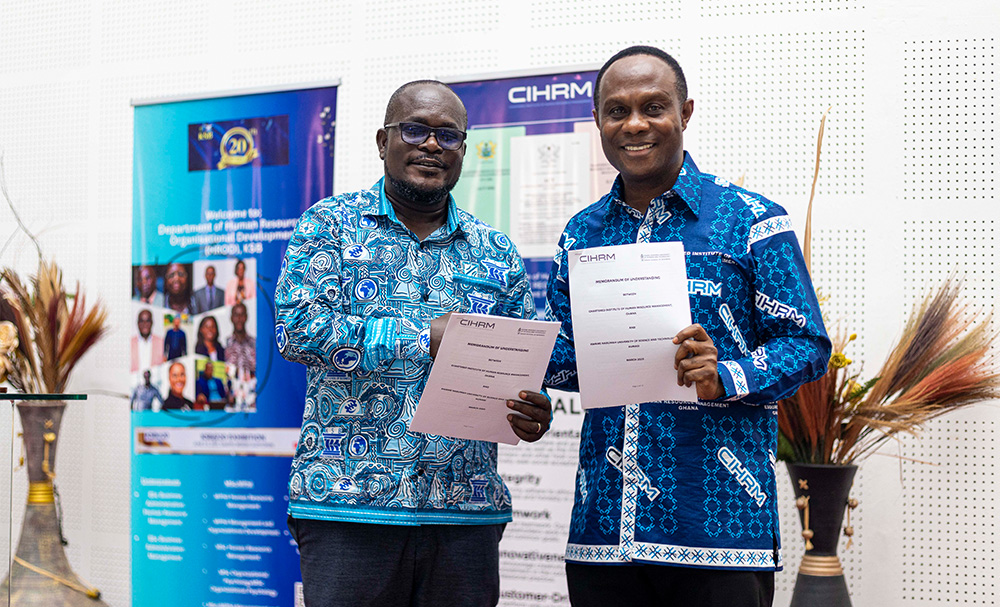
The Department of Human Resource Management and Organisational Development at the KNUST School of Business (KSB) has signed a memorandum of understanding with the Chartered Institute of Human Resource Management (CIHRM) aimed at strengthening professional training and certification for students.
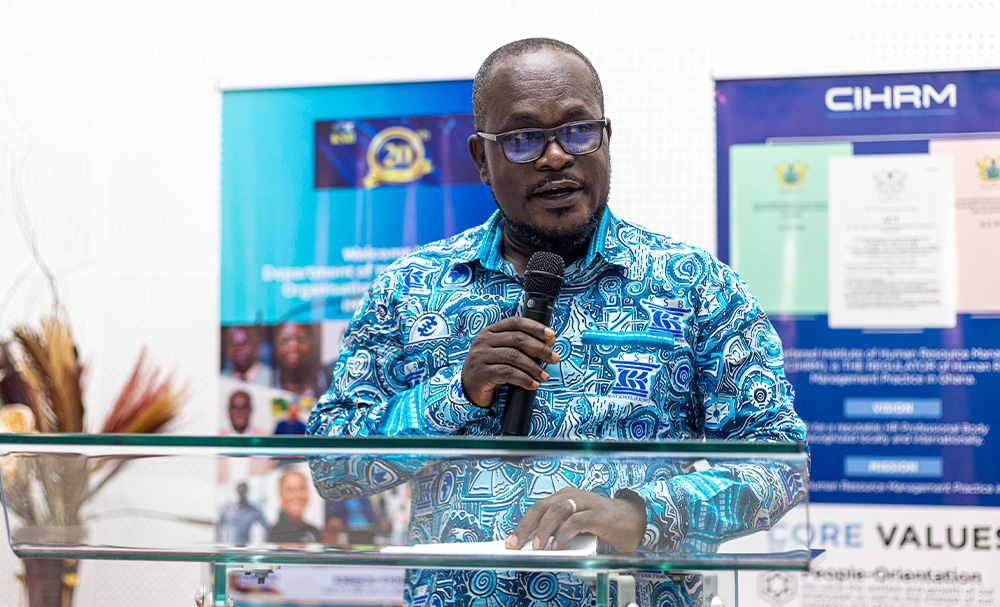
Professor Henry Kofi Mensah, Head of Department, described the agreement as a strategic milestone.
“Today, we are not merely signing a document; we are institutionalising a bridge between academic preparation and professional competence,” he said. “As we sign this MOU today, we affirm a shared commitment: to strengthen the HR profession in Ghana, to deepen academic-industry integration, and to produce practitioners who will shape resilient, ethical, and high-performing organisations.”
Professor Mensah said modern organisations require HR professionals who understand workforce analytics, labour regulation, organisational transformation, ethics and ESG imperatives.
“Universities must produce graduates who are not only theoretically grounded but professionally certified, practice-ready and globally competitive,” he stressed, adding that the partnership directly responds to that obligation.
“Through this MOU, our students will gain structured access to professional certification pathways while still in training,” he said. “This alignment ensures that upon graduation, they do not merely hold academic degrees; they possess recognised professional credentials anchored in national standards and global HR benchmarks.”
He noted that the partnership advances three key priorities for the department: curriculum alignment with professional standards, enhanced professional socialisation and ethical formation, and improved employability and competitiveness in the labour market.
“This agreement demonstrates trust in our academic processes, our students, and in shared purpose,” he said, expressing appreciation to CIHRM’s leadership. Addressing students, he added: “Certification is not ceremonial; it requires discipline, competence, and ethical commitment. You must earn it.”
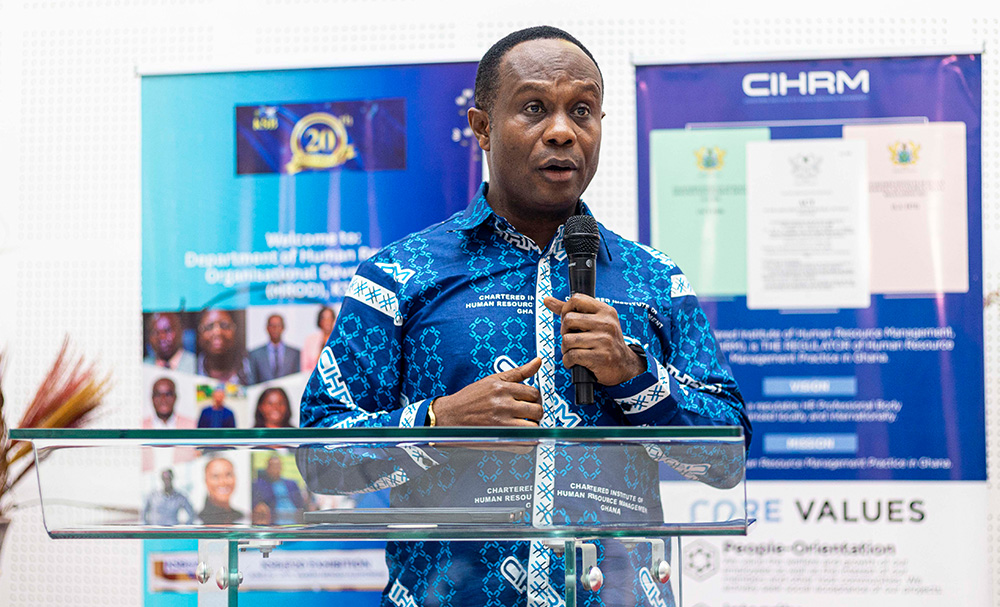
Chief Executive Officer of CIHRM, Dr. Francis Eduku, traced the evolution of the Institute from its establishment in 1978 to the attainment of Chartered status in 2020 under legislation. He described the charter as “a turning point in the history of the Institute,” giving stronger regulatory backing to the HR profession in Ghana.
“The days of unregulated HR activities in this country are over. No non-compliance will be permitted going forward,” Dr. Eduku said, noting that the Institute has issued public notices requiring practitioners to regularise their membership and certification status.
He underscored the central role of human resource management in national development.
“Buildings do not manage themselves. Technology does not coordinate itself. It is people properly aligned and strategically managed who drive organisational success,” he said. “We are not just signing a piece of document; we are making a commitment to raise the standard of HR education in this country and to protect the dignity of workers.”
Dr. Eduku said the agreement helps address longstanding gaps between academia and industry.
“The problem is the distance between academia and industry. Today, we are closing that distance through this strategic partnership,” he said.
Under the agreement, CIHRM will provide accreditation support, governance guidance and industry expertise across programmes within the Business School, from undergraduate to doctoral levels. The Institute will also facilitate internships, practitioner series, mentorship engagements and broader professional integration for students and staff.
“With this properly implemented, your students will graduate with more than academic knowledge. They will graduate with professional identity and practical competence,” Dr. Eduku said. “They will not just seek jobs; they will be prepared for the market and to create value for organisations.”
He encouraged students to recognise the importance of the profession.
“You are entering a profession that is respected and essential to national development,” he said, urging them to pursue excellence.
The Institute also announced upcoming campus engagement programmes, career fairs, practitioner series and mentorship initiatives designed to connect students directly with industry leaders.
Dr. Eduku acknowledged the roles played by Professor (Mrs.) Rosemary Boateng Coffie and Professor Henry Kofi Mensah in bringing the partnership to fruition.
By: Abigail Ofori


