
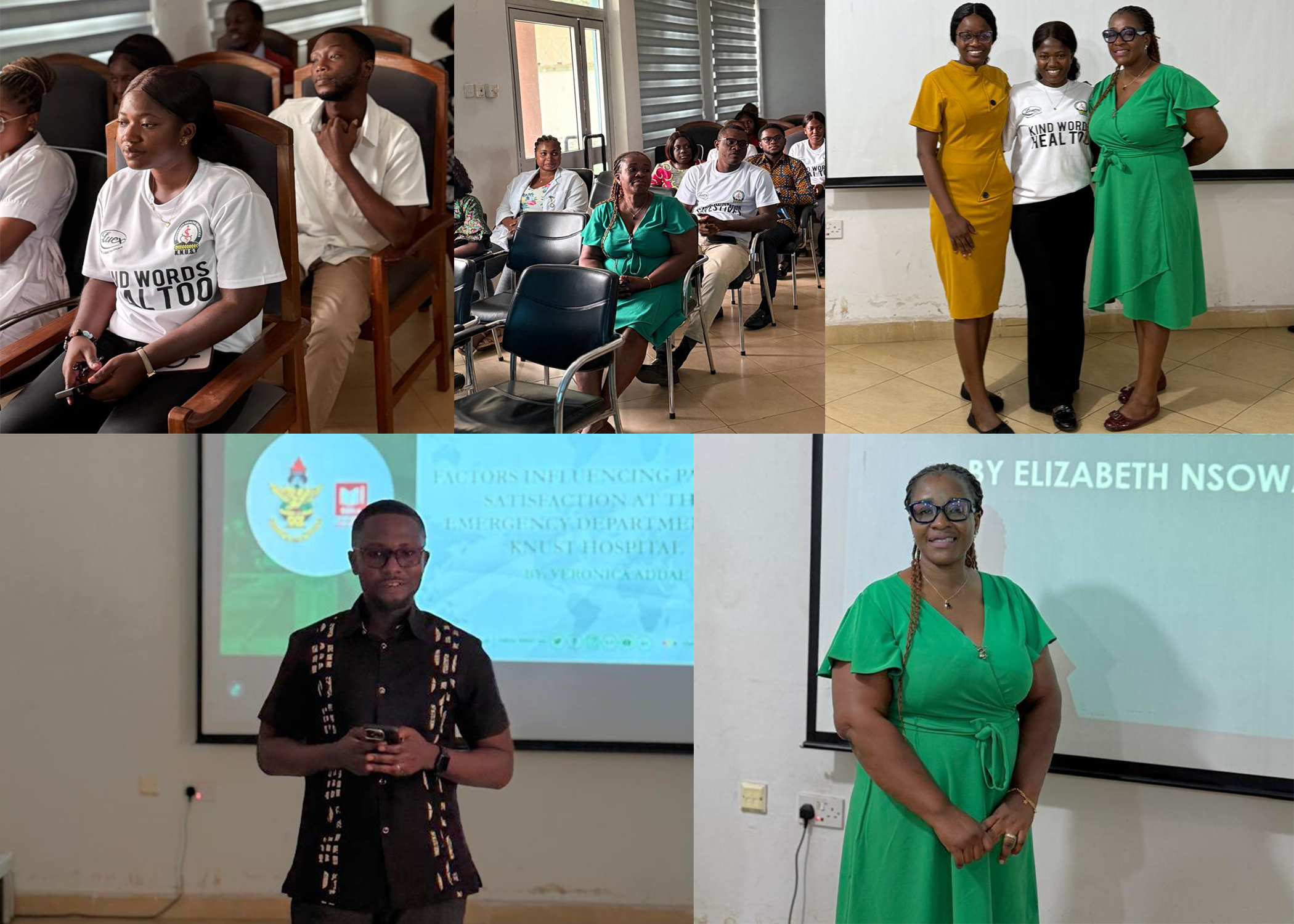
The University Health Services (UHS) of the Kwame Nkrumah University of Science and Technology, Kumasi (KNUST) has hosted a Research Dissemination Forum aimed at strengthening stroke management, improving HIV prevention strategies and enhancing patient satisfaction in emergency care.
The forum featured presentations by three hospital-based researchers whose studies addressed critical gaps in clinical care and service delivery.
Delivering the welcome address, Mr. Julius Kwabena Karikari, Head of the Records Unit and Project Administrator for the Antimicrobial Stewardship (AMS) Implementation Programme, underscored the hospital’s dual role as a healthcare provider and research hub.
“A hospital is more than a place where patients receive treatment,” he said. “It is also a space where knowledge is created, shared, and used to improve the lives of the communities we serve.”
He noted that the University Hospital takes pride in being selected by medical students and researchers as a training and research site, describing it as both a privilege and a responsibility.
“When students and researchers choose our facility as their training ground, we have a duty to support them,” he added.
Karikari said findings from the studies presented are expected to guide policy decisions, improve service delivery and address gaps in patient care.
Ms. Veronica Addae, a contract Senior Administrative Assistant, presented findings on factors influencing patient satisfaction in the hospital’s emergency unit, describing satisfaction as a key indicator of healthcare quality.
“Patient satisfaction is not just about comfort,” she said. “It reflects the effectiveness, responsiveness, and overall quality of care provided to patients.”
She explained that the cross-sectional study, conducted at the KNUST Hospital emergency department, assessed overall satisfaction levels and identified areas requiring improvement. While emergency departments play a critical role in saving lives, she noted that evidence on patient satisfaction in emergency settings remains limited.
The study sought to evaluate influencing factors, measure overall satisfaction and pinpoint service gaps for targeted reforms.
Mrs. Elizabeth Nsowaa Boateng, Chief Nursing Officer, presented research on awareness and utilization of post-exposure prophylaxis (PEP) among healthcare students.
She noted that although awareness of PEP is high, significant gaps remain in access, utilization and institutional support.
“I realized that most healthcare students are placed in high-risk environments before they fully understand how to assess and respond to exposure,” she said. “We talk a lot about awareness, but awareness alone does not guarantee action.”
Boateng highlighted that an estimated 28 million people globally are living with HIV, with sub-Saharan Africa bearing the greatest burden. PEP, she explained, is an emergency HIV prevention method that must be started as soon as possible, ideally within hours and no later than 72 hours after exposure.
“Treatment alone is insufficient in ending the epidemic,” she stressed. “Prevention strategies such as PEP are critical, especially for students and healthcare workers who face occupational risks.”
Another presentation by researcher Mercy Addae revealed that more than half of stroke survivors receiving outpatient care are living with frailty, signalling the need to expand stroke management beyond medication and blood pressure control.
The 10-month study, conducted across four specialized outpatient stroke clinics in Ghana, assessed 200 adults aged 18 and above with confirmed stroke diagnoses. Researchers examined frailty as a multidimensional condition encompassing physical, psychological and social health.
According to the findings, 57.2% of participants were classified as frail, with an additional proportion identified as pre-frail. The prevalence, she noted, mirrors findings from studies conducted in the United Kingdom and China.
“Stroke management must go beyond stabilizing blood pressure and prescribing medication,” she said.
Director of the University Hospital, Dr. Nana Kwame Ofori Ayisi-Boateng, emphasized the importance of translating research into practice to enhance patient outcomes and satisfaction.
He urged stakeholders to ensure that findings from the forum are implemented to drive measurable improvements in service delivery.
By: Alice Laura Kyerewaah Prempeh & Ama Pokuaa Mensah


