
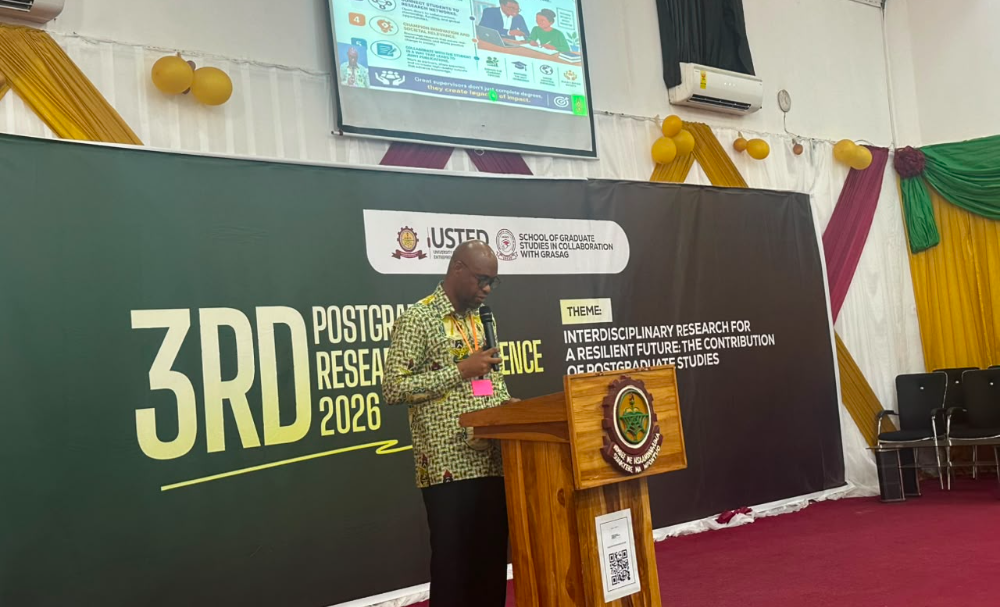
Professor Emmanuel Adinyira, Dean of the Faculty of Built Environment (FoBE) at the Kwame Nkrumah University of Science and Technology (KNUST), has urged universities to measure postgraduate research by its impact on society rather than the volume of academic output, calling for stronger collaboration among academia, industry, government and communities to address real-world challenges.
Delivering the keynote address on the second day of the 3rd USTED Postgraduate Research Conference, held under the theme, "Interdisciplinary Research for a Resilient Future: The Contribution of Postgraduate Studies," Professor Adinyira said postgraduate research must be purpose-driven, collaborative and focused on delivering tangible benefits beyond the university.
Speaking on the topic, "Shared Responsibility, Shared Future: Rethinking the Purpose and Impact of Postgraduate Research," he said that while interdisciplinary research has become increasingly important, the future lies in transdisciplinary research, which actively brings together researchers, industry, policymakers, governments, practitioners and communities to co-create solutions to complex societal problems.
Professor Adinyira described postgraduate research as society's investment in a better future, noting that its benefits extend beyond the university by strengthening students' research capacity, improving supervision and scholarly collaboration, producing a highly skilled workforce and enhancing the visibility and competitiveness of universities.
He said the shared benefits of postgraduate research require shared responsibility from all stakeholders.
"Shared benefits require shared responsibility. If everyone benefits from postgraduate research, then everyone has a role to play in making it successful," he said.
Professor Adinyira identified postgraduate students, supervisors, universities, industry and government as critical partners in building a research ecosystem capable of addressing national and global development priorities.
He called on universities to foster collaboration instead of unnecessary competition, share research resources, align research with national development priorities and society's most pressing needs, and evaluate research based on its societal impact rather than publication output.
"The future belongs to postgraduate research that moves beyond the university campus and into the communities we serve. Impact, not output, should become the defining measure of our success," he said.
He concluded by urging universities to adopt a vision of postgraduate research that is collaborative, inclusive, ethical and transdisciplinary, arguing that such an approach is essential for driving innovation, informing policy, supporting sustainable development and building resilient societies.


