
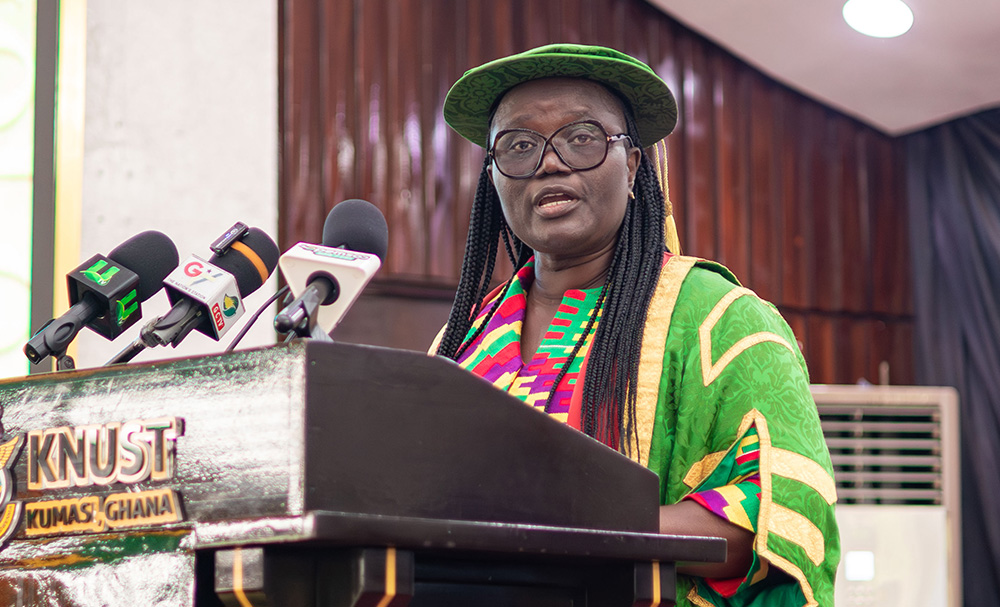
On a day layered with ceremony and transition, the Vice-Chancellor of the Kwame Nkrumah University of Science and Technology, Kumasi (KNUST), Professor (Mrs) Rita Akosua Dickson, marked her final congregation with a message shaped as much by reflection as by symbolism.
Clad in Kente that reflected the hues of the university’s colleges and directorates, she stood before the graduating class in a fabric long understood within African textile traditions as a visual language of leadership and continuity
The cloth’s interlocked, rectangular patterns, repeated yet varied, offered a fitting parallel to a tenure built in segments but held together by a shared institutional vision.
“Serving in this capacity… and providing leadership, guidance and direction to this great and noble university has been one of the greatest honours of my life. I am profoundly grateful,” she said.
Her remarks at the 59th Special Congregation echoed a broader tradition in leadership studies within Organizational Leadership, where legacy is often defined not by singular achievements but by the systems, people and structures sustained over time. In that sense, her gratitude extended beyond formality.
She paid tribute to the Chancellor, Otumfuo Osei Tutu II, citing his consistent presence at congregations and his role in anchoring the university’s ceremonial and strategic direction.
“You have never missed a single congregation… your deep love and commitment to the growth and improvement of the university is indeed admirable,” she said.
From there, her reflections moved across the university in deliberate layers, Council, past Vice-Chancellors, faculty, staff, alumni, partners and students, each group forming part of what scholars of Institutional Development often describe as the “distributed architecture” of a university’s progress.
Together, she said, they had built an institution grounded in innovation, creativity, inclusiveness, sustainability and excellence.

Like the geometry of Kente, that progress did not unfold in a single sweep. It emerged in steps.
Academic programmes strengthened.
Research output expanded.
Infrastructure improved.
Digital systems deepened.
Entrepreneurial pathways opened.
Each advance was distinct yet connected, mirroring what analysts in Systems Thinking identify as cumulative institutional growth.
Between November 2025 and March 2026, KNUST secured more than $2.3 million in competitive research funding, a figure that reflects international engagement and rising confidence in the university’s research capacity.
Indeed, behind the number lies a familiar pattern in global higher education, proposals developed, partnerships negotiated and research positioned within broader development goals.
The funding includes several faculty-led projects and KNUST’s participation in a £20 million climate and health research initiative supported by the Wellcome Trust, reinforcing the university’s role in advancing interdisciplinary research in West Africa.
The congregation itself provided a statistical snapshot of that growth. A total of 8,377 students graduated during the 2025/2026 Special Congregation, comprising 5,241 postgraduate and 3,137 undergraduate students. Seventy-one candidates earned PhDs, including 28 women, reflecting gradual progress in gender representation within advanced research training, a subject often examined within Higher Education Studies.
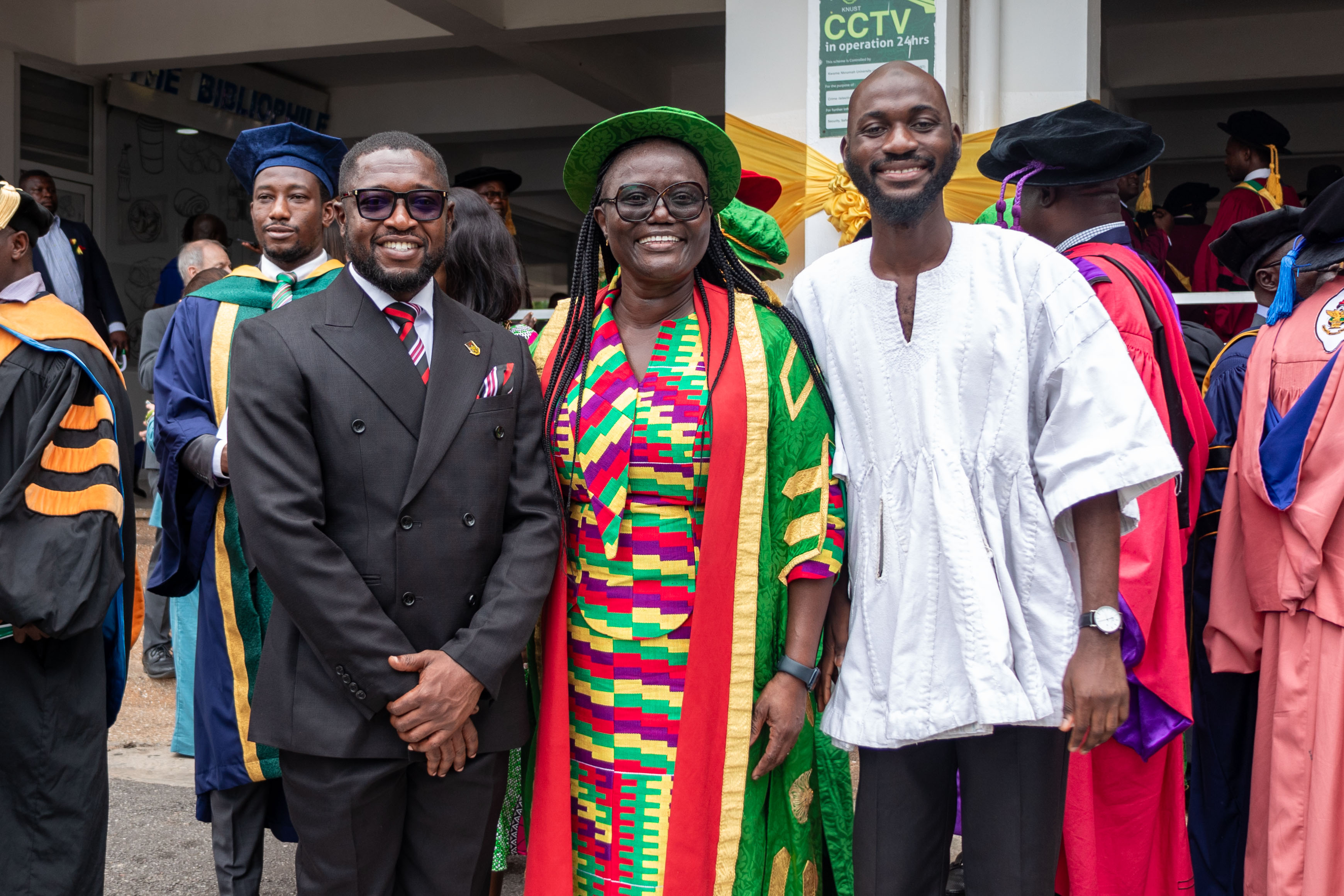
To the graduating class, her message was direct.
“Your education must translate into innovation and solutions to the many challenges facing our nation and beyond,” she said.
Her closing remarks turned to the future, referencing plans for the university’s 75th anniversary, an institutional milestone that, within University History, often serves as both a moment of reflection and strategic reset.
A planning committee chaired by a former Vice-Chancellor has been constituted to oversee activities marking the anniversary, with a focus on celebrating achievements while reinforcing commitments to teaching, research and community service.
In the end, her tenure, like the cloth she wore is layered, patterned and cumulative, where each contribution forms part of a broader institutional design.
| Story: Abigail Ofori | Alice Laura Kyerewaah Prempeh | Emmanuel Kwasi Debrah | Photos: Michael Kwawu |


