
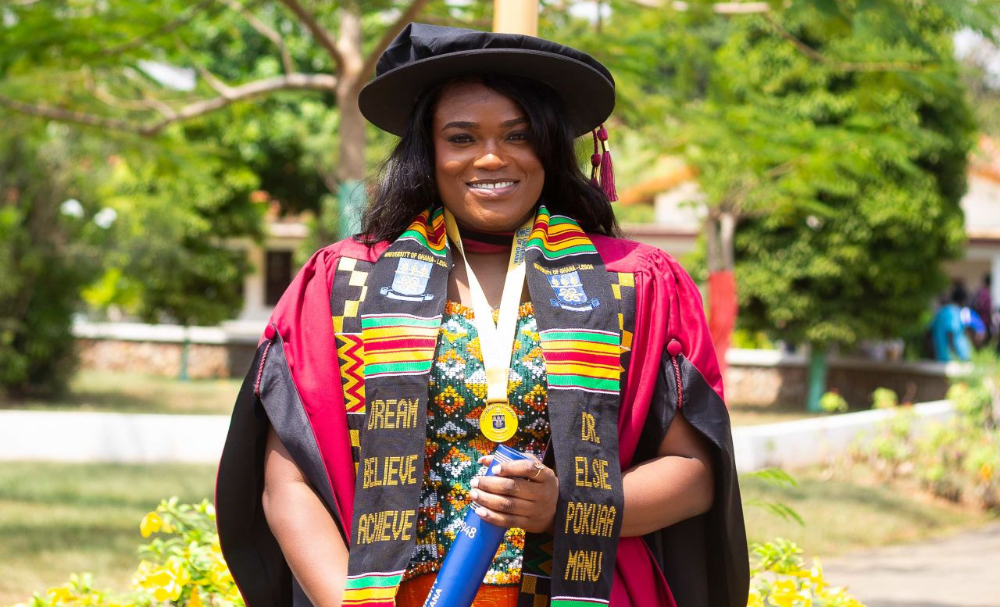
A distinguished alumna of the Kwame Nkrumah University of Science and Technology, Kumasi (KNUST), now a Captain in the Ghana Armed Forces, has earned a Doctor of Philosophy (PhD) degree after navigating years of military promotions, international deployment and a global pandemic.
Captain Elsie Pokuaa Manu, who completed her undergraduate studies in Political Studies at KNUST in 2013, later obtained an MPhil in Human Rights from the University of Education, Winneba (UEW) in 2016. In 2024, she completed her PhD in Political Science at the University of Ghana, graduating formally this year.
She began her doctoral journey as the only woman in a class of eight men, balancing the pressures of proving herself in a male-dominated academic environment with the demands of military service.
Weekdays were devoted to national duty, while weekends were spent teaching and conducting research. Rest, she recalls, became a luxury.
“In spaces where I often stood alone, resilience became a necessity,” she said.
While managing lectures and research deadlines, she prepared for and passed her promotional examinations from Lieutenant to Captain. She subsequently undertook the Elsie Initiative Cadre at the Ghana Armed Forces Command and Staff College and later attended a course at the Kofi Annan International Peacekeeping Training Centre, each milestone adding to an already rigorous schedule.
When the COVID-19 pandemic disrupted academic life globally, her doctoral studies at the University of Ghana faced fresh uncertainty. Virtual lectures, delayed supervision and restricted access to research resources became the norm.
“Through virtual platforms and collective perseverance, we continued,” she reflected.
Amid the pandemic, she again sat for promotional examinations, advancing from Captain to Major. Soon after, she completed the Young Officers Course, a six-month combat tactical programme that tested her physical endurance, mental strength and emotional stability.
Another course followed, and she was subsequently selected for deployment to Lebanon under a United Nations peacekeeping mission. Months of pre-deployment training preceded the assignment.
Barely a month into her tour, tensions between Israel and Palestine escalated, drawing Lebanon into heightened instability. For peacekeepers on the ground, uncertainty became routine. Long hours in bunkers, limited communication with loved ones and constant vigilance defined daily life.
“Even while seated on what felt like a powder keg, I refused to let go of the dream I had begun years earlier,” she said.


