
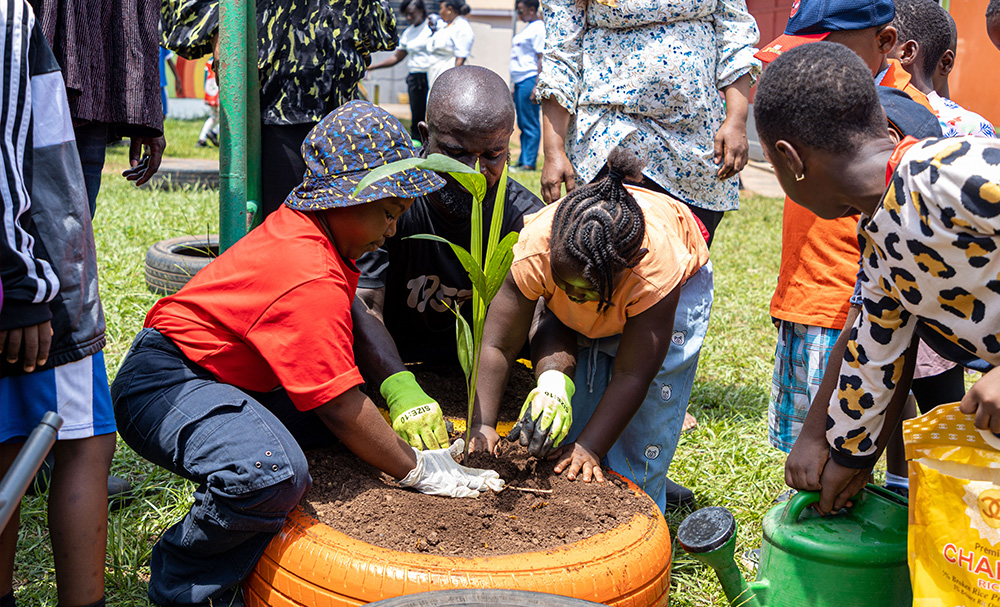
The KNUST Preschool has concluded its Plants for Life project, a month-long initiative held throughout May to promote environmental awareness, food security and sustainable agriculture among pupils.
The project featured a series of educational activities and presentations by resource persons from various departments of the University, aimed at exposing pupils and staff to the importance of plants in everyday life and environmental sustainability.

Mr. Edward Owusu Tenadu, Patron of the Green Club at the KNUST Basic School, educated the pupils on the vital role plants play in supporting life and maintaining ecological balance.
“Plants give us food, plants give us air. Let’s plant a tree today. Let’s show nature that we care,” he said.
As part of efforts to promote nutrition and healthy eating, Ms. Jacqueline Amo-Mensah of the Department of Food Science taught the pupils how plants serve as a major source of food for humankind. She explained how various plant-based foods provide essential nutrients required for growth and development.

Dr. Bernard Kofi Turkson, Head of the Department of Herbal Medicine, explained how plants are processed into various forms of medication and their role in healthcare delivery.
“Plants contain phyto constituents, which are the medication in plants that are used for treatment,” he said.
Dr. Turkson cautioned the pupils against consuming unknown plants, noting that some species can be poisonous. He also advised that although ginger and garlic have numerous health benefits, they should be consumed in moderation.
“Too much of everything is bad. So, not too much garlic, not too much ginger. We should use, but we should use in moderation,” he advised.
Dr. Paul Osei-Tutu educated the pupils on how plants provide shelter, materials and environmental stability. He highlighted various plant-derived materials that contribute significantly to human comfort and well-being.

Mrs. Olivia Ayensu, Deputy Head of Preschool, said the initiative was inspired by both the school curriculum and the rainy season, which provides favourable conditions for planting activities.
“We came up with this plant for life project at the beginning of May because certainly May is a rainy season where most farmers grow plants, and coincidentally in our curriculum we're studying about living and non-living things, as well as you know plants,” she said.
Mrs. Ayensu said the school remains committed to sustaining the project and transforming its green spaces into active learning gardens where pupils can continue to interact with nature.
“We still want to carry it on, we are going to have more gardening. So, we just want to encourage everybody, parents, stakeholders, whoever is interested in gardening, to come down to the preschool and join us to practice gardening and enjoy nature together with these little ones,” she said.
A major highlight of the project was the organisation of a Fruit Day, during which pupils used a variety of fruits to prepare fruit salad, fruit kebabs, fresh fruit juice and other healthy treats. The activity provided a practical learning experience on the nutritional benefits of fruits and healthy eating habits.
The month-long project concluded with the planting of selected trees and other plants within the school compound, reaffirming the Preschool’s commitment to nurturing environmentally conscious learners and fostering a culture of sustainability from an early age.


