
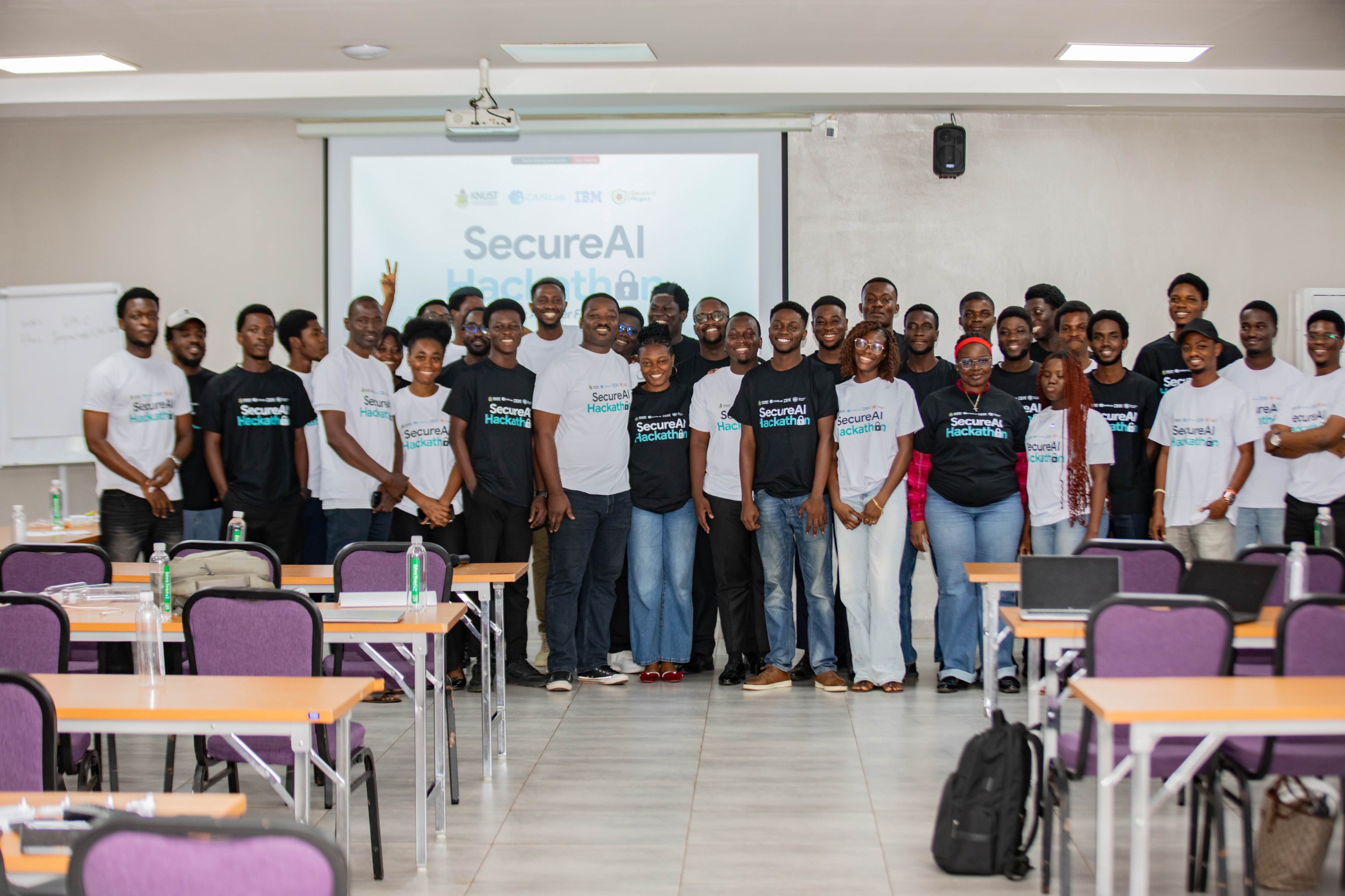
Team Zerooth has won the inaugural Secure AI Hackathon at the Kwame Nkrumah University of Science and Technology, Kumasi (KNUST), receiving US$700 for Guard+, a tool designed to strengthen the security of artificial intelligence assistants.
The team was among 13 finalists in the competition organised by the Cybersecurity and Artificial Intelligence Research Lab (CAIR Lab) at KNUST’s College of Science. Entries were assessed on practicality, potential impact and reliability.
Guard+ is designed to provide an additional layer of protection for AI assistants beyond conventional filters.
Team Athena Techne placed second, receiving US$200 for Athena Shield, a solution designed to protect AI conversations through multiple layers of security.
Team Neuralynx finished third and received US$100 for Ohwefo, an AI security tool designed to understand Ghanaian contexts. The team said “Ohwefo”, a Twi word meaning caretaker, reflected the tool’s protective role.
The hackathon ran over several weeks, bringing together students, developers, researchers and technology enthusiasts from Ghana and beyond to develop tools to help users identify and reduce privacy and security risks when using AI.
Dr. Emmanuel Ahene, a senior lecturer in the Department of Computer Science who leads the CAIR Lab, said the growing use of AI in healthcare, banking, education and public services made security and privacy essential considerations.
“AI is moving from the labs to hospitals, banks, classrooms and even government services. We therefore need to look at how we can make it safer, especially in our working environments and critical infrastructure,” he said.
Ahene said developers needed to ensure that AI models could withstand attacks, protect users’ privacy and operate safely.
The organisers said the competition aimed to produce tools that could be developed for use by industry and public institutions.
“We are not here just to give out money. We want you to give us a product that becomes very useful for the security domain; a product that we can recommend to organisations, government services or institutions,” Ahene said.
The CAIR Lab plans to mentor participants and help them refine their solutions into viable products.
“We hope that after this, we will be able to groom and mentor you and your team to develop this product into something excellent for the industry,” Ahene said.
The organisers also plan to hold the hackathon annually to support the development of technologies that address AI security and privacy risks.


