

Students in Ghana are learning in environments that may be quietly undermining their health, concentration and academic performance, Professor Samuel Amos-Abanyie, a professor of architecture at the Kwame Nkrumah University of Science and Technology has warned, calling for urgent improvements in classroom design and conditions.
He said poor lighting, excessive heat and high noise levels in many classrooms are negatively affecting students’ wellbeing and learning outcomes.
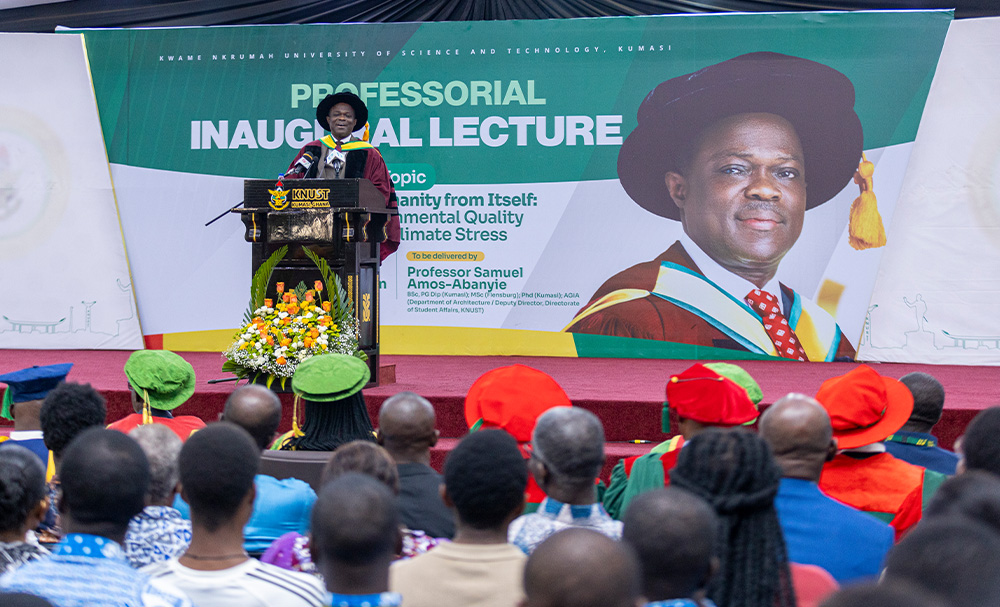
Delivering his inaugural lecture titled “Protecting Humanity from itself: Indoor Environmental Quality in an Era of Climate Stress,” Prof. Amos-Abanyie said many educational spaces in Ghana fall short of conditions required for effective teaching and learning. He attributed this to rapid urbanisation, unplanned building extensions and poor design decisions.
“Students are expected to concentrate, think critically, and perform academically in spaces that are noisy, poorly ventilated, and inadequately lit,” he said.
Drawing on his research, Prof. Amos-Abanyie said high noise levels significantly disrupt teaching and cognitive development. In some cases, noise levels around schools exceed recommended limits by 30% to over 100%, particularly in areas near highways and commercial zones.
“Communities internalise chronic noise as urban life. We must design our cities to respect both functionality and wellbeing,” he said.
He also identified poor daylighting as a major concern, noting that building extensions carried out without professional input often reduce window sizes and limit natural light.
“Occupants accept inadequate daylight as normal but normal should never compromise health,” he said.
Prof. Amos-Abanyie said poor lighting increases reliance on artificial sources and is linked to stress, fatigue and reduced academic performance. He added that rising temperatures and poor ventilation are forcing schools to depend on artificial cooling, raising energy costs and straining electricity supply.
“These challenges are not inevitable but the result of design and planning choices,” he said, urging authorities to integrate indoor environmental quality considerations into the design, construction and modification of educational facilities.
“Planning ahead for housing growth is planning ahead for human wellbeing,” he added.
He called on school authorities, developers and policymakers to prioritise proper ventilation, adequate daylight and effective noise control, while urging students to be mindful of their study environments.
“Seek spaces with adequate ventilation and daylight. These are not luxuries, they are essential for your health and productivity,” he said.
Prof. Amos-Abanyie ended with a broader call to rethink how buildings are designed and used.
“Healthy buildings are not luxuries; they are necessities. If we fail to act, we risk normalising environments that quietly undermine human potential,” he said.

Vice-Chancellor Professor Rita Akosua Dickson commended Prof. Amos-Abanyie for his contributions to architectural education and environmental quality in the built environment, highlighting the growing importance of indoor environmental quality amid climate change and rapid urbanisation.
“Indoor environmental quality is not just a design aspiration but a moral necessity in protecting humanity from unplanned consequences,” she said.
| Story: Abena Serwaa Gyamfi || Ama Pokuaa Mensah | Photos: Isaac Kwaku Duah |


