
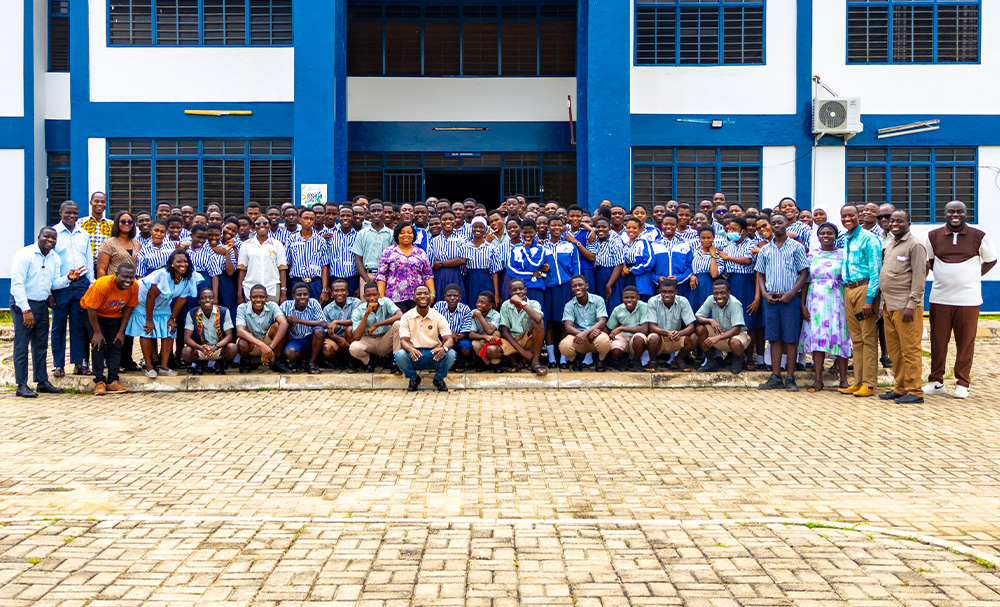
The Kwame Nkrumah University of Science and Technology, Kumasi Nutrition and Sustainable Agri-food Collaborative, in partnership with the Mastercard Foundation (Nkabom Collaborative), has expanded its transformative agribusiness training initiative to Asuansi Technical Institute (ASUTECH) in the Central Region.
The 10-day training programme equipped 120 participants with practical entrepreneurial and agribusiness skills aimed at transforming Ghana's agricultural sector into an innovation-driven and economically sustainable industry.
The training forms part of the Nkabom Collaborative's broader commitment to nurturing a new generation of agribusiness entrepreneurs and professionals capable of creating employment opportunities and strengthening Ghana's food systems.

The Principal of Asuansi Technical Institute, Mr. Ishmael Arthur, commended the Nkabom Collaborative for complementing technical education with entrepreneurship mindset change. He described the initiative as a catalyst for economic transformation among Ghana's youth.
He stressed that while technical and vocational education provides valuable occupational skills, therefore, entrepreneurship enables young people to transform those competencies into viable businesses capable of creating jobs and contributing to national development.
"We believe that the level of skills acquisition and knowledge students gain in their trade areas becomes far more impactful when the spirit of entrepreneurship is added as an economic booster," he said.
Mr. Arthur added that the collaboration provides students with opportunities to identify agribusiness ventures aligned with their career aspirations, ultimately empowering them to establish sustainable enterprises.
"We believe that through this collaboration, our children can identify agribusiness opportunities that align with their ambitions, creating jobs for themselves and employment opportunities for others," he noted.

Mr. Frederick Acquah, one of the facilitators described the Nkabom Collaborative as a unique initiative that prepares students not only to establish their own enterprises but also to thrive within existing agribusiness organisations.
He explained that the programme deliberately develops participants into "responsible entrepreneurs or intrapreneurs," stressing that its practical and learner-centred approach equips them with both technical expertise and essential workplace competencies.

According to him, the training exposes participants to practical idea-generation techniques, including the SCAMPER innovation method, enabling them to improve existing products and services within the agri-food sector.
"We focus on practical idea generation techniques to assist these students to innovate ideas in the agri-food sector to make them better," he said.
Mr. Acquah further noted that the programme employs participatory learning methods, group assignments, and collaborative activities to strengthen participants' communication, coordination, and teamwork skills.
"These are soft skills that are critical to building successful careers, and we believe that our training is really making a change in the lives of these students," he stated.


