
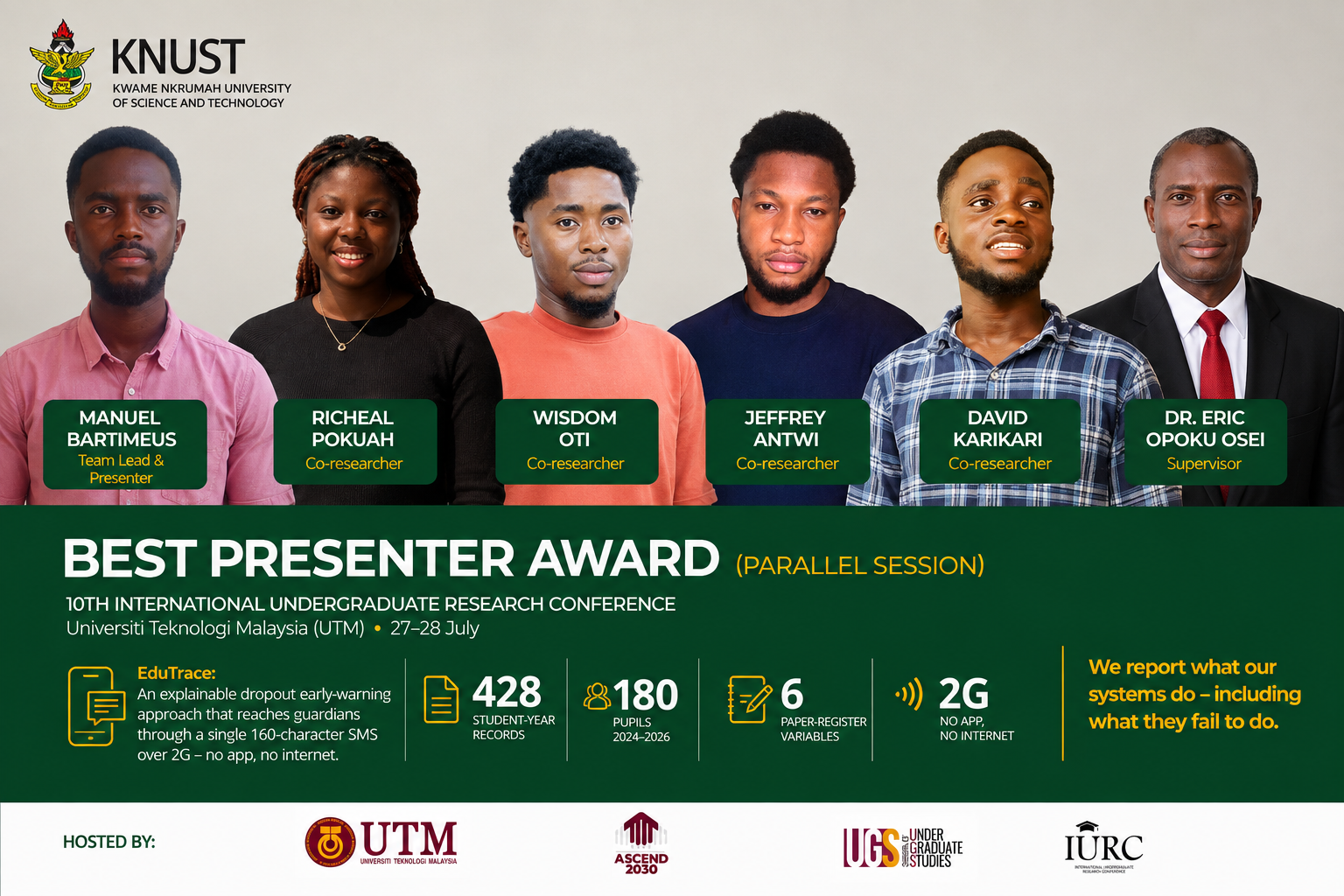
A five-member student team from the Department of Computer Science at the Kwame Nkrumah University of Science and Technology (KNUST), Kumasi, has won the Best Presenter Award (Parallel Session) at the 10th International Undergraduate Research Conference (IURC 2026), hosted online by Universiti Teknologi Malaysia (UTM).
The students, from the CAN-DO Virtual Lab, received the recognition for their presentation of EduTrace, an explainable early-warning system designed to help identify pupils at risk of dropping out of rural Junior High Schools in Ghana.
The team comprised Manuel Bartimeus, Presenter and Team Lead; Richeal Pokuah; Wisdom Oti; Jeffrey Antwi; and David Karikari. The project was supervised by Dr. Eric Opoku Osei of the Department of Computer Science.
EduTrace seeks to address a major limitation associated with existing machine-learning systems for predicting school dropout. Many such systems depend on smartphones, reliable internet connectivity and digital dashboards, resources that may not be readily available in rural and low-connectivity schools.
At the heart of the system is an approach known as SHAP-to-SMS, which converts the reasoning behind a pupil's risk prediction into a single 160-character SMS. The message can be transmitted over a 2G network without requiring an internet connection or smartphone application, making the system potentially suitable for resource-constrained communities.
The model relies on six variables obtainable from ordinary paper-based school registers and uses machine-learning techniques to identify pupils who may be at risk of dropping out. The researchers designed the prediction process to prioritise identifying more genuinely at-risk pupils, while recognising that this could result in more false alarms.
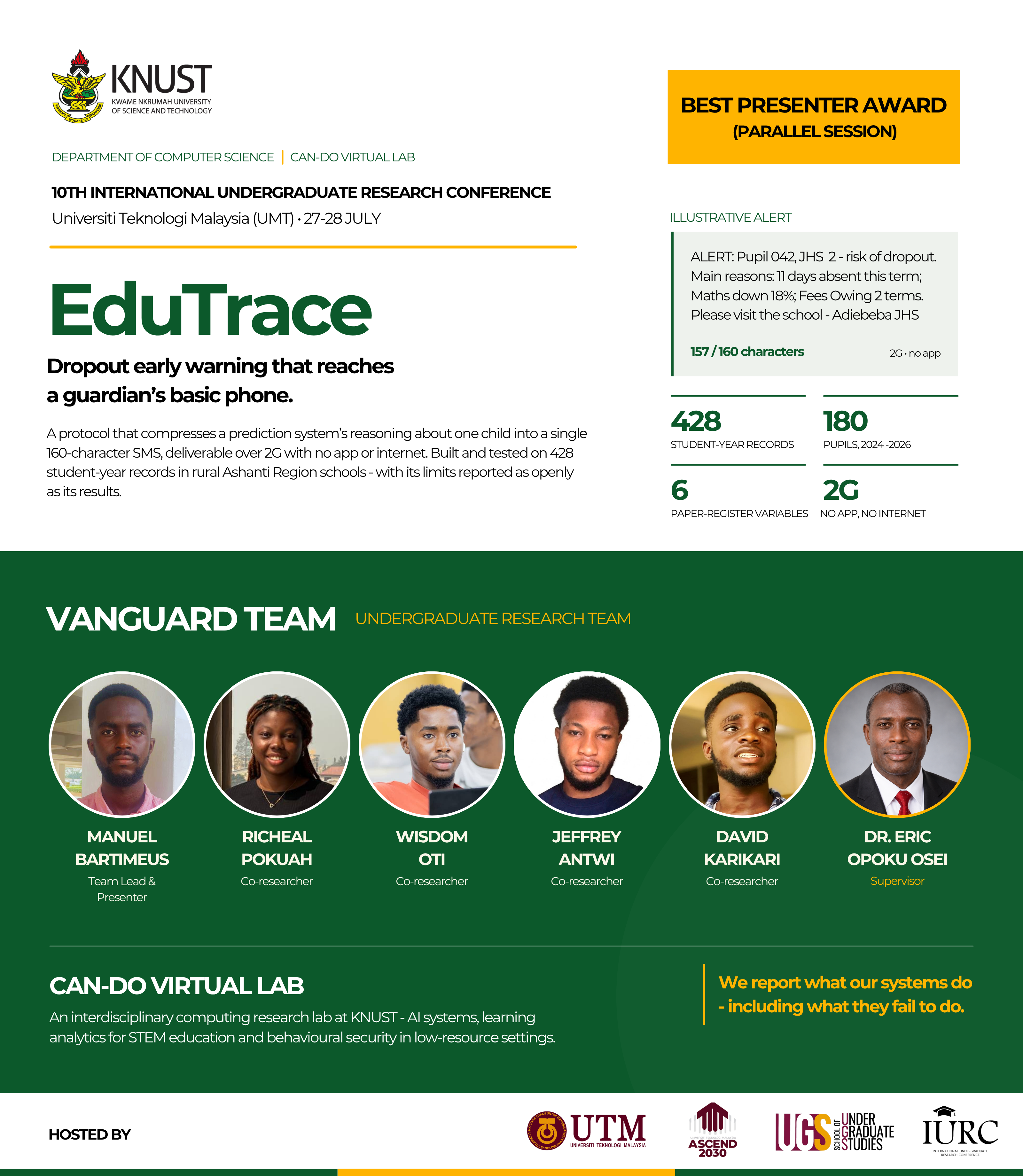
The researchers evaluated 428 student-year records involving 180 pupils between 2024 and 2026 and subsequently tested the system on 248 records it had not previously encountered. The later dataset contained seven dropout events.
At its selected operating point, EduTrace identified more genuine dropout cases than an untuned baseline, while every alert generated by the system remained within the single-message GSM limit.
The researchers, however, acknowledged limitations in the results. The system's advantage in ranking genuinely at-risk pupils above others was not statistically distinguishable from chance, demonstrating the team's cautious approach to interpreting the findings.
The study therefore presents EduTrace not as a replacement for educational decision-making, but as a locally deployable decision-support and educational technology that could help communicate early-warning information in settings where internet-dependent systems may be impractical.
Story: Emmanuel Kwasi Debrah


