
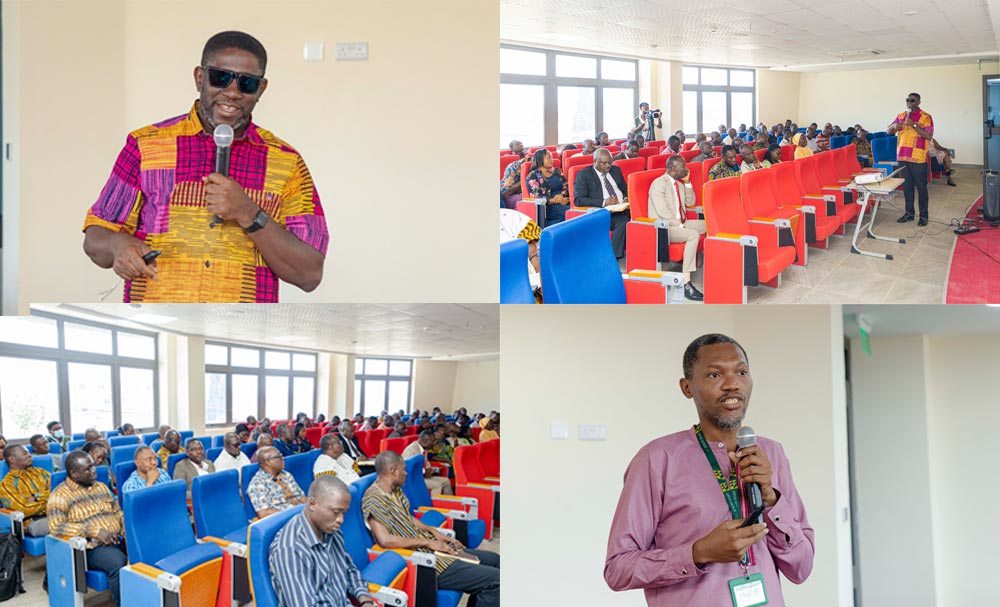
The School of Graduate Studies (SGS) at the Kwame Nkrumah University of Science and Technology (KNUST), Kumasi has organised a workshop for heads of department to deepen their understanding of graduate studies policies and administrative procedures.
Addressing participants, the Director of SGS, Professor Michael Poku-Boansi, said a significant number of student complaints received by the School stem from misunderstandings and inadequate information, particularly regarding the concept of the grace period.
Using programmes in the health sciences as an illustration, Prof. Poku-Boansi explained that variations in programme duration often lead to confusion.
“If you go to health sciences, there are some programmes that are 18 months and others that are 15 months. When it is set up in the SIS, students are not billed once they pass 12 months. Billing only starts when they go beyond the 15 or 18 months,” he said.
He clarified that the grace period applies when a student exceeds the stipulated duration of a programme.
“When a student goes past the duration, the student is said to be in the grace period. The grace period is when the student pays one-third of the fees based on the programme they are pursuing,” he added.
On deferment, Prof. Poku-Boansi noted that postgraduate students may defer their programmes for valid reasons, including personal, financial or health-related challenges, but only for a full academic year.
“The rule is that every postgraduate student can defer his or her programme for whatever reason,” he said, adding that deferment cannot be done for a single semester.
He stressed that applications for deferment must be submitted within the first four weeks of the semester and that first-year postgraduate students are not permitted to defer unless for medical reasons. He urged heads of department to take responsibility for guiding students on such matters.
Touching on termination and suspension of studies, Prof. Poku-Boansi explained that some students are not formally dismissed but become unaccounted for in the system, necessitating the introduction of an amnesty policy approved by the Academic Board.
“We have termination and suspension of stay, and there are reasons for that. If a student fails to register, the student has technically abandoned the programme,” he said.
“That is why we went to the Academic Board to ask for amnesty. If a student has not established contact with the department, has not been assigned an advisor, and has not completed the programme by a defined period, such cases will be cleared,” he added.
He also announced the introduction of the Doctorial Dialogue, an initiative aimed at documenting and showcasing graduate students’ theses.
“It is a way of communicating the research work that has been done,” he said.
On changes to the academic calendar, Prof. Poku-Boansi noted that adjustments have affected graduation timelines. He disclosed that the graduation ceremony scheduled for March 2026 will be part of the 2024–2025 academic year and announced the introduction of a mandatory oral examination for students graduating from November 2026.
“We have reviewed the timelines, and moving forward, all students graduating in November will be required to defend their thesis,” he said.
The workshop concluded with an interactive question-and-answer session, allowing participants to seek clarification on policy issues and strengthening their understanding of graduate studies regulations.
By: Belinda Danso Photos: Emmanuel Offei


