
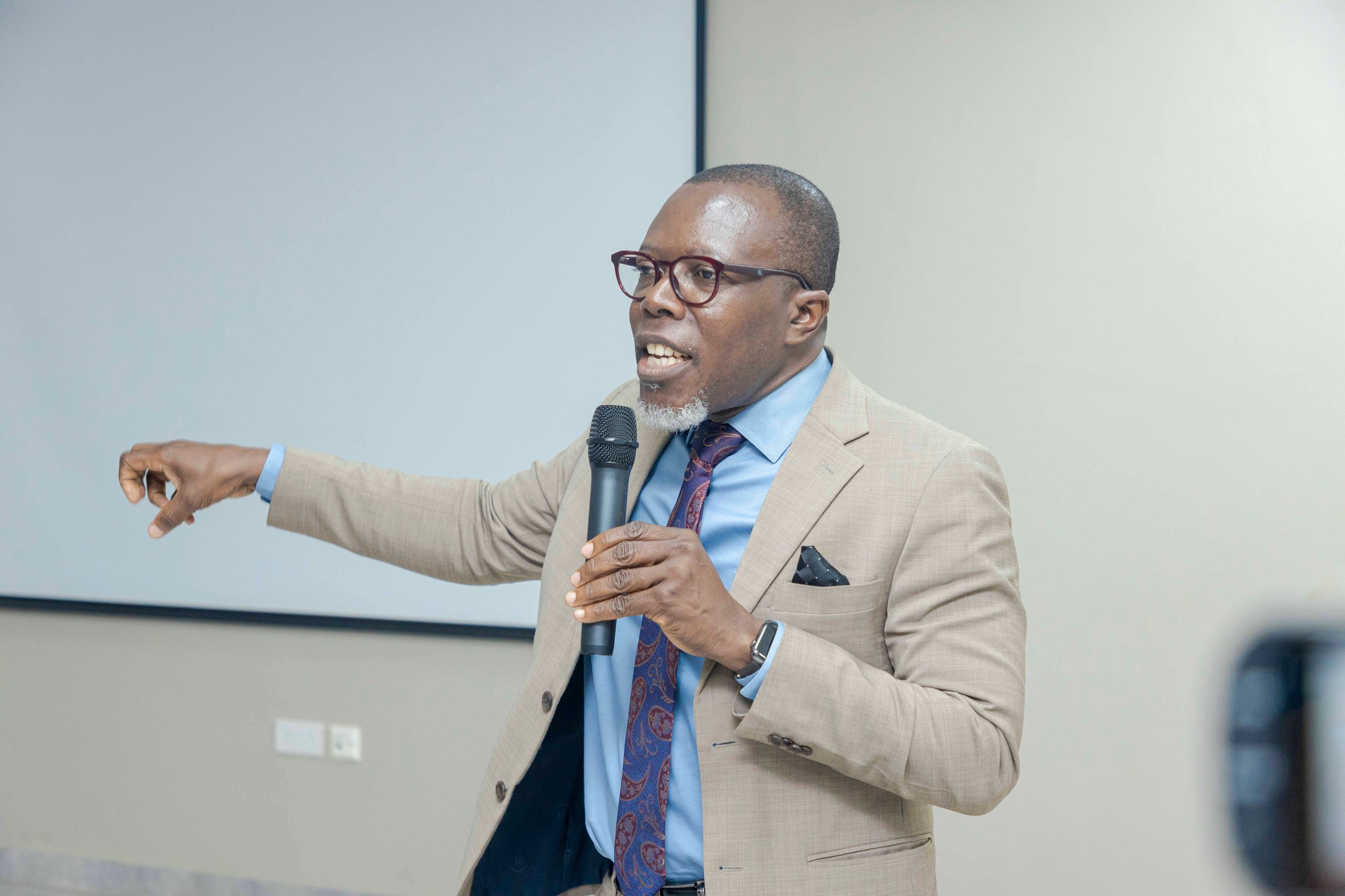
Public health expert Professor Ellis Owusu-Dabo has urged the KNUST School of Public Health to reposition itself as a continental leader in health innovation, calling for a decisive shift toward precision public health, systems thinking and community-driven approaches.
Addressing faculty at the School’s Staff Training and Retreat at Nyansapo Eco Resort, he said the School must improve data systems and adopt “higher-resolution data and tailor-made solutions” to confront emerging public health threats.
“Precision public health is one area that we need to learn,” he said, citing interventions such as precision vaccination and environmental engineering.
Prof. Owusu-Dabo said the School must also prepare its workforce for rapid changes in science and technology.
“We, as a school, should be thinking about how we can increase some of these programmes and be able to understand our workforce,” he noted, emphasising the expanding role of digital public health and AI-enabled modelling.
He also urged faculty to look beyond traditional social determinants to deeper structural forces shaping health outcomes.
“Beyond social determinants, there are societal structural intents we can learn,” he said. “These include governance, empowering people, and ensuring that they have what it takes to take home their future in terms of health.”
On environmental and planetary health, Prof. Owusu-Dabo stressed the need for integrative thinking. “Health is affected by the environment, by messaging, and by the ecology,” he said, linking these factors to One Health and climate-resilient approaches.
He also called for stronger participatory research methods and community ownership of health interventions.
“Sometimes we think we know it all. But when we introduce interventions, are we able to learn and adapt over time?” he asked. Community-led stewardship, mobilisation and respect for local knowledge were essential, he added. “Trust is built, and once trust is built, interventions will last.”
On sustainability, Prof. Owusu-Dabo described wellness as a national asset. “Wellness is health and wealth,” he said, arguing that stronger communities improve life expectancy and reduce preventable diseases.
He further underscored the importance of research ethics and data governance. “Confidentiality will be very key in the future, especially for those of us in clinical trials,” he noted.
Closing his address, he urged collective action and a renewed sense of institutional unity.
“Let’s build a formidable future for public health. We always want to be united as one people. Everybody brings something to our school, our faculty, and our department. Let’s bring it together.”
By: Edith Asravor


