

Dr. Paul Kwadwo Addo, an educationist and Registrar of the College of Engineering has called for a decisive global shift toward strategic school leadership as the true catalyst for improving learning outcomes, declaring that “apart from direct instruction, strategic school leadership emerges as the real driver of excellence in learning.”
Dr. Addo made this assertion during a hybrid technical session at the International Conference on “Transforming Learning Environment for Leadership Development: Pathways to Innovation and Sustainability,” held on 27–28 February 2026 at Guru Nanak Dev University in Amritsar, India.
The conference brought together scholars and practitioners to deliberate on contemporary dimensions of leadership development, innovative educational ecosystems, inclusivity and sustainability in education.
Presenting on the theme “Achieving Excellence in Learning Outcomes: The Role of Strategic Leadership,” Dr. Addo shared Ghana’s experience with the National Educational Leadership Institute (NELI), a pilot initiative that has trained hundreds of school leaders across six regions.
“Strategic leadership is key to excellence in learning outcomes, as evidenced by NELI’s 83.7 percent certification success,” he told participants, referencing findings from Ghana’s national pilot.
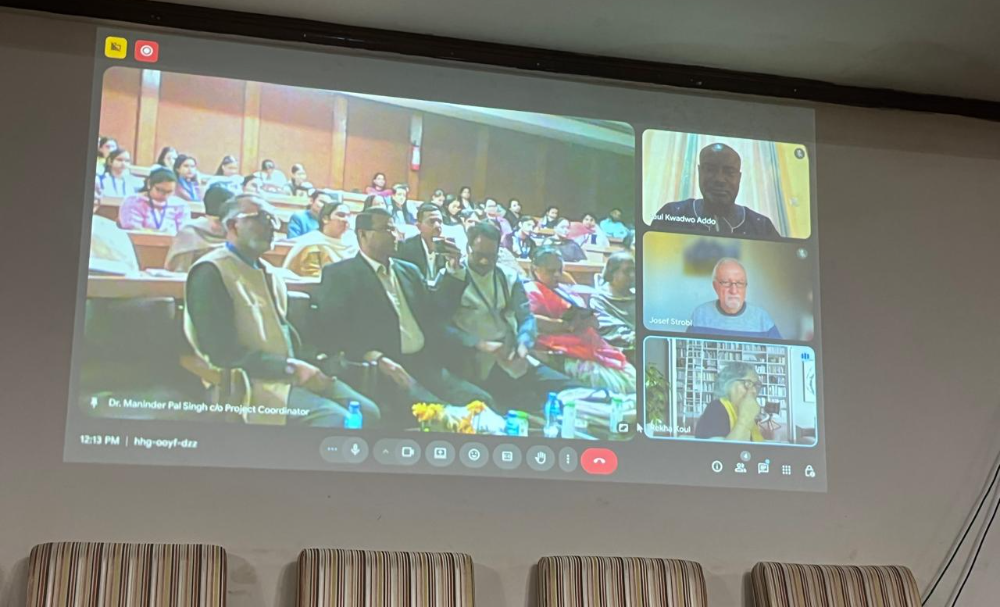
In his presentation, Dr. Addo painted a sobering picture of global learning gaps, using Ghana as a case study.
“Fifty-three percent of ten-year-olds in Ghana are unable to meet basic literacy standards,” he noted, citing Ministry of Education data. He added that while the average Ghanaian child spends 12 years in school, the system delivers only the equivalent of six years’ worth of effective learning due to weak leadership, supervision and accountability structures.
He emphasized that fragmented training systems and the absence of professional preparation for school leaders remain central challenges in many developing contexts.
“Preparation has traditionally emphasized teaching experience over leadership training,” he said. “Yet without strategic leadership, schools struggle with policy compliance, staffing decisions, resource allocation and accountability.”
Dr. Addo, who served as National Coordinator for the NELI pilot under Ghana’s Ministry of Education, described the program as a deliberate intervention to bridge leadership gaps in the education sector.
“NELI directly tackles these issues by providing tailored leadership training focused on strategic planning, data-driven decision-making and shared leadership,” he explained.
The six-month proof-of-concept phase between 2023 and 2024 trained over 600 school leaders across northern, middle and southern zones of Ghana, using a blended model that combined face-to-face sessions, virtual platforms, performance tasks and coaching.
Drawing parallels between Ghana and other developing economies, including India, Dr. Addo argued that leadership reform is globally transferable.
“Strategic leadership can transform learning environments worldwide,” he said, urging institutions to integrate structured leadership programs within long-term education reform frameworks.
He recommended active learning approaches, shared accountability in teaching and learning processes, distributed leadership structures, and sustained capacity building as pathways to innovation and sustainability.
“Leadership must move beyond managerial compliance,” he said. “It must become instructional, collaborative and evidence-driven.”
Dr. Addo expressed gratitude to Professor Karanam Pushpanadham for the recommendation and to Professor (Dr.) Deepa Sikand Kauts, Head and Dean of the Department of Education at Guru Nanak Dev University, for hosting the conference.
By: Emmanuel Kwasi Debrah


