
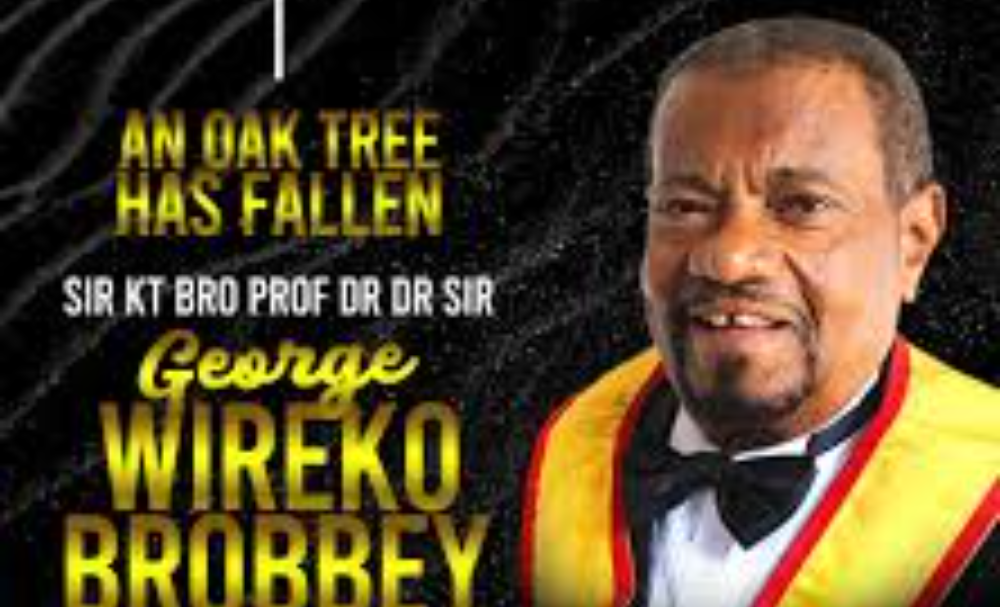
It was in a lecture hall at KNUST that a young medical student first heard Prof. Dr. Dr. Sir George Wireko-Brobby describe the pterygopalatine fossa: that small, deep space in the skull where major nerves and vessels gather before branching into the nose, palate, orbit, and upper jaw.
To many, it is one of anatomy’s most intimidating regions: hidden, compact, and crowded with critical structures.
But Prof. Wireko-Brobby refused to let complexity intimidate. Instead of a dry definition, he compared the pterygopalatine fossa to the bustling inner alleys of Kejetia Market, a small but powerful crossroads where countless routes meet, where movement never stops, and where every path leads somewhere important.
The students laughed, then nodded, and suddenly the abstract became tangible.
That moment, etched in memory, captured the essence of a man who could make medicine human and turn science into story.
Prof. Wireko-Brobby was more than a teacher. He was a nation-builder, a visionary whose fingerprints are on some of Ghana’s most enduring medical institutions.
As Dean of the School of Medical Sciences at KNUST, he saw a glaring gap: Ghana had a medical school but no research laboratory. Samples had to be shipped abroad, and young scientists lacked the infrastructure to test, innovate, and lead.
He refused to accept that limitation. With characteristic foresight, he drafted a proposal that would change the trajectory of medical research in Ghana.
That proposal, carried forward with German collaborators and Ghana’s Ministry of Health, birthed the Kumasi Centre for Collaborative Research in Tropical Medicine (KCCR).
Today, KCCR stands as the country’s second-largest research centre, a hub where Ghanaian and German scientists work side by side on malaria, tuberculosis, neglected tropical diseases, and emerging pandemics.
It was Prof. Wireko-Brobby’s vision that ensured Ghana could respond to crises like COVID-19 with homegrown expertise, rather than dependency on external laboratories.
But his story is not only about institutions. It is about people. Students remember his warmth, his humor, and his ability to anchor abstract concepts in everyday Ghanaian life.
Parishioners at Our Lady of the Holy Rosary Catholic Church recall his reverence at Mass, his embrace during the Sign of Peace, his living testimony that faith and science could coexist in harmony. Colleagues remember his composure, his insistence on excellence, and his quiet but firm leadership.
Prof. Wireko-Brobby’s journey began in Ghana, carried him to Germany where he earned double doctorates in Medicine and Dentistry, and brought him back home to serve.
He rose to become President of the Ghana College of Physicians and Surgeons, a consultant to the World Health Organization, and a recipient of the Order of the Volta. The Vatican honored him as a Papal Knight of St. Gregory.
Yet for all the titles, it was his humanity that lingered most: his ability to hug his family wholeheartedly at Mass, his gift of turning Kejetia into anatomy and his belief that science must serve life.
By: Emmanuel Kwasi Debrah


