
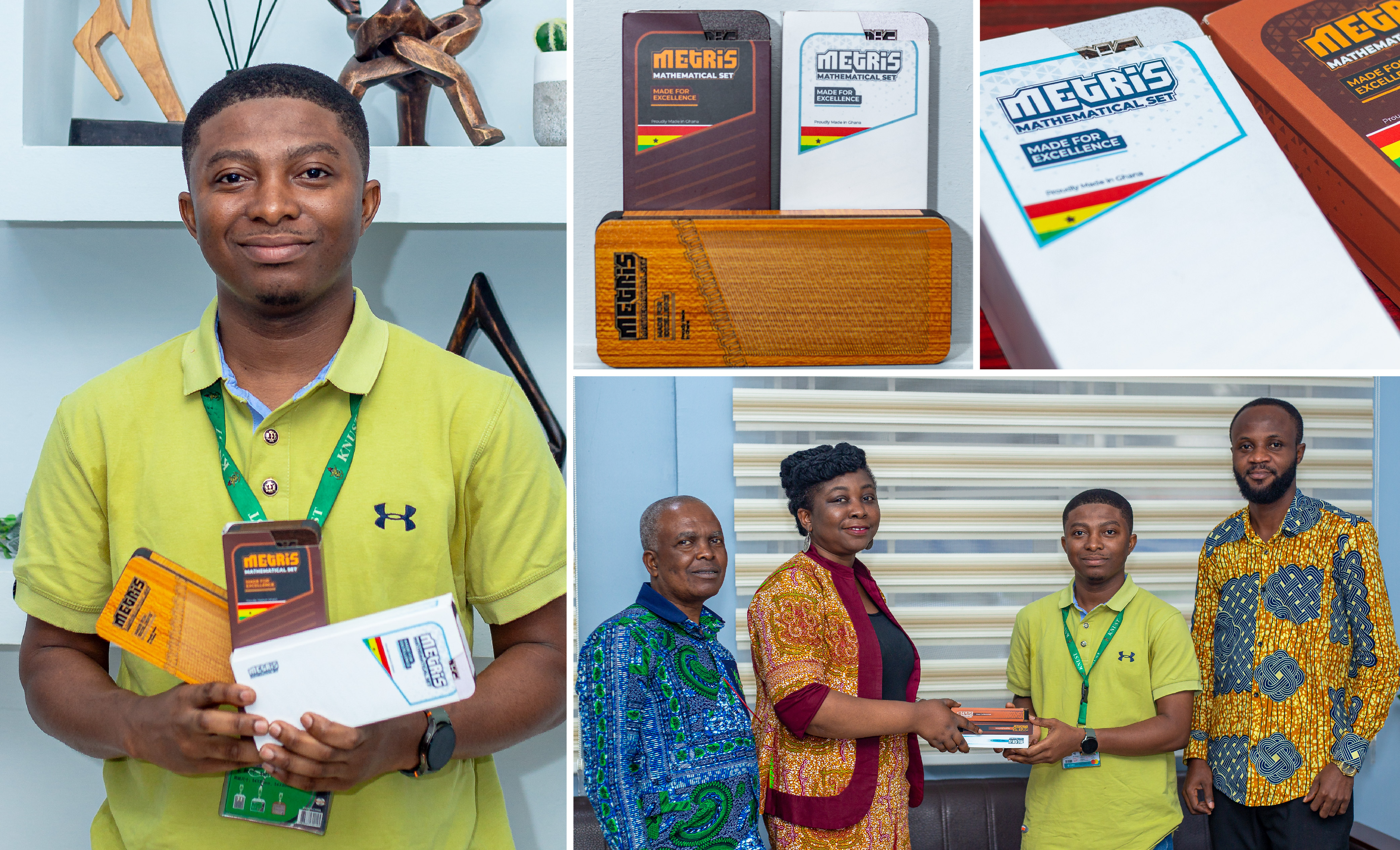
For decades, the mathematics set has remained one of the most familiar learning tools in Ghanaian classrooms. Yet its design has barely changed; light plastic, thin metal, often fragile, and almost always imported.
Sabbathsian Asante Bonsu, a third-year Information Technology student at the Kwame Nkrumah University of Science and Technology (KNUST), Kumasi saw an opportunity to rethink this everyday instrument using eco-friendly locally sourced materials to design a ‘‘Ghanaian-made Mathematical Set.’’
Sabbathsian explained that the project emerged from observation about the country’s overreliance on foreign-made learning tools and the need to harness local talent for national development.
“We realised we could create something useful, affordable, and environmentally friendly right here in Ghana,” he said. “Our goal is to help reduce overdependence on importation, cut costs for Ghanaian parents, create employment opportunities, and promote the use of locally made products.”
With access to the right tools, Sabbathsian and his team’s journey began by producing small designs for clients, engraving cards, and creating custom-made items. Each design refined their skills and strengthened their belief that they were building something bigger than a product.
“Designing this came with a lot of work,” he recalls. “We needed precise tools and equipment, and at the beginning, we didn’t have much.”
From this foundation, the idea for the Ghana-made mathematics set fully took shape: durable, biodegradable, beautifully crafted, and proudly local.
“We think our product is unique,” Sabbathsian explains. “It’s eco-friendly, very affordable, and made from materials sourced right here in Ghana. Parents who struggle to buy imported sets can easily afford this for their children.”
The innovation has not gone unnoticed. Professor Marian Asantewaah Nkansah, Director of Student Affairs at KNUST, praised Sabbathsian’s ingenuity and dedication.
“The Directorate is always interested in nurturing the talents of students by creating a space where all their endowments are nurtured to become the best they can be, both in the classroom and outside,” she said.
Professor Nkansah lauded his commitment to using innovative ways to transform existing ideas.
“When I heard of his exploits, I was intrigued. What is new here is that he is looking around, finding the materials suitable for tools that already exist, and using them to support science education through the mathematical set. We encourage him to keep it up, and we hope that this visibility will open more doors for him beyond KNUST.”
As Sabbathsian continues to refine the design and explore possibilities for wider distribution, he hopes to receive support from government (Ghana Education Service), NGOs, corporate bodies and collaborate with stakeholders to scale and commercialize the product to promote locally made educational resources.
Story: Abigail Ofori Photos: Vincent Gross Hope
KNUST-Ghana and West Africa’s number-one science and technology university, renowned worldwide for excellence in STEM education, innovation, research leadership, and unmatched quality in higher education.


