
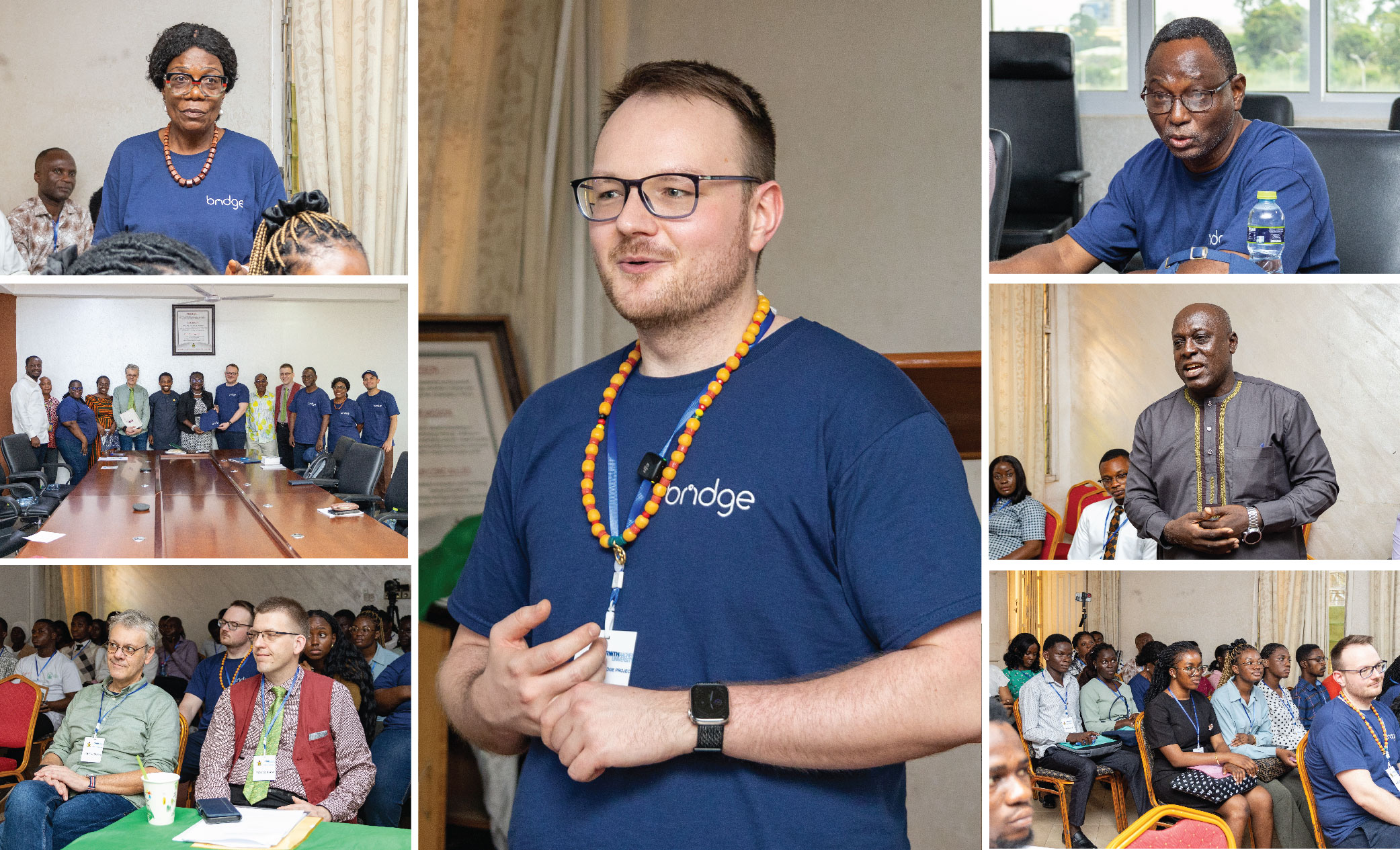
The Kwame Nkrumah University of Science and Technology, Kumasi (KNUST) and Germany’s RWTH Aachen University have held a wrap-up meeting for their three-year BRIDGE project on climate resilience, ahead of its conclusion on March 31, 2026.
The project, launched in January 2023, brought together the College of Art and Built Environment and the College of Humanities and Social Sciences, whose contributions were recognised at the meeting.
The initiative formally titled Building Resilient Communities through the Integration of Climate Adaptation with the SDGs for University Education and Research (BRIDGE) aims to strengthen climate change education, research and community engagement in Ghana.
Supported with about €240,000 from the German Academic Exchange Service (DAAD), the project links academic research with community-led adaptation strategies while promoting capacity building.
BRIDGE Coordinator Professor Divine Kwaku Ahadzie said the proposal was developed in 2022 following initial online discussions between the partner institutions and focused on climate resilience across Ghana’s ecological zones.
“We started writing the proposal in 2022. On Zoom, that is where the engagement started, so we put the proposal together and then we were able to do it. The research was to look at climate resilience for communities. We looked at three ecological zones in Ghana; the savannah, semi-deciduous and the coastal,” he said.
Professor Ahadzie noted that events in 2023, including flooding in Agbozume and Mepe in Ghana’s Volta Region, where a paramount chief provided an excavator to support drainage works, and a similar intervention by a resident in Schweinheim, Germany helped shape the direction of the project.
He added that the team later secured additional funding from the Volkswagen Foundation to support the development of a digital exhibition documenting these experiences.
“Some interviews have gone on and we have produced what we call the digital exhibition trying to document the experiences of those at Mepe and we are going to premiere the exhibition on the twelfth of February,” he said.
Dr. Bruno Arich-Gerz, Professor in the Department of Linguistics at RWTH Aachen University, said the team travelled to affected communities to engage residents and record their reflections on the 2023 events for future reference.
“We thought it would be a good idea to go there, see the place, talk to the people there and conduct interviews with them. We wanted to listen to what they had to say to us, the way they remembered the past events from 2023 in the present which was then 2025 in order to preserve it for the future, 2026 and after,” he said.
He described the digital exhibition as an outcome that emerged organically from the collaboration.
“This is something that came off the project. It was not in the original project. I think this is a strong token of how good, productive and creative the cooperation has been between KNUST, our dear colleagues, and us in Aachen,” he said.
Project Manager Florian Balmes described the interdisciplinary collaboration, particularly with the Settlement Studies and Religious Studies departments as rewarding.
“It was very engaging from the very beginning when we started to write the proposal all together because we have different ideas of how things work and come from different perspectives, and bringing that all together into one proposal was an interesting challenge which we managed very well and what we managed even better was the implementation of the project,” he said.
Speaking on behalf of the Provost, Professor Charles Peprah, Vice-Dean of the Faculty of Built Environment, said the Centre for Settlement Studies aligns closely with the project’s climate and sustainability goals and has benefited from the partnership.
“Through this collaboration, the centre has strengthened its international research links and expanded its contribution to policy relevance and community-focused scholarship,” he said.
He said the college was proud of the project’s outcomes.
“We are proud of what has been achieved together under the BRIDGE project. The exchange visits, capacity-building workshops, PhD research engagement and shared academic activities have enriched our staff and students and laid a strong foundation for sustained institutional cooperation,” he added.
Vice-Dean of the Faculty of Social Sciences, Professor Samuel Adu-Gyamfi, speaking on behalf of the Dean and Provost, attributed the project’s success to the strength of the academic team involved.
“I was reflecting on the key people you have been working with and I am certain that you have had great results also because of the great team you have found here. Professor Ahadzie himself and Professor Gedzi and the others are prolific academics and they have really continuously contributed to the building of this community,” he said.
He expressed optimism about the future of the partnership.
“And I’m also anticipating that this relationship will continue unabated and will have a place of pride in the future,” he said.
For many beneficiaries, the BRIDGE Project has been more than an academic exchange; it has marked a turning point in how they approach research, responsibility and engagement with society.
One beneficiary, Ms. Victoria Ahenkan, a PhD candidate in the Department of Sociology and Social Work, said her participation moved beyond theory into real-life community action.
“Coming back to Ghana, I witnessed a similar flood situation in my own community,” she said. “Unfortunately, we lost a man who was critically ill because the flooding made it impossible for any vehicle to move in or out.”
Drawing on lessons from the project, Ms. Ahenkan said she applied flood-management strategies she had observed in Germany within her own community. As a member of the local landlords’ association, she presented community-led approaches during an emergency meeting, stressing the need for local action rather than waiting for government intervention.
Another beneficiary, Alexander Afriyie Osei, a PhD candidate in the Department of Land Economy, said the BRIDGE Project aligned closely with his research on wetlands and accountability systems but had a broader impact beyond academic focus.
“The project helped me see more clearly how decisions made at higher levels affect ordinary people who are often excluded from decision-making,” he said. “Bringing together people from different departments and perspectives is a holistic approach that research should be about.”
Project partners include Professors Sylvana Rudith King and Victor Selorme Gedzi, as well as Dr. Margaret Makafui Tayviah. RWTH Aachen collaborators include Prof. Dr. Michael Leuchner, Dr. Michael M. Kretzer and Prof. Heribert Nacken.
By: Esther Nutsugah & Erica Boateng Photos: Michael Kwawu


