
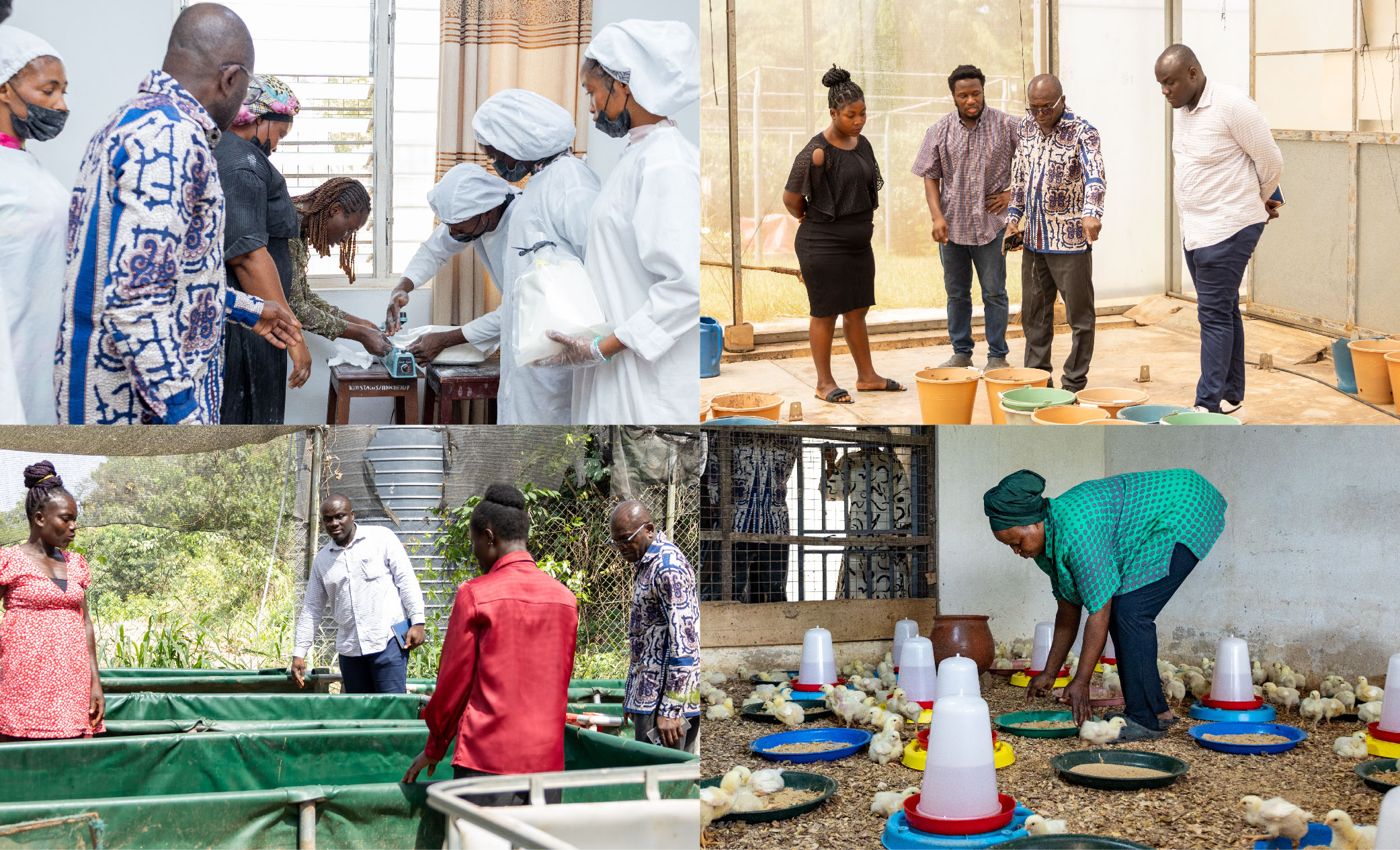
The Kwame Nkrumah University of Science and Technology (KNUST) Nutrition and Sustainable Agri-food Collaborative, in partnership with the Mastercard Foundation (Nkabom Collaborative), has begun intensive hands-on training for the first cohort of trainees enrolled in its Multi-Purpose Integrated Programme (MIP) for Community Youth in Agribusiness.
The initiative targets 37 non-tertiary youth drawn from the Wenchi District, Kwadaso and Ejura-Sekyedumase, aiming to equip them with practical skills and entrepreneurial knowledge to strengthen agribusiness ventures and improve livelihoods.
The six-month programme follows an initial theoretical phase and is structured around experiential learning across key segments of the agricultural value chain, including climate-smart agriculture, aquaculture, poultry production, value addition and processing.
Participants are currently undertaking practical training in poultry farming, rabbitry, greenhouse cultivation, aquaculture and high-value cassava flour processing, exposing them to real-world production systems and business practices.
One of the participants, Mercy Kabuu, who is specialising in cassava processing and value addition, described the training as transformative.
“I had no idea that I could be able to process cassava into high-value flour. The whole process has really opened my eyes,” she said.
Kabuu said the packaging techniques had impressed her most, adding that the training had strengthened her confidence to consider establishing her own business.
Another participant, Donor Salamatu, who is part of the poultry farming group, said the programme had reshaped her understanding of the sector’s economic potential.
“I have really come to appreciate the economic viability of poultry farming. As a lady, I am fully committed to going into poultry because of the skills I am acquiring from this programme,” she said.
During a monitoring field visit, the Entrepreneurship Pillar Lead of the Nkabom Collaborative, Professor Wilberforce Owusu-Ansah, commended the pace of learning and the enthusiasm shown by the trainees.
“It is amazing that just in the second week, the kind of learning taking place and the level of engagement and excitement we are seeing is just remarkable,” he said.
Owusu-Ansah noted that such progress had been expected much later in the programme, possibly around the sixth week or after three months, but said trainees had demonstrated rapid advancement across poultry, greenhouse production, value addition and aquaculture.
“For us as organisers, this is very exciting. It is about the belief we have in the youth, and they are manifesting it in a way we never anticipated,” he said.
According to him, the performance of the first cohort signals strong prospects for the programme.
“It is a really good omen for us, and we believe the future is bright. MIP will go places, and we appreciate what the Mastercard Foundation is doing in this regard,” he added.
By: Michael Kwawu


