
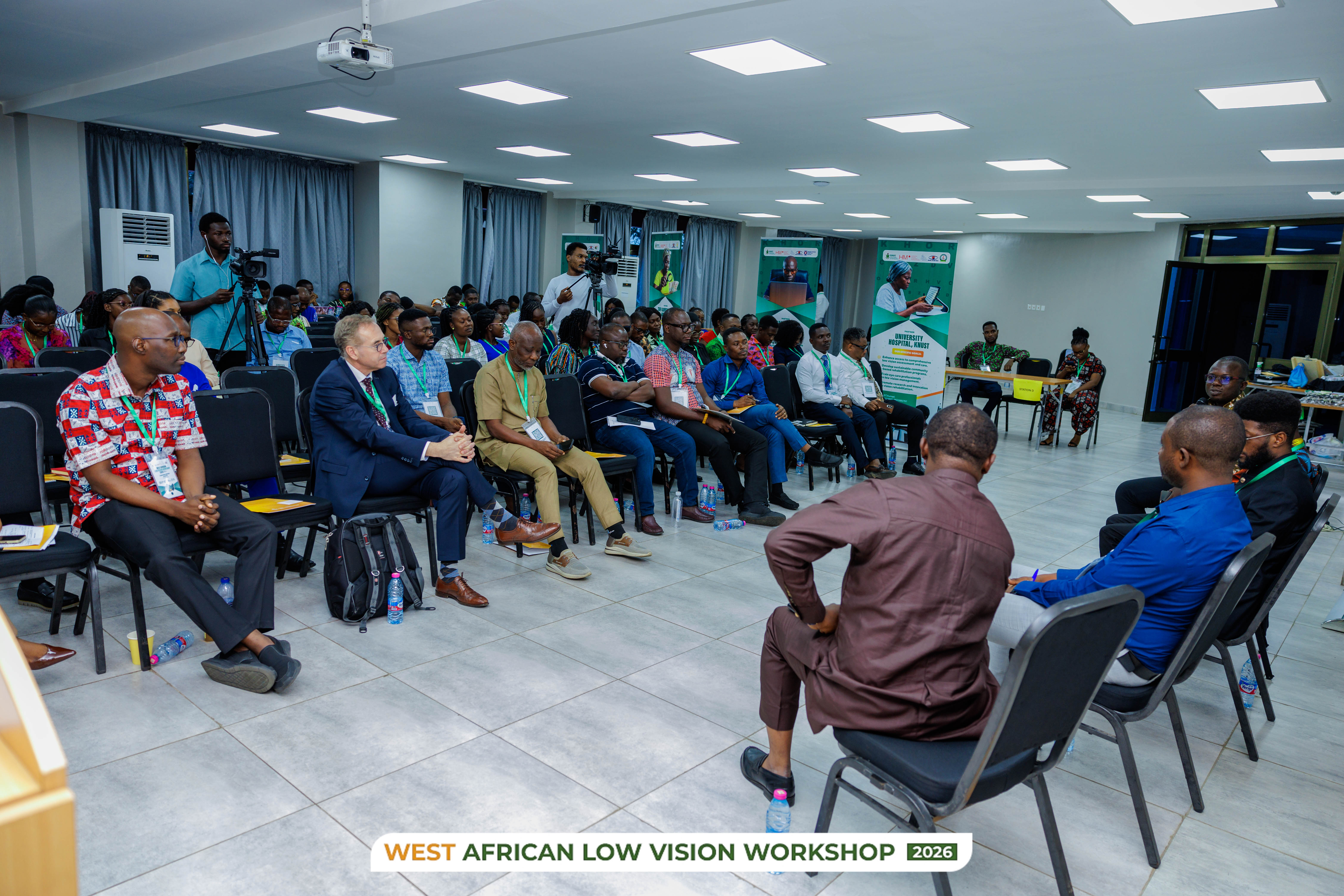
The Kwame Nkrumah University of Science and Technology, Kumasi (KNUST), in collaboration with Hochschule München University of Applied Sciences, has hosted the West African Low Vision Workshop under the HM KNUST Low Vision Project, funded by the Else Kröner-Fresenius Stiftung (EKFS) Foundation.
The Workshop aimed to strengthen capacity in low vision assessment, rehabilitation, and service delivery across the sub-region. It brought together optometrists, ophthalmologists, ophthalmic nurses and opticians to enhance clinical competence, promote evidence-based practice, and share knowledge on optical and non-optical low vision aids. The workshop also provided a platform to identify key challenges and opportunities in low vision service delivery in West Africa.
In the opening address, Dr. Kwadwo Owusu Akuffo, Senior Lecturer in the Department of Optometry and Visual Science, KNUST and Ghana Lead for the HM KNUST Low Vision project, explained that the project is modelled on the World Health Organization’s integrated, tiered approach to low vision care and aligned with the Global SPECS 2030 initiative, which seeks to make low-vision services available at all levels of care, noting that it has helped improve the quality of life for people with vision impairment. “The project has significantly improved access to low vision services and rehabilitation,” he stated.
Prof. Mohammed Abdul-Kabir, Head of the Department of Optometry and Visual Science at KNUST, reaffirmed the project’s goal of improving access to comprehensive low vision care and enhancing the quality of life of persons with visual impairment, expressing appreciation to the funding partners for their support and appealing for the continuous strengthening of the partnership.
In his special address, Supt. Dr. Remi Ninkpe, President of the African Council of Optometry, expressed optimism that the impact of the project would contribute to reducing the burden of low vision within communities and promote the sharing of knowledge across the African continent.
The keynote speaker, Prof. Werner Eisenbarth, German Lead for the HM KNUST Low Vision Project, outlined key achievements of the project, including the establishment of a tertiary low vision centre at KNUST Hospital, the development of a network of primary and secondary centres, research initiatives in the Ashanti Region, and continuous professional development programmes. “The knowledge gained from this study is to inform stakeholders and facilitate the implementation of a national health policy to address visual impairment,” he said.
Dr. Hornametor Afake, Head of the National Eye Care Unit of the Ghana Health Service, represented by Dr. Louis Oteng-Gyimah (Medical Director, Anglican Eye Clinic, Jachie), emphasized that low vision care remains under-prioritized, despite the needs of patients whose vision cannot be restored. “For these individuals, our responsibility does not end, it evolves,” he stated. He emphasized the indispensable role of optometrists, noting that their responsibilities extend beyond detecting visual impairment. “When you prescribe a magnifier or a telescope, you are not simply improving vision, you are enabling a child to read, an adult to work, and an individual to live with dignity,” he said.
Delivering his remarks at the workshop, Dr. Alfred Gardemor, President of the Ghana Optometric Association (GOA), acknowledged Ghana’s progress in reducing avoidable blindness but stressed that low vision rehabilitation remains limited and largely urban-centered.
He called for stronger policy integration, service expansion, improved training, and insurance coverage for low vision devices. He urged stakeholders to work toward making vision rehabilitation accessible, affordable, and inclusive nationwide. “Let us commit ourselves into building a Ghana where visual impairment does not determine one’s opportunity, dignity and contributions to society” he stated.
Mr. Frank Quarshie Ofori, President of the Optician’s Association of Ghana, described the workshop as an important step toward strengthening low vision care in West Africa, and called for greater collaboration, investment, and professional training to integrate low vision into mainstream eye care.
Summary of events
The workshop featured a series of scientific sessions, guest lectures, practical trainings, and panel discussions focused on strengthening low vision care. The presentations covered preliminary and visual function assessments, evidence synthesis in low vision practice, the effects of visual aids, and strategies for improving clinical outcomes. Participants also received detailed training on optical and non-optical low vision aids, rehabilitation approaches, and case history evaluation through hands-on workshops. A panel discussion examined clinical perspectives on low vision service delivery, while reflection sessions identified key lessons, challenges, and the way forward. Additional sessions addressed low vision in persons with co-occurring disabilities, reinforcing the need for inclusive and comprehensive rehabilitation services.


