
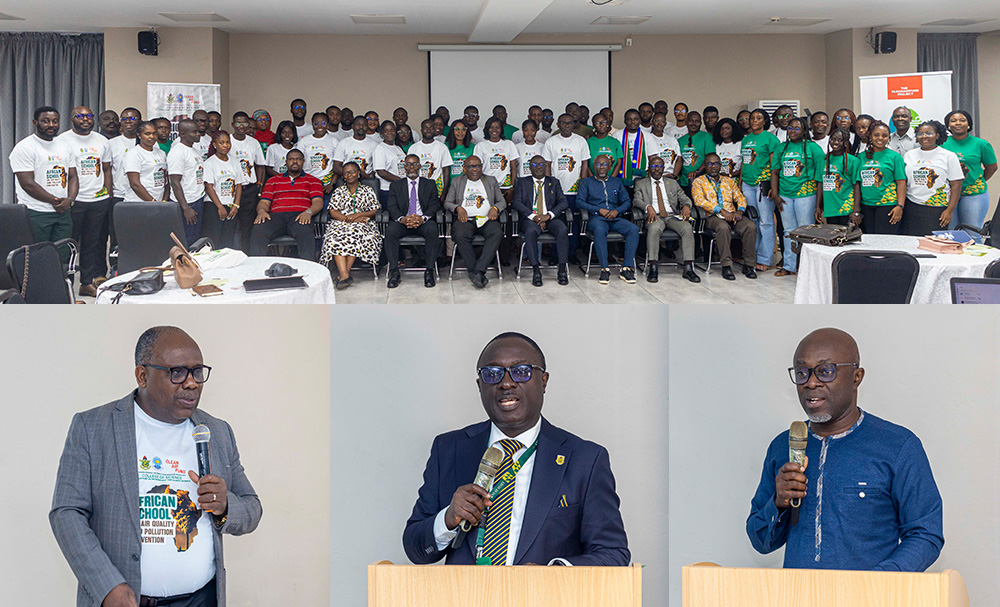
The Pro Vice-Chancellor of the Kwame Nkrumah University of Science and Technology (KNUST), Kumasi, has called for the empowerment of Africa’s next generation to tackle air pollution-related deaths for a healthier continent.
He emphasized the gravity of air pollution on the continent, describing it as one of the most serious environmental and public health threats facing Africa today.
“Air pollution causes over one million premature deaths every year in Africa. The air we breathe is under siege,” he stressed.
Speaking on behalf of the Vice-Chancellor, Professor Asamoah made this call at the third edition of the African School on Air Quality and Pollution Prevention, that brought together environmental experts, researchers, students, policymakers, and international partners to tackle one of Africa’s most pressing public health threats, air pollution.
The two-week training programme, funded by the Clean Air Fund, attracted over a thousand applications from 47 countries, out of which 70 participants were selected.
Participants include professionals from fire services, environmental agencies, architecture, pharmacy, journalism, planning, forestry, and public health.
Amid the challenges posed by poor air quality, Professor Asamoah lauded African youth for their motivation to take action against this invisible pandemic.
‘‘Across our universities and research institutions, young scientists are developing low-cost air monitoring devices, designing clean cookstoves, and advocating for climate-smart cities,’’ he said.
The Pro Vice-Chancellor further urged universities to continue investing in research, policy engagement, and community outreach. ‘‘Let us transform knowledge into leadership and leadership into action,’’ he said. ‘Let us ensure that next generation inherits a cleaner, safer and healthier continent.’’
Professor Leonard Amekudzi, the Principal Investigator of the project, underscored the growing importance of air quality research and capacity building on the continent. He said that with rapid population growth and increasing human activities, the challenge of air quality management has become even more urgent.
He noted that the School began in 2018 as a small initiative within the College of Science and has now evolved into one of the university’s major training programs.
A core goal of the School, according to Professor Amekudzi, is to train “clean air champions” who will drive advocacy, research, and public awareness across the continent.
“Air quality is health-related, and health is life-related. We must talk about it, empower people with knowledge, and develop champions who will carry the message across Africa. We do not want to only publish research, we want to make real impact on the continent,” he stressed.
Professor Amekudzi revealed that the team has developed a comprehensive training manual on air quality, which has been submitted for external review as part of the project requirements.
Mr Desmond Appiah, Ghana’s Clean Air Fund Lead, described air pollution as a “silent killer,” urging participants to prioritise sustainability and continuity of the project, translating their knowledge into real community action.
“We don’t want you to go back and end the story. We want to see clean-air initiatives, advocacy, and action wherever you are. When people take action, governments pay attention,” he encouraged.
He advised participants to engage local leaders, improve waste management practices, support segregation at the household level, and explore ways to reduce burning and other pollution sources in their communities.
Story: Abigail Ofori Photos: Isaac Kwaku Duah


