
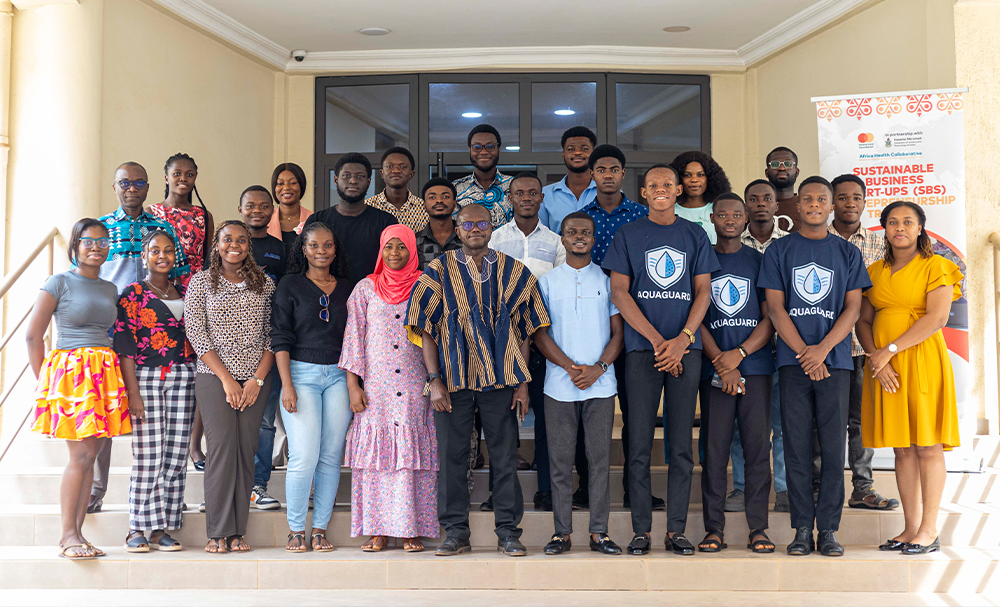
The Africa Health Collaborative at the Kwame Nkrumah University of Science and Technology, Kumasi (KNUST), in partnership with the Mastercard Foundation, has organised a training programme in business management and regulatory requirements for its grant awardees, aimed at strengthening their management capacity and operational readiness.
Giving an overview of the training, Prof. Wilberforce Owusu-Ansah, Pillar Lead for Health Entrepreneurship, said the programme is designed to equip beneficiaries with the skills needed to legally and effectively manage their businesses.
“This training is a three-day training. It's a follow-up after the award, where we are building their capacity to be able to manage the businesses that are going to set up in a very legal manner,” he said.
He noted that participants are being guided to understand the full range of regulatory requirements necessary for operating their businesses.
“So, we have invited a number of regulators from the Medical and Dental Council, Nursing and Midwifery Council, FDA and GRA, for them to be able to know what the legal requirements in regulatory issues are, in terms of running a business,” he stated.
Prof. Owusu-Ansah added that beyond the demonstrated technical abilities of the beneficiaries, the programme places emphasis on developing strong management and investment plans.
“We really need to work with them to see how they can manage very well and draw an investment plan with them,” he mentioned.
In a presentation, Mrs Eunice Adu Boahen, a representative from KNUST’s Office of Grants and Research (OGR), addressed intellectual property (IP) and small and medium-sized enterprises in health, focusing on how innovators can navigate growth and innovation.
She explained that intellectual property allows innovators to control how their work is used and to seek compensation if others use it without permission, adding that IP protection is territorial and applies only in the countries where it is registered.
Mrs Adu Boahen outlined various IP regimes, including patents, copyrights, trademarks, industrial designs, trade secrets and geographical indications, noting that each serves a specific purpose.
She advised beneficiaries to select protection strategies based on cost and business objectives rather than relying solely on patents.
“You really need to assess the commercial value of what you are doing before you look at patent. But you can still use trademark, trade secrets, copyright to promote what you are doing,” she urged.
Participants were reminded that registering a business is not the same as securing intellectual property rights, and Mrs Adu Boahen encouraged them to seek support from IP offices to properly protect and manage their innovations.
By: Belinda Opoku Danso Photos: Isaac Kwaku Duah


