
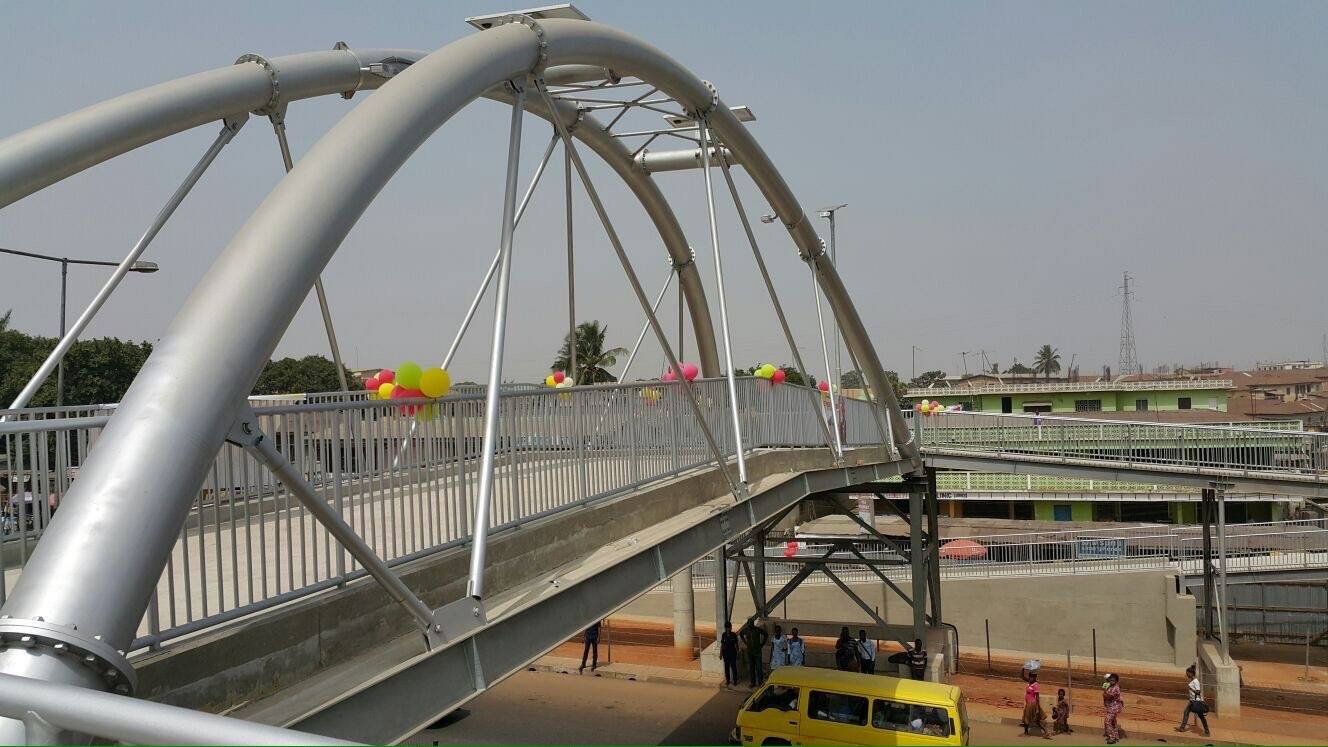
Schoolchildren who are running or riding bicycles are significantly less likely to use footbridges when crossing multi-lane highways in Ghana.
The joint KNUST research, published in African Transport Studies, found that children observed running were 32.5% less likely to use footbridges, while those cycling were 11.7% less likely, despite the structures being intended to reduce pedestrian-vehicle crashes.
Overall use was high. Observers recorded 91% compliance among 8,056 schoolchildren monitored over seven days at seven footbridges in the Greater Accra (six sites) and Kumasi (one site) metropolitan areas. Use peaked on Mondays (94.8%) and during morning hours (7–9 a.m.), and was higher among girls and among children walking in groups.
Location, however, strongly influenced behaviour. Compared with Lapaz, where children were only 3.3% more likely to use the bridge, schoolchildren were 24.4% less likely to use the Kwashieman footbridge and 12.8% less likely to use the Madina footbridge. The Mallam and Accra Mall sites also showed lower utility among children.
The study identified bridge location, day of the week, time of day, accompaniment, wearing earphones, carrying luggage, running and cycling as significant predictors of use. Children seen between 7–9 a.m. and 11 a.m.–1 p.m. were more likely to use footbridges than those observed between 3–5 p.m.
Children who were accompanied, carrying luggage or wearing earphones were more likely to comply.
By contrast, speed discouraged compliance. The authors say running and cycling likely reflect perceived time costs and designs that are not bicycle-friendly, reducing willingness to climb bridges.
The study argues that early, habitual use of footbridges can improve long-term pedestrian safety but warns that remaining non-use “still portends danger” given traffic volumes on urban highways. It calls for targeted road-safety education, footbridge policing and design improvements, particularly to accommodate cyclists.
The paper, “An observational survey of the use and non-use of footbridges by school children in Ghana,” includes contributors from several institutions, including the Department of Surgery at Kwame Nkrumah University of Science and Technology, the University of Cape Coast, the University of Ghana, the Alabama Transportation Institute and the Harborview Injury Prevention and Research Centre.
By: Emmanuel Kwasi Debrah


