
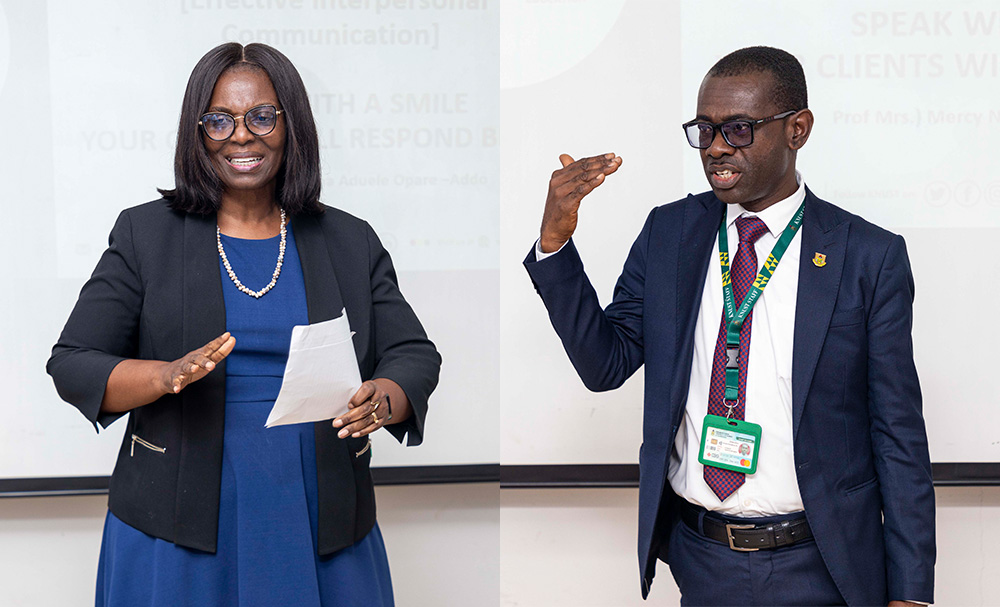
The Registrar of the Kwame Nkrumah University of Science and Technology, Kumasi (KNUST), Mr. Benjamin Boampong Owusu, has urged staff of the University Health Services (UHS) to prioritise listening and openness in their engagement with patients.
He made the call at the closing ceremony of a training seminar on Effective Patient-Centered Communication organised by the University Health Services.
Mr. Boampong Owusu said clear communication and empathy are essential to effective healthcare delivery, noting that patients are more receptive to treatment when medical procedures and terminology are properly explained.
“We need to communicate with them. We need to explain to them what some of the terminologies are all about,” he said.
He urged healthcare providers to give patients adequate time and attention, stressing that listening is itself part of the healing process.
“We need to have time for our patients, especially listening. When the patient knows that we are ready to listen, that alone is a healing process,” he said.
Mr. Boampong Owusu added that some challenges in healthcare delivery stem not from clinical limitations but from technical language barriers and poor communication.
“We need to be open to our patients. When the patient comes, we should go all out to support in our own way,” he said.
Also speaking at the event, Prof. (Mrs.) Mercy Naa Aduele Opare-Addo, facilitator of the eight-session training seminar, highlighted active listening as a core element of patient-centered care.
“We should listen actively to show empathy. And once we do that, we foster collaboration. We let them have some trust in us,” she said.
She emphasised the importance of emotional intelligence and self-awareness in healthcare delivery.
“We need to know who we are, and then we need to know how patients are likely to react and see how we can accommodate everybody,” she said.
Encouraging participants to apply the lessons from the training, Prof. Opare-Addo noted that simple acts of courtesy can significantly enhance interpersonal and therapeutic communication.
“Saying please, saying sorry does not change you. You still remain as your career when you say please. And when you smile, you look better. So, smile all the time,” she urged.


