
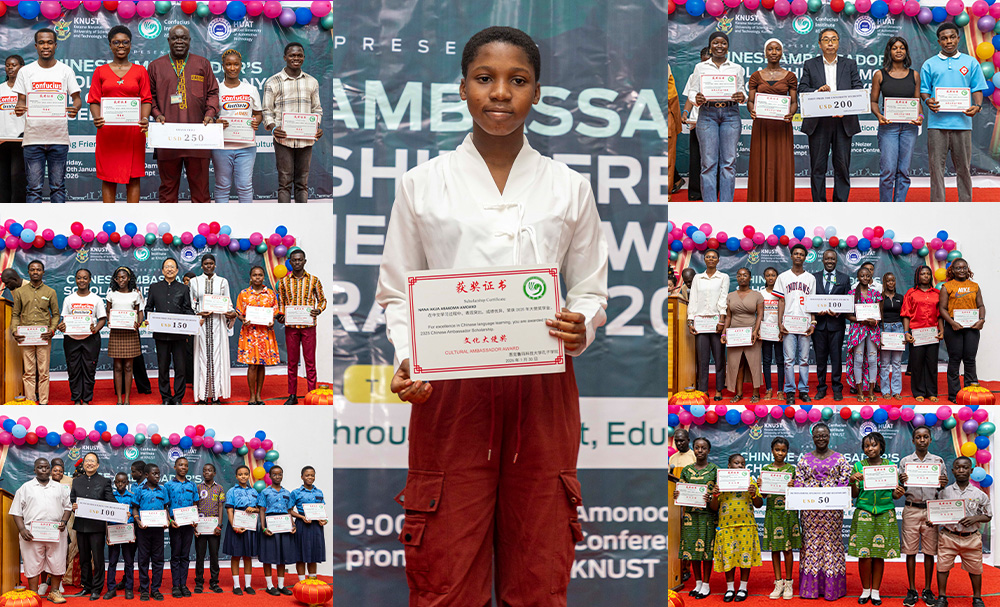
The Confucius Institute at the Kwame Nkrumah University of Science and Technology, Kumasi (KNUST) in collaboration with the Chinese Embassy in Ghana and partner institutions, has awarded 71 students the Chinese Ambassador’s Scholarship during a ceremony that also marked celebrations for the Chinese Lunar New Year.
The awards were presented during a colourful ceremony showcasing Chinese and Ghanaian cultural displays, held under the theme “Strengthening Friendship Through Support, Education and Culture.”
Scholarship recipients were drawn from several teaching centres, including KNUST Basic School, KNUST Senior High School, Hill Top School, Boankra MA Junior High School, as well as KNUST students pursuing the Chinese Minor programme at the Department of Language and Communication Sciences.
Students were recognised across several award categories, including the Cultural Ambassador Award, the highest honour under the 2026 scholarship scheme, Chinese Star Award, Chinese Superstar Award, First Prize, Second Prize, Third Prize, and Special Prize, in recognition of excellence in Chinese language proficiency, cultural performance and overall academic achievement.
Prof. Ke Ningli, the Chinese Director of the Confucius Institute at KNUST, said the scholarship scheme reflected the depth of educational cooperation between the two countries.
“The establishment of the Ambassador Scholarships is an important achievement in educational exchanges and cooperation between China and Ghana,” Prof Ningli said, describing the beneficiaries as “envoys of cultural exchange and bridges of friendship between the two nations.”
He urged award recipients to continue strengthening their Chinese language proficiency and cross-cultural communication skills to contribute to long-term bilateral relations. He reaffirmed the Confucius Institute’s commitment to deepening mutual understanding through language and cultural programmes.
Professor Philip Antwi-Agyei, Provost of the College of Science, in a speech delivered on behalf of the Vice-Chancellor, conveyed management’s appreciation to the Chinese Embassy, describing the scholarships as an investment in Ghana’s intellectual and human capital.
“These scholarships are far more than financial support; they are seeds sown into the fertile soil of Ghanaian intellect,” he said. “Your generosity doesn’t just ease a financial burden, they open doors for students to focus on learning, growth, and service. We are deeply grateful for your continued support and commitment to education.”
He on behalf of the Vice-Chancellor reaffirmed KNUST’s commitment to international partnerships, citing ongoing collaboration with Hubei University of Automotive Technology and the Chinese International Education Foundation as key drivers of academic exchange and global exposure for students.
Addressing the gathering, Mr. Yan Liquan, the President of the Northeast China General Chamber of Commerce in Ghana, congratulated the award recipients and paid tribute to Tong Defa, Ghana’s former Chinese Ambassador.
“This award is not only financial support, but also recognition of dedication, talent and the pursuit of excellence,” he said. “The former ambassador’s contributions to education, culture and talent exchange laid a solid foundation for China–Ghana friendship.”
In her remarks, Nana Akua Abakoma, winner of the Cultural Ambassador Award from KNUST JHS, reflected on her experience at the international Chinese Bridge competition and described cultural exchange as a powerful tool for global understanding.
“I realised that learning a culture is not only about preserving history but about building bridges between people,” she said, recalling interactions with participants from different countries during her time in China.
She said the experience deepened her appreciation of Chinese values such as respect, hospitality and wisdom, and inspired her to continue learning and sharing through cultural exchange.
Also speaking, Prof. Daniel Duah, Ghanaian Director of the Confucius Institute at KNUST, said the Institute had recorded steady growth since its establishment, supported by successive Chinese ambassadors.
“Scholarships like these motivate young people to study hard and excel,” Prof. Duah said.
He highlighted Abakoma’s national victory in the Chinese Bridge competition as evidence of the Institute’s progress and encouraged more students to participate as KNUST prepares to host the 2026 Chinese Bridge competition.
The ceremony also marked the official opening of activities for the 2026 Chinese Spring Festival, China’s most significant traditional celebration, symbolising renewal, unity, and prosperity.
By: Abigail Ofori


