
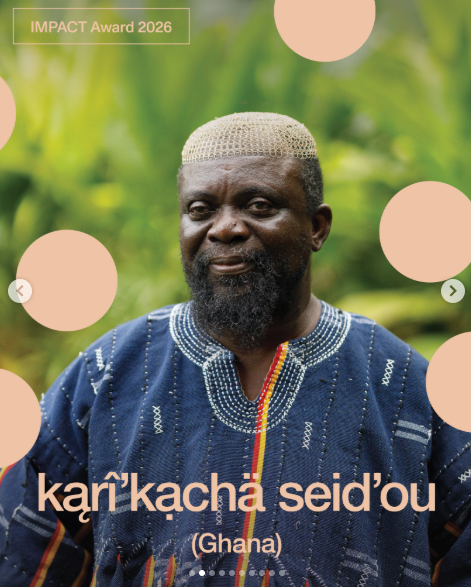
Professor Karî’kachä Seid’ou, Dean of the Faculty of Art at the Kwame Nkrumah University of Science and Technology, Kumasi (KNUST), has been named the sole recipient of the 2026 Prince Claus Impact Award, earning global recognition for more than two decades of work that has transformed art education and contemporary artistic practice in Ghana and beyond.
The Prince Claus Fund announced the Ghanaian artist, poet and educator as its 2026 Impact Awardee as the organisation marks its 30th anniversary and the centenary of the birth of Prince Claus.
In announcing the award, the Fund described Prof. Seid’ou as a practitioner who has transformed not only what art can be, but also how it can be taught, shared and imagined.
It said his work has, for decades, questioned the systems through which art is taught, knowledge is produced and cultural authority is distributed, while creating collective approaches to learning and artistic practice.
The Fund particularly highlighted his work at KNUST, where it said the Emancipatory Art Teaching Project challenged inherited colonial models of art education and empowered generations of critically engaged artists.
The recognition is particularly significant this year. Unlike previous editions that recognised multiple practitioners, the 2026 Impact Award is being conferred on a single recipient.
The award therefore places international attention on an artistic and educational movement developed at KNUST and whose influence has spread from Kumasi into the global contemporary art scene.
For more than two decades, Prof. Seid’ou has challenged conventional ideas of art as primarily an object to be produced, owned and displayed. His practice instead explores art as a means of building communities, sharing knowledge, questioning established systems and creating new possibilities.
An artist, educator, curator, poet, mathematician and scholar of modern and contemporary African art, Prof. Seid’ou has built much of his career around an expansive understanding of what art can do.
Central to that work is the Emancipatory Art Teaching Project, which he conceived and implemented at KNUST in 2003.
The project transformed approaches to fine art education within the Department of Painting and Sculpture, encouraging students to move beyond established conventions and approach art as a space for critical thought, experimentation and collective practice.
Rather than positioning artists simply as individual creators, the approach opened pathways for students to become artists, curators, exhibition-makers, researchers and active participants in broader cultural conversations.
Its influence has extended far beyond the classroom.
Prof. Seid’ou has mentored generations of artists, curators and scholars, many of whom have become important figures in Ghana's contemporary art ecosystem.
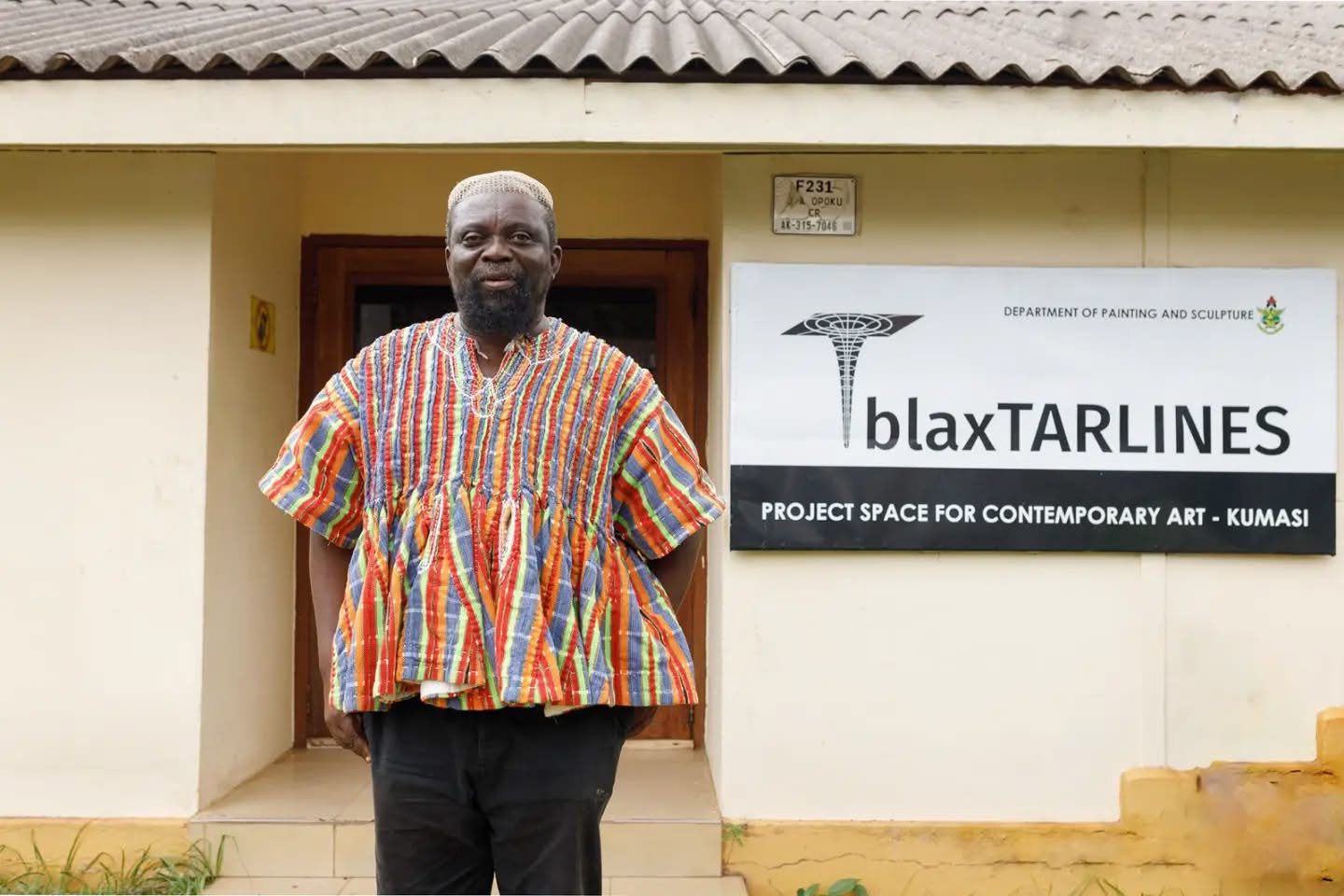
The intellectual and artistic environment fostered by the Emancipatory Art Teaching Project also contributed to the emergence of blaxTARLINES KUMASI, an open-source, community-driven art collective associated with a new generation of Ghanaian contemporary art.
Prof. Seid’ou is a co-founder of blaxTARLINES, which the Prince Claus Fund described as an artist-run community built around the principle that knowledge should be shared rather than owned.
The Fund said the impact of his work could be seen not only in his own artistic and intellectual practice but also in the communities he has nurtured, which have helped shape Ghana's contemporary art landscape and contributed to decolonial discourse across West Africa and beyond.
The collective has itself attracted international attention. ArtReview’s Power 100 has recognised blaxTARLINES in successive years, drawing attention to its significance as a model for independent artistic communities and to the pedagogical movement at KNUST from which it emerged.
Among the artists shaped by that environment is internationally acclaimed Ghanaian artist Ibrahim Mahama, who has publicly acknowledged Prof. Seid’ou and blaxTARLINES as important influences on his artistic journey.
Mahama, who served on the 2026 Impact Award jury, said Prof. Seid’ou's approach had fundamentally influenced contemporary understandings of artistic practice.
“His approach has profoundly changed how art is perceived and practiced,” Mahama said.
After receiving the inaugural Art Basel Awards Gold Award in 2025, Mahama dedicated the recognition to the KNUST Faculty of Art and blaxTARLINES, describing Prof. Seid’ou as a mentor who had devoted his life to shaping the discourse of art-making.
Prof. Seid’ou’s artistic journey, however, began long before his academic career.
His relationship with art can be traced to street-art workshops and commercial sign painting in Accra during the 1980s before he pursued formal art education in Kumasi.
His practice has since moved across art, education, philosophy, mathematics, research and curating.
His international engagements have included the Tate Modern/KNUST institutional-building programme, the Stedelijk Museum Bureau Amsterdam and the KNUST/Städelschule Frankfurt Research Exchange Programme.
He has also contributed to major artistic projects, including Ibrahim Mahama’s Parliament of Ghosts, presented at the Venice Biennale, and Songs About Roses, exhibited at the Fruitmarket Gallery in Edinburgh.
Running through much of Prof. Seid’ou’s work is an interest in non-proprietary art practice, an approach that questions the idea of art as something defined principally by individual ownership and instead explores its possibilities as a shared and collective experience.
The 2026 Prince Claus Impact Award therefore recognises an influence that cannot easily be measured by Prof. Seid’ou’s individual artistic output alone.
It can be traced through the generations of artists who emerged from KNUST, exhibitions that challenged established approaches to artistic practice, networks connecting Kumasi with artistic communities around the world and students introduced to a different understanding of what an artist could be.
The recognition also places KNUST and Kumasi within a wider story about the growing international influence of Ghanaian contemporary art.
What began as an experimental approach to teaching art at KNUST more than two decades ago has developed into an artistic ecosystem whose practitioners and ideas now circulate across some of the world's major galleries, exhibitions and cultural institutions.
The Prince Claus Fund's assessment captures the wider significance of that contribution: Prof. Seid'ou's influence lies as much in the communities and generations of practitioners he has helped develop as in his individual artistic practice.
The award will be formally presented to Prof. Seid’ou at the Royal Palace in Amsterdam on 26 November 2026, as part of the Prince Claus Fund’s 30th Anniversary Awards Week, scheduled for 23 to 28 November 2026.
Story: Erica Boateng


