
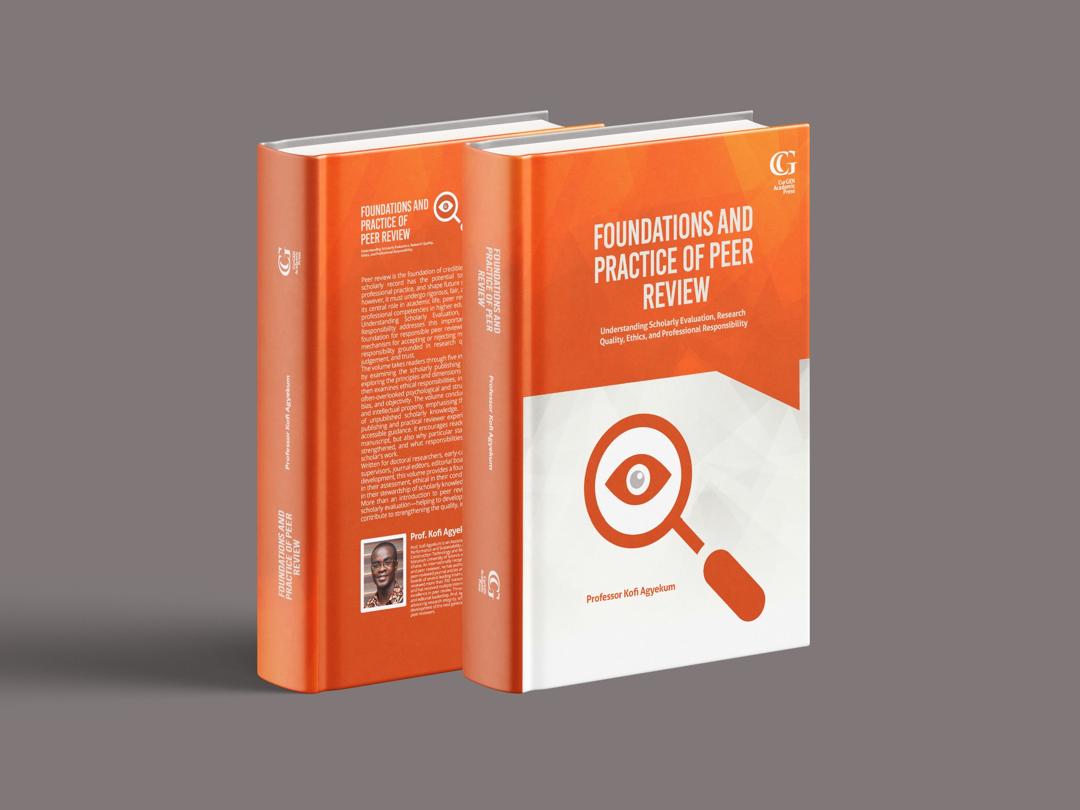
Prof. Kofi Agyekum of the Department of Construction Technology and Management at the Kwame Nkrumah University of Science and Technology, Kumasi (KNUST) has published a new book that seeks to strengthen peer review practice, promote research integrity and enhance the quality of scholarly publishing.
The book, Foundations and Practice of Peer Review: Understanding Scholarly Evaluation, Research Quality, Ethics, and Professional Responsibility, was published by CurGen Academic Press on September 1, 2026. It carries the ISBN 978-9988-44-178-4.
The publication offers a comprehensive examination of one of the most critical, yet often under-taught, aspects of academic publishing, peer review. It explains how rigorous and ethical manuscript evaluation underpins research quality, academic credibility, scientific integrity and the responsible dissemination of knowledge across disciplines.
Professor Agyekum said the book was written to help bridge a gap in researcher development by equipping academics with the knowledge and ethical foundations required to become competent reviewers.
"Peer review is more than deciding whether a manuscript should be accepted or rejected. It is a professional responsibility that safeguards the credibility of research and advances knowledge. This book is intended to help researchers develop the competence, objectivity and ethical judgement needed to contribute meaningfully to scholarly publishing."
The book introduces readers to the scholarly publishing landscape before examining the principles of research quality and manuscript assessment. It provides a structured framework for evaluating originality, methodological rigour, significance, validity, clarity and scholarly contribution.
A central theme of the publication is the ethical responsibility of reviewers. It explores issues including confidentiality, conflicts of interest, intellectual property, fairness, professional conduct and the influence of conscious and unconscious bias on editorial judgement. The book also provides practical guidance on producing constructive, balanced and evidence-based reviewer reports.
According to Professor Agyekum, effective peer review is a learned scholarly competence rather than an automatic outcome of becoming a researcher.
"Excellent researchers do not automatically become excellent reviewers. Effective reviewing requires methodological awareness, critical judgement, ethical sensitivity and the ability to communicate constructive criticism that strengthens research."
The publication also responds to emerging developments in global scholarship, including increasing research output, interdisciplinary collaboration, open science, artificial intelligence, evolving publishing models and growing expectations for transparency and research integrity.
Designed for journal reviewers, editors, university faculty, doctoral candidates, postgraduate students and early-career researchers, the book serves as both an introductory guide and a professional reference for those involved in scholarly evaluation.
By positioning peer review as an essential pillar of research quality assurance and scholarly communication, Foundations and Practice of Peer Review seeks to contribute to a stronger culture of responsible, ethical and high-quality peer review within universities and the global research community.
Story: Emmanuel Kwasi Debrah


