
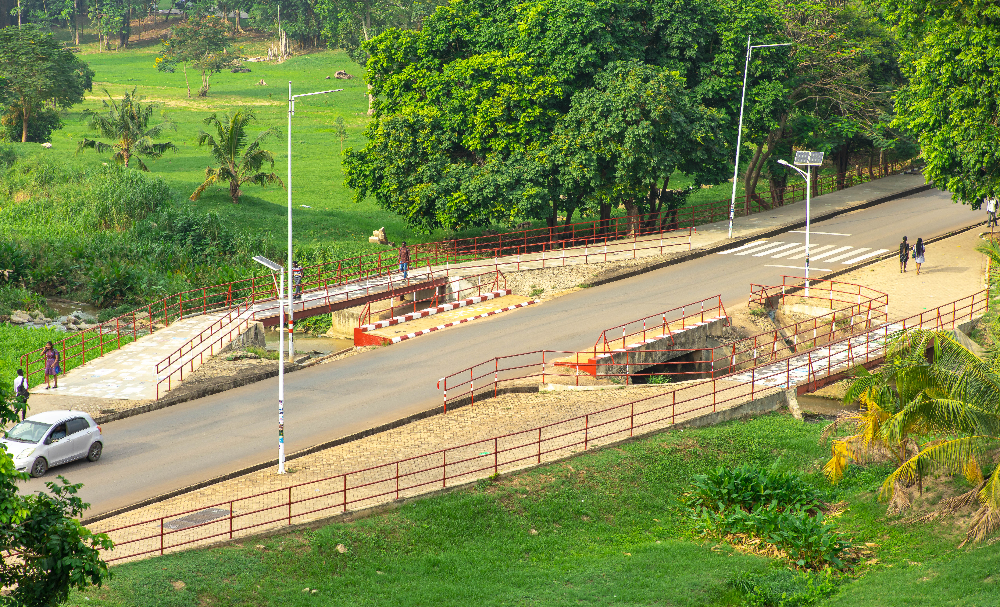
When the Wewe River overflowed its banks after heavy rains on June 11, flooding sections of the Kwame Nkrumah University of Science and Technology, Kumasi (KNUST), the incident quickly drew public attention and concern.
But according to flood risk expert, Prof. Divine Ahadzie, what occurred on the campus was not a failure of flood management but rather evidence of a flood resilience strategy embedded in the University's design decades ago.
Standing on the floodplain near the affected area, Prof. Ahadzie explained that the flooding was a classic example of river flooding, which occurs when a river swells beyond its banks due to sustained rainfall upstream.
"What happened here on Tuesday is a typical example of river flooding. It was not flash flooding caused by choked drains. The river simply overflowed its banks because of the volume of water it received from rainfall," he said.
He noted that KNUST's founders deliberately preserved extensive open spaces along the river corridor when the University was established more than seven decades ago. These floodplains serve as natural buffers that allow excess water to spread safely during periods of high flow.
"The intention is that once in a while the river will overflow its banks and spread onto the floodplain. That is why these open spaces were left undeveloped. This is part of flood risk management," he explained.
According to him, floodplains play an important ecological role by absorbing excess water and supporting surrounding ecosystems. Problems arise when such areas are encroached upon through construction and other human activities.
He contrasted the KNUST situation with conditions in many Ghanaian cities where wetlands and floodplains have been built upon, leaving floodwaters with nowhere to go.
"If there had been houses or developments on this floodplain, the water would have been forced into surrounding communities. That is exactly what we see in many urban areas today," he said.
Prof. Ahadzie pointed to ongoing discussions surrounding flood management projects in Accra, where encroachment has reportedly limited available land for retention basins and other mitigation infrastructure.
He described KNUST as a practical example of how preserving wetlands and floodplains can enhance resilience to climate-related flooding.
"This is an education for the public. If you want a good example of flood risk management and resilience, then the KNUST example is one we need to showcase," he said.
The floodwaters temporarily overtopped a bridge on campus, but alternative routes were activated to ensure the continued movement of vehicles and pedestrians.
According to Prof. Ahadzie, maintaining alternative transportation routes during emergencies is an important component of flood resilience.
"It did not disrupt activities to the extent some people suggested. Alternative routes were provided, and that is part of building transportation resilience," he noted.
While commending the University's long-term planning, he said future interventions could include expanding the flood storage capacity of the area and strengthening early warning and communication systems.
"Going forward, it is about improving early warning systems and communication so that panic and uncertainty are reduced when such events occur," he added.
As climate change increases the frequency and intensity of extreme weather events, Prof. Ahadzie believes the lessons from KNUST's preserved floodplain offer valuable guidance for communities across Ghana seeking sustainable approaches to flood management.


