
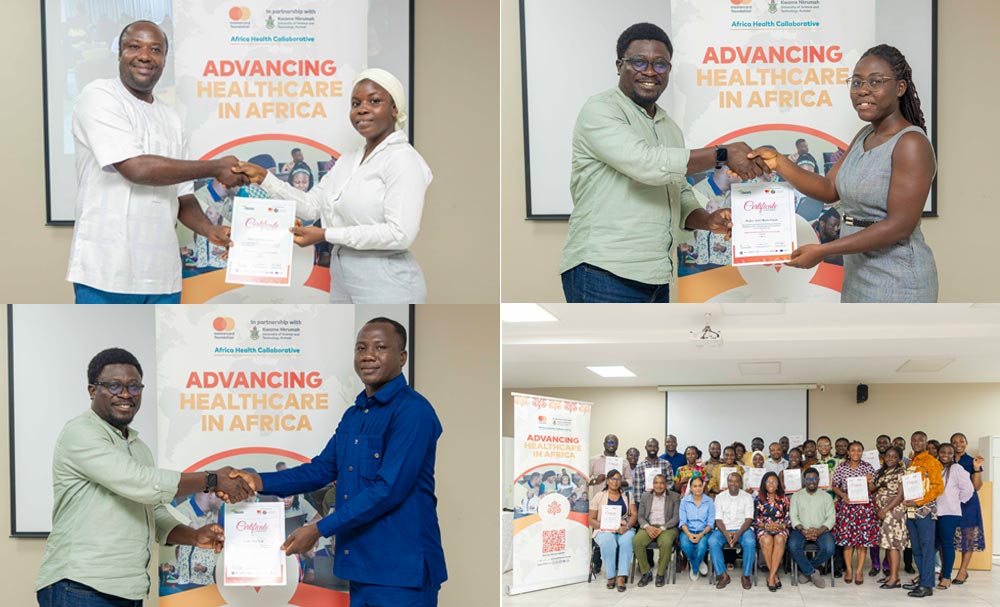
Participants of the Implementation Science Programme run by the Africa Health Collaborative at the Kwame Nkrumah University of Science and Technology (AHC-KNUST) say the training has reshaped their understanding of how health research can be translated into real-world impact, with many describing it as “transformative,” “confidence-building,” and a long-awaited answer to challenges they face in the field.
The programme, organised in partnership with the Mastercard Foundation and the Capstone Project, is designed to equip postgraduate students with the tools to convert research evidence into effective policies and interventions.
At the closing session, Project Manager Ms. Eva Boakye-Yiadom commended participants for their commitment throughout the intensive course, saying their reflections showed how deeply the lessons had been absorbed.
“Through all this intense work and learning, when you are posed a question or hear of implementation science research, I am sure you can now say a lot, right?” she said. She urged them to apply their new skills to advance their professional work.
Ms. Regina Ama Elinam Papah, an MPH Global Health student, said the training answered longstanding questions she had struggled with.
“I had some prior knowledge about implementation science and wanted to deepen my understanding,” she said. “I had questions and challenges on how to apply implementation frameworks effectively. This course has made me so excited because it answered those questions.”
She added that her perception of the discipline had shifted significantly.
“Initially, I thought implementation science was simple and linear. I now understand that it involves analysing stakeholders, identifying contextual challenges, and selecting the right frameworks to adapt evidence-based interventions from one setting to another. This learning has been truly impactful.”
Ms. Khosa Mohammed, a midwife at the Thai District Hospital and an MPH Population and Reproductive Health student, said the programme helped her confront a recurring challenge in clinical research.
“We do a lot of research, but the challenge has always been implementing our findings,” she said. “Implementation science taught me how to ensure that the research I conduct is translated into interventions that benefit the very people from whom I collect data.”
She added that the programme broadened her understanding beyond what she expected.
“I had no idea what implementation science was about… Coming into the programme, I realized it was much broader than I imagined.”
Mr. Joseph Abdul-Latif, an MPhil Field Epidemiology and Applied Biostatistics student, said the course exceeded his expectations.
“I came in with very little knowledge about implementation science but with high expectations,” he noted. “I have learned that there is a wealth of literature and recommendations on how to improve health outcomes. This course taught me how to apply these systematically.”
He said the training sharpened his understanding of non-communicable diseases.
“It has deepened my understanding of NCDs, particularly diabetes and hypertension, and how to use the knowledge gained to improve management in our facilities.”


