
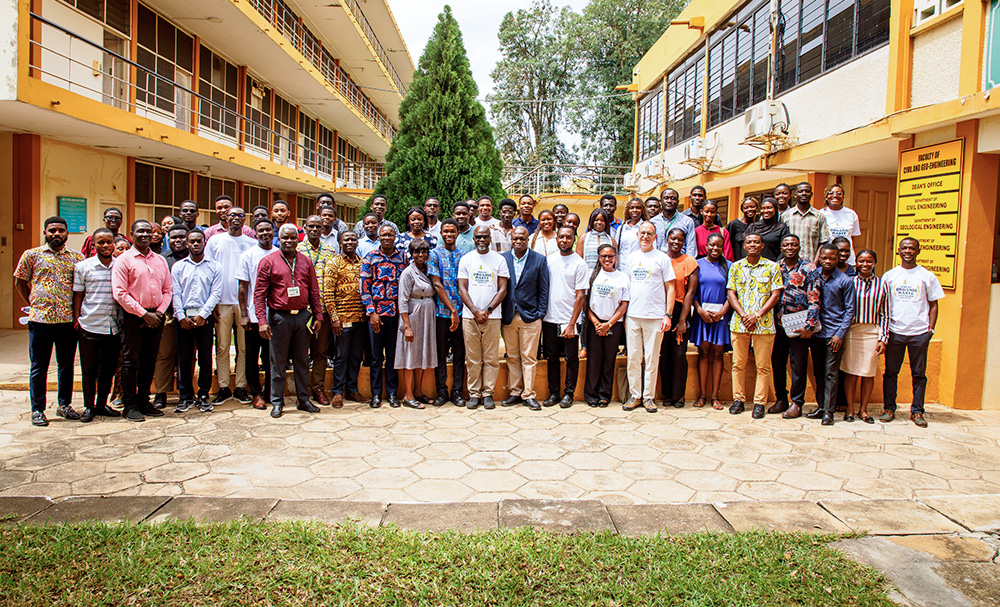
The Brew-Hammond Energy Centre (TBHEC) at Kwame Nkrumah University of Science and Technology (KNUST), in partnership with the Clean Air Task Force (CATF), has launched the KNUST Organic Waste Diversion Project to promote sustainable waste management and strengthen environmental stewardship on campus.
The project investigator, Professor Francis Kemausour, said the initiative grew out of CATF’s interest in methane emissions from municipal solid waste in Ghana, with a primary focus on measuring methane released from landfill sites.
“One of the key objectives was to determine methane gas emissions from the landfills,” he said.
Although the team initially planned to pilot the project across the city of Kumasi, Prof. Kemausour said operational challenges led to a scaled-down implementation within the university community, focusing on eight restaurants.
Despite the adjustment, he said the project has made significant progress, with organic waste transported to its technical partner, Safisana Ghana Ltd, recording a high acceptance rate.
“So far, we have managed to send about 20 tonnes of waste to Safisana. There’s close to 99% overall acceptance rate and only about 1.2% has been rejected because it’s not organic,” Prof. Kemausour said.
Applying Intergovernmental Panel on Climate Change (IPCC) guidelines and the U.S. Environmental Protection Agency’s Waste Reduction Model, he said the team estimates the project has prevented about 12 tonnes of carbon dioxide equivalent emissions, contributing to the university’s climate action efforts and supporting a circular economy.
“We are transforming our waste into value-added products to foster a circular economy on our campus,” he said.
A CATF representative, Mr. Chris Godlove, reaffirmed the organisation’s commitment to supporting innovative waste management initiatives and said the KNUST project could serve as a model for replication elsewhere.
“By supporting this type of activity, we hope to create models that can be replicated in other places,” he said.
Godlove described CATF’s role as largely supportive, stressing that the project’s success has been driven by the university community and extends beyond climate benefits to broader environmental and social impacts.
“We’ve provided some capital funding to provide equipment, but you all have done this work, so I commend you for getting that started, for keeping this momentum going,” he said.


