
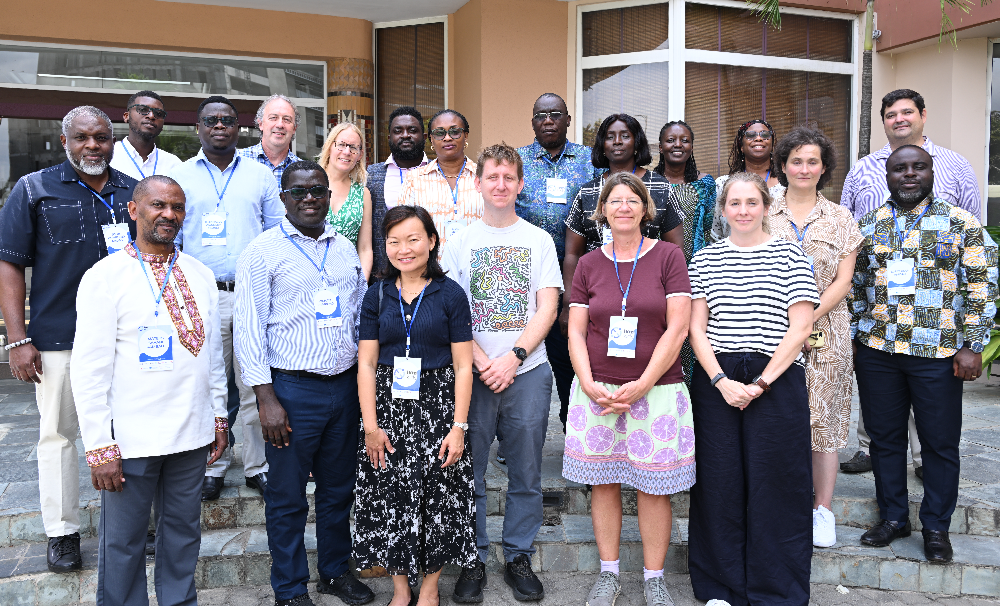
The Kwame Nkrumah University of Science and Technology, Kumasi (KNUST), through the Kumasi Centre for Collaborative Research in Tropical Medicine (KCCR), is taking a leading scientific role in an international research project seeking to generate evidence for the safe use of ivermectin in young children.
The four-year IVM-KIDS project brings together eight research, pharmaceutical and non-profit organisations across Africa and Europe to address an important evidence gap affecting children weighing between 5 and 15 kilogrammes.
KCCR-KNUST is contributing scientific leadership to the project, with Professor John Amuasi serving as Scientific Project Leader.
The University also hosted representatives of the consortium in Accra for the project's first in-person meeting, bringing together researchers, clinicians, pharmaceutical experts and public health specialists to coordinate the next stages of the clinical research programme.
Ivermectin is widely used in the control of several neglected tropical diseases, including onchocerciasis, lymphatic filariasis, scabies and soil-transmitted helminth infections.
However, children weighing less than 15 kg, broadly corresponding to children under five years, are currently excluded from ivermectin-based public health programmes because there is not yet sufficient safety evidence to support routine use of the drug in this population.
Prof. Amuasi said the research provides an opportunity for African scientists and institutions to help shape evidence that is directly relevant to countries where neglected tropical diseases remain a public health concern.
“Generating evidence in the countries where these diseases are endemic is fundamental. African institutions should not simply be places where research is conducted; we should be helping to shape the scientific questions, lead the research and determine how the findings can be translated into policy and practice,” he said.
The IVM-KIDS research programme will evaluate the safety, pharmacokinetics and efficacy of ivermectin in children weighing between 5 and 15 kg.
Researchers will assess both generic ivermectin and a new 3 mg orodispersible formulation designed with young children in mind. The programme will also examine appropriate dosing and the acceptability of the formulation to children and caregivers.
Speaking during the consortium meeting, Prof. Amuasi explained that developing evidence appropriate for younger children is central to improving access.
“For children, it's based on their weight. A formulation that fits for different children based on their weight has not yet been done before, so they are not having access to this drug,” he said.
“The study looked at how we can formulate this so that children can have access to it.”
The project's clinical programme will include studies involving Trichuris trichiura, an intestinal parasite associated with anaemia, stunting and impaired development, as well as scabies.
Principal Investigator of IVM-KIDS, Professor Michael Marks of the London School of Hygiene & Tropical Medicine, said the research is intended to provide evidence that is currently missing for younger children.
“Ivermectin has transformed the control of several parasitic diseases, but the youngest children are still left out because we do not yet have the evidence needed to routinely treat them,” he said.
“IVM-KIDS is designed to address that gap by generating the safety, dosing, efficacy and acceptability data that regulators and policy-makers need.”
Dr Stella Kepha, Principal Research Scientist at the Kenya Medical Research Institute and a member of the clinical research team, said the studies will also assess how the child-friendly formulation performs in real-world settings.
She noted that young children live in the same families and communities affected by parasitic infections even though they cannot currently be included in ivermectin programmes.
The consortium brings together KCCR-KNUST in Ghana; the London School of Hygiene & Tropical Medicine in the United Kingdom; the Kenya Medical Research Institute; the Institut National de Recherche Biomédicale in the Democratic Republic of the Congo; Laboratorios Liconsa and Fundación Mundo Sano in Spain; and the Drugs for Neglected Diseases initiative and Swiss Tropical and Public Health Institute in Switzerland.
IVM-KIDS runs from September 2025 to August 2029 and is supported by the Global Health EDCTP3 Joint Undertaking and its members under the European Union's Horizon Europe research and innovation programme, with additional funding from Coefficient Giving


