
When Construction Becomes a Public Risk
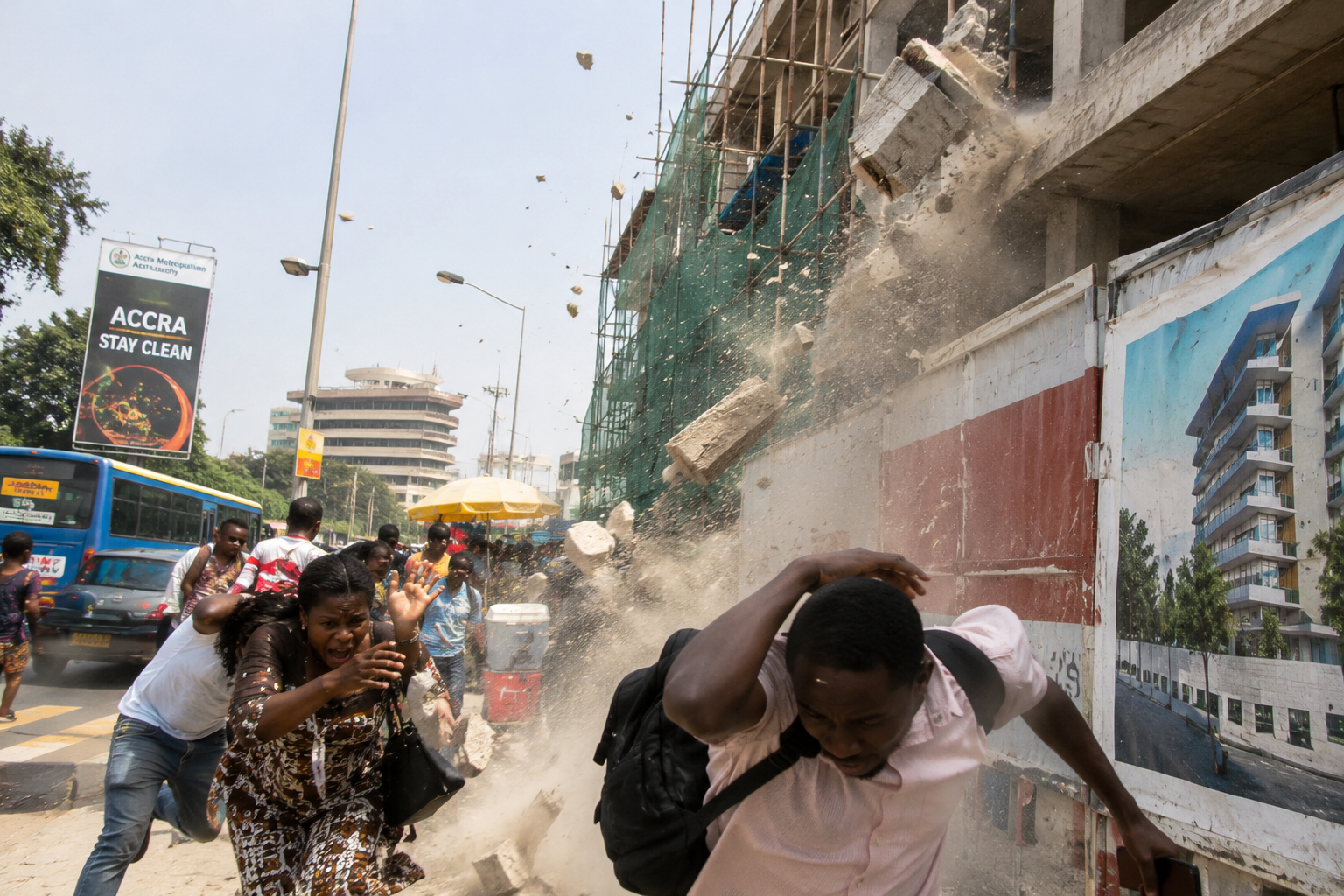
Imagine walking along a busy street in Accra when suddenly blocks, concrete fragments or other construction materials come crashing down from a building several floors above you. You have no connection to the project, yet your life could be in danger simply because you happened to be nearby. This is the uncomfortable reality of poorly managed construction activities. It is worse in brownfield construction projects. i.e. construction projects that involve renovating, expanding, or redeveloping an existing, previously used property, often while surrounding operations or infrastructure remain active
On 21 October 2026, an incident at a high-rise development at Villaggio, near the Tetteh Quarshie Interchange in Accra, brought this concern into sharp focus. While some accounts suggested that the falling materials may have resulted from a deliberate attempt to dispose of construction debris, other reports attributed the incident to strong winds sweeping away freshly constructed blockwork. Subsequent inspections reportedly identified vulnerabilities in recently laid blockwork, while indicating that the building's main structural system was not at risk of collapse. Fortunately, no casualties were reported. However, the incident raises a more important question: what happens when construction activities put the lives and properties of people who have nothing to do with the project at risk? This concern is reinforced by other building-related incidents in Ghana, including the building collapses reported at Avenor and Adenta in June 2026, which resulted in fatalities, injuries and damage to surrounding properties. These incidents remind us that the consequences of unsafe construction can extend far beyond the workers and structures directly involved.
Looking beyond the Fence: The Construction Site Is Not an Island
In major cities like Accra and Kumasi, rapid urbanisation and rising demand for residential and commercial developments have created an environment around the central business district where new construction projects are often undertaken close to existing homes, offices, shops, schools, and public roads. In some neighbourhoods, a multi-storey development may rise directly beside an occupied residential building, leaving little physical separation between construction activities and everyday human activities. Consequently, construction risks extend beyond the site boundary. Falling materials, unsecured scaffolding, uncontrolled demolition, excessive dust, vibration, deep excavations and moving construction equipment can affect pedestrians, motorists, residents and neighbouring buildings. This makes it necessary to distinguish between occupational safety, which primarily protects workers, and public safety, which extends protection to everyone who may be affected by construction activities. A construction fence should not be viewed as the boundary of a project's safety responsibility; it should be the first line of protection between potentially hazardous activities and the public.
The Legal and Contractual Responsibility
Ghana has established legal and regulatory provisions to guide construction activities and protect people and properties. The Factories, Offices and Shops Act, 1970 (Act 328), particularly Section 57, addresses safety in building and civil engineering operations, while the Labour Act, 2003 (Act 651), Section 118, requires employers to provide safe and healthy working conditions. Importantly, contractors also have a responsibility to safeguard people who are not in their employment but may be affected by their operations, including members of the public. The National Building Regulations, 1996 (LI 1630), also provide for hoarding, scaffolding, temporary structures and precautions during demolition to protect the public and adjoining properties. Beyond statutory requirements, the Public Procurement Authority's Standard Tender Document for Major Works contains relevant contractual provisions. In particular, Sub-Clause 4.8 addresses safety procedures and the protection of the public and adjoining land, while Sub-Clause 6.7 addresses health and safety arrangements. These provisions demonstrate that public protection is not merely a professional courtesy; it is an important part of construction and contractual responsibility. Furthermore, the law of tort provides another basis for accountability. Under the principle of negligence, a party may be liable where a failure to exercise reasonable care results in foreseeable injury or damage. Nuisance may arise where construction activities unreasonably interfere with the use and enjoyment of neighbouring properties through excessive noise, dust or vibration, while trespass may become relevant where construction materials or equipment unlawfully encroach on adjoining land. These principles reinforce the need to prevent harm rather than wait until someone suffers a loss before taking safety seriously.
What Causes These Incidents?
Construction-related incidents affecting the public often result from a combination of preventable factors. These include inadequate site fencing and perimeter protection, poorly secured blockwork and scaffolding, careless handling or disposal of construction debris, inadequate supervision and weak enforcement of safety procedures. Weather conditions, particularly strong winds and heavy rainfall, can expose weaknesses in temporary structures and unsecured materials. Poor traffic management also creates risks where pedestrians and construction vehicles share access routes without adequate separation, warning signs or designated crossing points. Additionally, excavation, piling and demolition undertaken without proper assessment of neighbouring buildings can result in cracks, settlement and other forms of property damage. Ultimately, pressure to meet deadlines and minimise costs can sometimes mean safety gets less attention than it deserves, especially safety beyond the site fences.
What Should Change?
Addressing these challenges requires a combination of traditional safety practices and modern technological solutions. Construction sites should have adequate hoarding, safety nets, covered pedestrian walkways, warning signs, designated traffic routes and proper separation of pedestrians from construction vehicles. Materials must be stored securely, and waste from elevated floors should be brought down using designated chutes or hoists rather than thrown from heights. Pre-construction condition surveys should also be undertaken on neighbouring buildings, with appropriate vibration and settlement monitoring where necessary. Beyond these conventional measures, the industry should embrace innovations such as Artificial Intelligence (AI) for predicting hazards and detecting unsafe site activities, Building Information Modelling (BIM) for identifying construction risks before work begins, drones for inspecting elevated structures, and Virtual Reality (VR) for simulating hazardous situations during safety training. Internet of Things (IoT) sensors can also monitor vibrations, structural movement and weather conditions, providing early warnings when safety thresholds are exceeded. However, technology must complement, not replace, competent supervision, professional judgement and regulatory enforcement.
Development Must Not Come at the Expense of Public Safety
The responsibility for improving construction safety must be shared. Developers must provide adequate resources for safety, consultants must incorporate risk considerations into project planning and supervision, contractors must implement approved safety procedures, and regulatory authorities must strengthen inspections and enforcement. As Accra continues to expand, the proximity of new developments to existing buildings and public spaces makes this responsibility increasingly important.
The Villaggio incident, irrespective of the competing explanations surrounding the falling materials, should encourage a broader conversation about how construction activities affect the public. Perhaps the industry should begin asking a question beyond whether projects are being delivered on time, within budget and to specification: are they being delivered without placing the lives, properties and livelihoods of others at unnecessary risk? After all, the true success of a construction project should not be determined solely by the structure that stands when construction is completed, but also by the lives, properties and communities that remain safe throughout its delivery.
The author, Emmanuel Adinyira, is co-founder of Adinyira Built Environment Research Foundation (AberFoundation) and a Professor of Construction Project Management at KNUST, Kumasi, Ghana. He is a Fellow of the Ghana Institute of Construction, a Fellow of the Occupational Safety and Health Association, UK (FOSHA-UK), a Professional Member of the Ghana Institution of Surveyors, and a Professional Engineering Technologist with the Institution of Engineering and Technology, Ghana
The assistance of Mr Michael Abakah, a National Service Personnel at the Office of the Dean, Faculty of Built Environment, KNUST, is acknowledged.


