
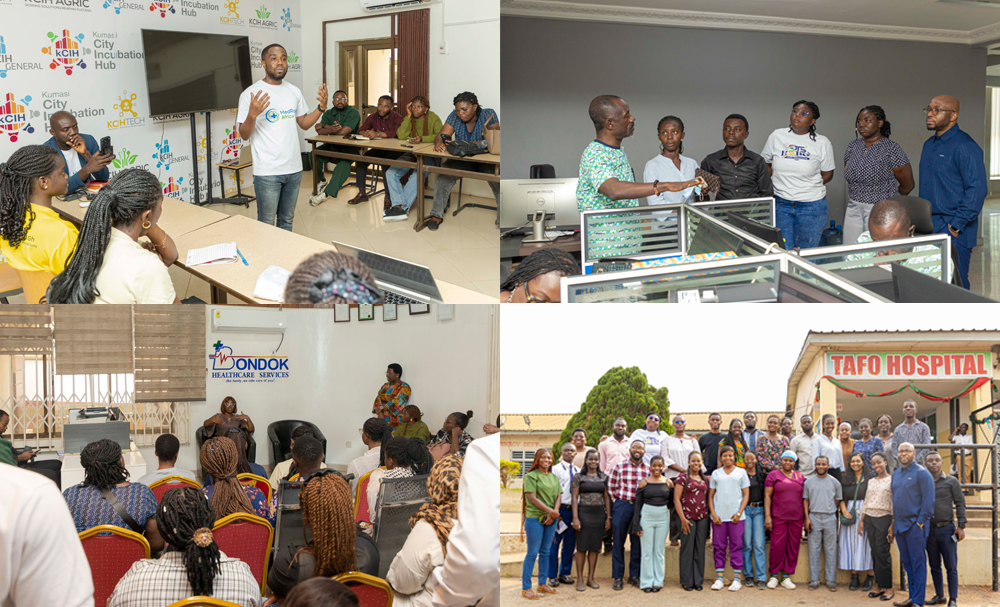
Students of the MSc Health Entrepreneurship programme led by Africa Health Collaborative, Kwame Nkrumah University of Science and Technology, Kumasi (KNUST), have undertaken a two-day field trip aimed at bridging classroom learning with practice within Ghana’s evolving health ecosystem.
The exercise, held on Jan. 26 and 27, 2026, formed part of the practical sessions of the Health Ecosystem course and was structured as a contextual enquiry to expose students to real-world health systems and service delivery.
The field visit took students to public, private and innovation-driven health institutions, including Tafo Government Hospital, the National Health Insurance Authority (NHIA) Claims Office, MedRoam Africa and Bondock Health Services.
Through direct engagement with the facilities, students gained first-hand insight into healthcare delivery, financing, digital health innovation and patient-centred care, while identifying practical challenges and entrepreneurial opportunities that could inform the development of sustainable, user-centred health solutions.
Speaking after the visit, Ruth Doe, a student on the programme, said the experience reshaped her understanding of health entrepreneurship.
“I knew this programme was going to open doors for me, but I didn’t expect ideas to come so quickly. The field trip has really opened my eyes. Every facility we visited presented a new opportunity,” she said.
At Bondock Health Services, students observed a care model focused on treating severe cancer patients in a home-like environment. Ruth said the visit demonstrated that healthcare entrepreneurship extends beyond drugs and medical equipment.
“Bondock’s model showed me that healthcare can integrate services like nutrition and catering. There are opportunities for partnerships with food entrepreneurs who are health- and FDA-compliant, especially for patients requiring specialised diets,” she said.
Another student, Elizabeth Adwoa Gyanwah Karikari, a nurse enrolled in the MSc Health Entrepreneurship programme, said the visit changed her perception of government institutions.
“This visit changed my perception of government institutions from being difficult systems to essential partners in health innovation,” she said.
At the NHIA, she said she gained insight into how governance, credibility and partnerships with public institutions can enable healthcare innovations to scale.
“Once trust and accreditation are gained, innovation can reach more people. Governance and partnerships are not barriers; they are pathways to access,” she said.
She added that the experience enhanced her critical thinking, understanding of accreditation processes, partnership building and perseverance.
“As a nurse building capacity through health innovation courses and accelerator programmes, I can now clearly identify gaps that need action. I’ve learned not to sit on ideas, but to put them to work, knowing that giving up is never an option,” she said.
The MSc Health Entrepreneurship programme continues to integrate experiential learning with classroom instruction, equipping students with practical insight into Ghana’s health ecosystem and preparing them to develop sustainable, user-centred innovations that address societal needs.
By: Emmanuel Offei


