
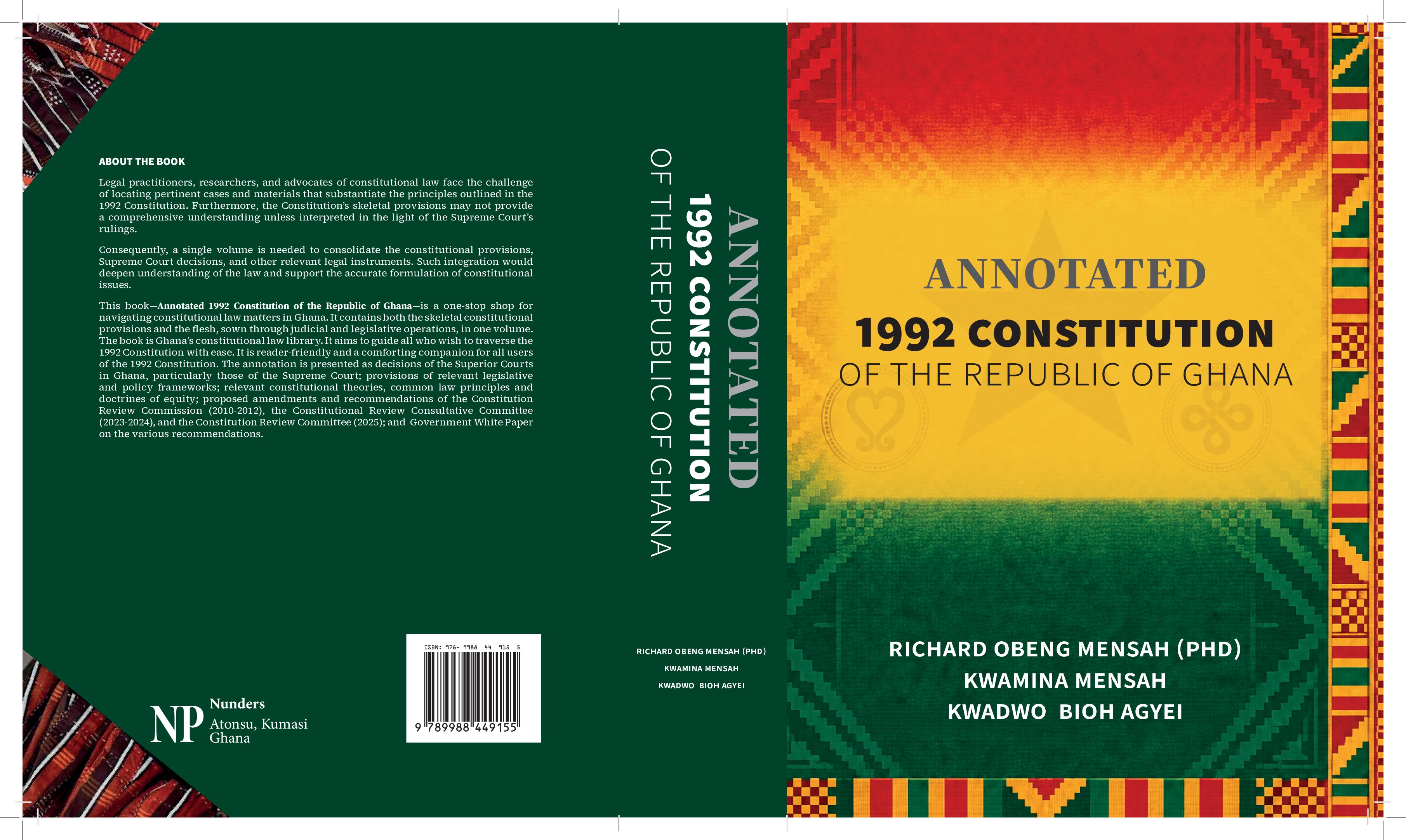
A new book by Dr Richard Obeng Mensah, Kwamina Mensah and Kwadwo Bioh Agyei seeks to make Ghana’s 1992 Constitution easier to understand by bringing its provisions, court decisions and related legal materials into a single volume.
Titled Annotated 1992 Constitution of the Republic of Ghana, the book addresses the difficulty of locating cases and other materials that explain how constitutional provisions have been interpreted and applied.
Explaining the inspiration behind the book, Dr Obeng Mensah said the constitutional text alone did not provide all the information readers needed to appreciate its meaning and implications.
“The black and white text alone is not able to give its readers and those who seek to know more about it what it really represents,” he said.
He said the authors had brought together constitutional principles, Supreme Court decisions and other relevant legal instruments to help readers understand the provisions in context.
Kwamina Mensah, outlining the book’s scope, said it sought to address legal questions by consolidating materials needed to interpret and apply the Constitution.
“It contains legislative and policy frameworks, decisions of the Supreme Court, constitutional amendments and proposed amendments by the respective constitutional bodies that have been established so far under this constitution,” he said.
The volume also includes constitutional theories, common law principles and doctrines of equity. Its coverage of constitutional reform includes recommendations from the Constitution Review Commission of 2010–2012, the Constitutional Review Consultative Committee of 2023–2024 and the Constitution Review Committee of 2025, alongside government responses to review recommendations.
Kwadwo Bioh Agyei said the book’s intended readership extended beyond the legal profession because the Constitution shaped everyday life and reflected the country’s history and aspirations.
“So a constitution is a very integral part of our everyday life,” he said.
He said citizens needed to understand their constitutional rights and obligations, as well as what they could expect from the government and state institutions.
“So I would say that the law is very broad, but when it comes to constitutional matters, it is important that everybody knows what is in the constitution,” he said.
Asked who the book was intended for, Bioh Agyei said: “I would say that it belongs to everybody.”


