
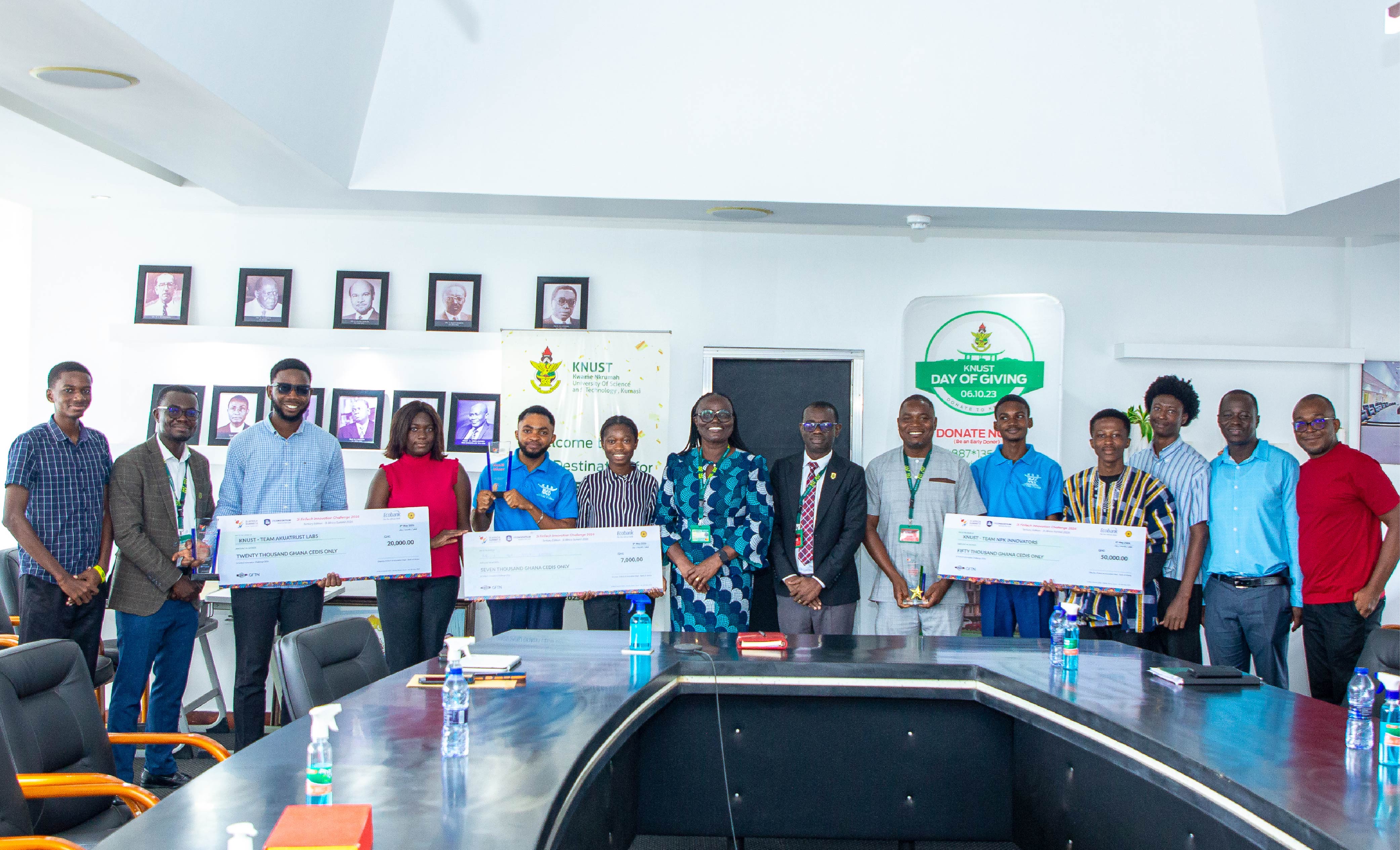
Student innovators from the Kwame Nkrumah University of Science and Technology, Kumasi (KNUST) who won the Fintech Innovation Challenge at the 3i Africa Summit 2026 have shared the story behind their award-winning solutions as they presented their trophy to the Vice-Chancellor, Professor Mrs. Rita Akosua Dickson.
The students, who developed artificial intelligence-driven solutions targeting challenges in agriculture and financial access, said their innovations were inspired by real-life problems faced by smallholder farmers and agribusinesses across Ghana.
For many student innovators, ideas begin in the classroom. For Team NPK Innovators, their award-winning solution began with a simple question: how can technology help smallholder farmers gain access to credit?
That question earned the team first place in the Fintech Innovation Challenge at the 3i Africa Summit 2026, where they emerged winners among five finalist teams from tertiary institutions across Ghana, including the University of Ghana and the University of Cape Coast.
KNUST demonstrated its dominance in the competition, with three teams: NPK Innovators, AkuaTrust Labs and HappyPay, advancing to the final stage.
Sharing the inspiration behind the project, team member Ida Nhyira explained that the name “NPK” was derived from the initials of the group members: Nhyira, Prince and Kelvin.
According to her, the team focused on addressing the challenges smallholder farmers face in securing loans from financial institutions.
“We realised that one of the biggest reasons lenders hesitate to give credit to farmers is the lack of reliable data and collateral,” she said. “So we asked ourselves: what if we could bridge that gap with technology?”
The team developed an artificial intelligence-powered digital platform that creates a “digital twin” of farms, a virtual representation that provides lenders and other stakeholders with real-time visibility into farming activities, crop types and risk levels.
The platform integrates farmers, lenders, suppliers, insurers and buyers into a single ecosystem where AI tools analyse data, generate predictions and offer insights to improve decision-making and build trust among stakeholders.
“What was missing was data,” Nhyira noted. “If lenders can see credible information about farmers and their operations, then confidence increases and access to credit becomes easier.”
She credited the success of the project to the guidance and support of their lecturers and mentors, including Doc Percy and the team’s chaperones, who helped refine the idea into a viable innovation.
Another student innovator, Alour Bright, linked the project to his agribusiness startup, Happy Farmers, which aggregates and processes agricultural produce from farmers across Ghana for export to international markets.
Bright explained that the startup was inspired by challenges encountered within agricultural supply chains, particularly the inability to trace responsibility for damaged produce during shipment.
“Sometimes shipments arrive damaged, but there is no clear way to identify who caused the damage along the supply chain,” he said. “We wanted to create transparency and accountability.”
Through technology, the team developed systems capable of tracking products across the supply chain and identifying where damage occurs, helping protect both farmers and buyers from financial losses.
Professor Dickson praised the students for demonstrating the university’s commitment to innovation, entrepreneurship and problem-solving.
“This is just the beginning,” she told the students. “You are brilliant, you are thinkers, and you are looking at your communities and asking what solutions you can provide. That is what education is all about.”
She emphasised that education, research and innovation must directly address societal challenges, particularly in agriculture, health, sustainability and climate change.
“We are training employers and job creators, not job seekers,” she said. “The entrepreneurship drive of this university is central to our mission, and your innovations prove that you have the capacity to solve real-world problems.”
The Vice-Chancellor encouraged the students to remain focused, hardworking and committed to innovation, stressing that the future belongs to young people willing to sacrifice and create solutions that impact society.
“We are extremely proud of you,” she added. “This victory has brought honour not only to yourselves and your families, but also to the entire university community.”
Leader of the delegation and Director of the E-Learning Centre, Prof. Emmanuel Akowuah, thanked the Vice-Chancellor for the support and pledged to groom more start-ups in fulfilment of the university’s mandate to nurture entrepreneurs.
Also present were Dr. Griffith Selorm Klogo, Dr. John Serbe Marfo and Mr. Makafui John Bedzra.


