

Students of the MSc Health Entrepreneurship programme at the Kwame Nkrumah University of Science and Technology, Kumasi (KNUST), have pitched innovative ventures in health and related sectors as part of efforts to promote entrepreneurship, innovation and commercialization among health professionals.
The pitch programme, organized under the Health Ecosystem pillar of the Africa Health Collaborative (AHC), in partnership with the University of Toronto’s H2i, was held on Thursday, August 13, 2026, at the KNUST School of Business.
The programme provided a platform for current students and alumni to present their ventures, receive expert feedback and explore opportunities to test and develop their business ideas. It also sought to strengthen collaboration between KNUST and international partners, particularly the University of Toronto, while providing visibility, support and recognition for student- and alumni-led ventures.
A total of 11 ventures were pitched, including three presented by alumni of the programme. The participation of alumni highlighted the growing ecosystem and continuity of innovation fostered through the MSc Health Entrepreneurship programme.
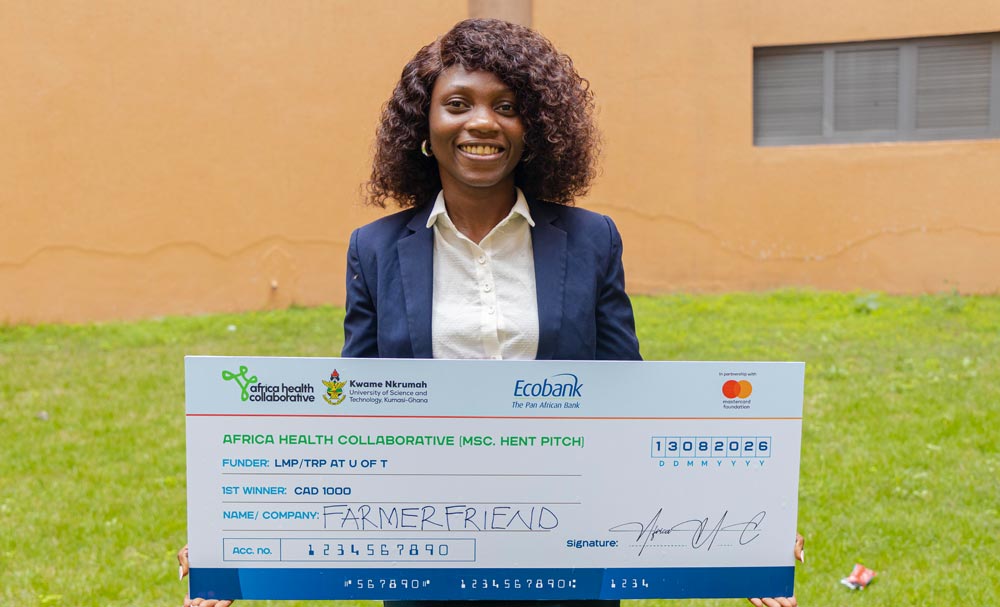
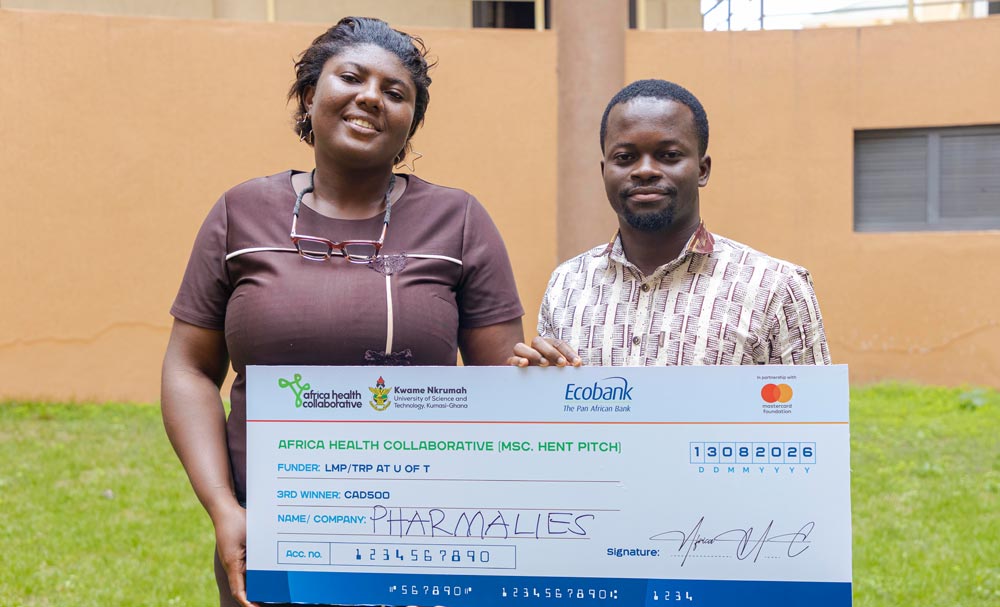
FarmerFrend emerged as the overall winner and received a cash prize of C$1,000, while Somensa placed first runner-up and received C$750. Pharmalies was named second runner-up and received C$500. Elias Biosciences who were promised a special prize from the University of Toronto.

The judging panel comprised representatives of the Translational Research Program in the Department of Laboratory Medicine and Pathobiology and H2i at the University of Toronto. Their expertise provided an independent and rigorous assessment of the ventures presented.

The Health Ecosystem Pillar Lead, Dr. Joseph Owusu, said the pitch programme was designed to help health professionals develop commercially viable solutions to challenges within the health sector.
He said students from the first and second cohorts had previously pitched their business ideas and received feedback, but the 2026 programme was the first to introduce financial awards to support the testing of promising ideas.
“Students have been pitching their business ideas, but this is the first time we are giving awards to those who excel,” Dr. Owusu said.
He explained that the MSc Health Entrepreneurship programme introduces students to entrepreneurship from the ideation stage, with support from collaborators at the University of Toronto.
“The objective of this MSc Health Entrepreneurship is to orient these health professionals to come up with business ideas so that, at the end of the day, when they complete the programme, they can commercialize these ideas,” he said.
Students are taken through practical sessions on areas including product development, market assessment and entrepreneurship, rather than relying solely on theoretical instruction.
The University of Toronto collaborators support the students through experiential learning, helping them understand how to develop and assess their ideas and determine their potential for commercialization.
“At the end of the day, they form groups or teams as founders for a specific business, normally health-related. They pitch and also receive feedback on where to modify, what to improve, what to add and what to remove,” he said.
Dr. Owusu said the prize money was intended to help the winning teams test the feasibility of their ideas beyond the classroom and determine whether they could become commercially viable ventures.
“The money we gave was for them to test the ideas they have mooted in the classroom and see whether they can be commercially viable at the end of the day,” he said.

He also commended the students for demonstrating significant progress in applying business concepts to health-related challenges.
“People who are coming from a health background were speaking business vocabulary, and it looked as if they had been in business class for years. It is because of the training they have gone through,” he said.
Dr. Owusu said the programme was also helping to shift students’ perspectives on career development by encouraging them to view entrepreneurship as an alternative pathway to employment.
“They have also understood that the pathway to employability is entrepreneurship, rather than depending on the government,” he said.
Story: Emmanuel Offei


